
 Justin D.
Introduction
Hey there, and welcome back to the Pool Nerd. I’m Justin, your resident pool aficionado, and today I’m helping you solve one of the biggest problems of pool ownership: cloudy water.
Cloudy pool water is something all of us pool owners encounter at one point or another. Often due to rain, debris, or a whole variety of factors, it is extremely annoying as a pool owner. Cloudy water can be a hassle to fix, so the best way to deal with it is to prevent it before it starts.
Cloudy Pool Water: What You Need Checklist
Cloudy is usually filtration + chemistry balance + sometimes a clarifier or floc—test first so you’re not dumping random bottles in.

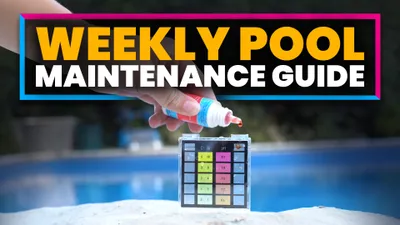
Taylor K-2005 Test Kit
What it is: A professional drop (titration) kit for chlorine, pH, alkalinity, calcium hardness, and cyanuric acid.
Why you need it: You can’t SLAM or balance blind—especially CYA, which handcuffs chlorine. This kit gives numbers you can trust, not strip guesswork.

Champion Muriatic Acid
What it is: Dilute hydrochloric acid—standard for lowering pH and, with the right method, total alkalinity.
Why you need it: High pH destroys chlorine efficiency. Always follow the label; never mix acid with chlorine.

In The Swim pH Reducer (dry acid)
What it is: Sodium bisulfate (dry acid)—lowers pH (and can pull TA down when used in controlled steps).
Why you need it: Easier to handle and store than jugs of muriatic acid for small, precise corrections; still an acid—never mix with chlorine, follow the label, and retest after circulation.

In The Swim Soda Ash
What it is: Sodium carbonate—raises pH faster than baking soda with less alkalinity bump.
Why you need it: Use when pH is low and you need pH up without overshooting TA; check TA first.
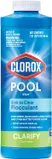
Clorox Pool Flocculant
What it is: Drops fine particles to the floor so you can vacuum to waste (per label).
Why you need it: When the filter won’t clear dead algae or ultra-fine dust, floc is often faster than clarifier alone.
Quick Fix: Shock and Filter
If you need a fast solution to clear up cloudy pool water, follow these steps:
-
Shock the Pool: Add a generous amount of pool shock to your water. Shocking the pool increases the chlorine levels temporarily, killing bacteria and algae that may be causing the cloudiness.
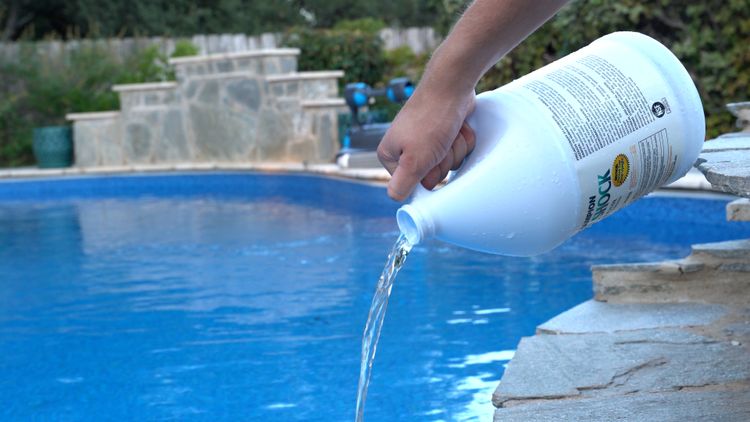
Pouring shock into my swimming pool // The Pool Nerd -
Run the Filter: Keep your pool filter running continuously for at least 24 hours. The filter will help to remove the dead algae, bacteria, and other microparticles that are clouding your water. TIP: Make sure your filter is clean or has been cleaned recently
-
Check the Water Clarity: After 24 hours, check the water clarity. If the pool is still cloudy, you may need to repeat the process or look into other underlying issues, such as poor water chemistry or a malfunctioning filter.
Understanding Cloudy Pool Water
Before I can prevent something though, I have to understand what causes it so I can target it quickly and efficiently. Cloudy pool water is caused by fine particles that are suspended in your water, from dust to dirt to algae. Don’t worry though, just because there is a variety of particles doesn’t mean the solution is complex. In fact, there are three things you can do to prevent your pool water from becoming cloudy: run your pool pump 24/7, filter your water with a robotic pool cleaner, and disinfect your pool water with a UV system.
Run Your Pool Pump 24/7
By circulating your pool water as much as possible, you push more debris through your filters, getting rid of those small particles that could build up over time and cloud your water. By turning over and cleaning more water, you prevent algae from settling and growing. Running your traditional pool pump 24/7 can get expensive quickly though, as they are not very efficient.
So if you don’t want to spend an arm and a leg preventing cloudy water and an ugly pool, I recommend a variable speed pump, like the Leaf Pump I just added to my pool system. The Leaf Pump has saved me over 1000 dollars so far in electricity bills, as it uses 90% less energy than your average pool pump, thanks to its high-tech magnetic motors. So if you want to run your pool 24/7 to prevent cloudy water and maintain a healthier pool, and save money while doing it, look into a variable speed pump, like the Leaf Pump.
Filter Your Water with a Robotic Pool Cleaner
Another way to prevent cloudy water is to add an extra layer of filtration to your pool system, such as the filtration system of a robotic pool cleaner. Robotic pool cleaners can filter up to 4500 gallons per hour, which is around the same amount as your average pool pump. While most people consider a robotic pool cleaner just to pick up leaves and other debris, it can also help clear up your pool’s water.
I recommend looking for a robot that comes with NanoFiltration in addition to the standard fine filter, such as the Dolphin Quantum, Premier, or Sigma. The ultrafine filter can filter particles as small as two microns. In other words, it can filter all of those ultrafine particles that cloud your pool water. With an ultrafine filter, your pool filter will have much less work to do, as the pool water will be clear by the time it gets there.
Disinfect Your Pool Water with a UV System
My final recommendation for preventing cloudy pool water is to add an Ultraviolet Light System, such as the SpectraLight I use on my pool. After doing a ton of research on keeping a pool clean and clear, a UV system is one of the best-kept pool industry secrets. UV systems target all of the pathogens and algae that you may find in your pool with high-powered beams of light.
These ultraviolet beams destroy the pathogens and algae that become particles before they can ever grow big enough to cloud your pool water. Of course, shocking your pool can remove these particles too, but the SpectraLight disinfects without the need for harmful chemicals. I saw a huge improvement in my pool when using the SpectraLight within even just a few hours of first starting it up. From there, my pool water has never looked clearer.
Conclusion
To summarize, if you are currently struggling with a cloudy pool, shock the water and run the pump all day to filter the particles out. Once your water is back to normal, you probably don’t want it happening again, so prevention is key. To prevent cloudy pool water, run your pump all the time, filter your water more frequently and thoroughly with a robotic pool cleaner, and kill those pathogens and algae before they can grow and multiply with a SpectraLight UV system.
If testing points to calcium imbalance or scaling rather than live algae, use the pool calcium hardness calculator before adding calcium chloride or planning water replacement.
If you want to keep nerding out over your pool, be sure to hit that subscribe button to keep learning how to make pool maintenance way easier. Head on over to thepoolnerd.com to view my comparison page and see all the differences between the many robotic pool cleaners out there. Until then, enjoy that pool and check back soon for more pool maintenance tips and insight.


Comments
Loading comments…