
 Justin D.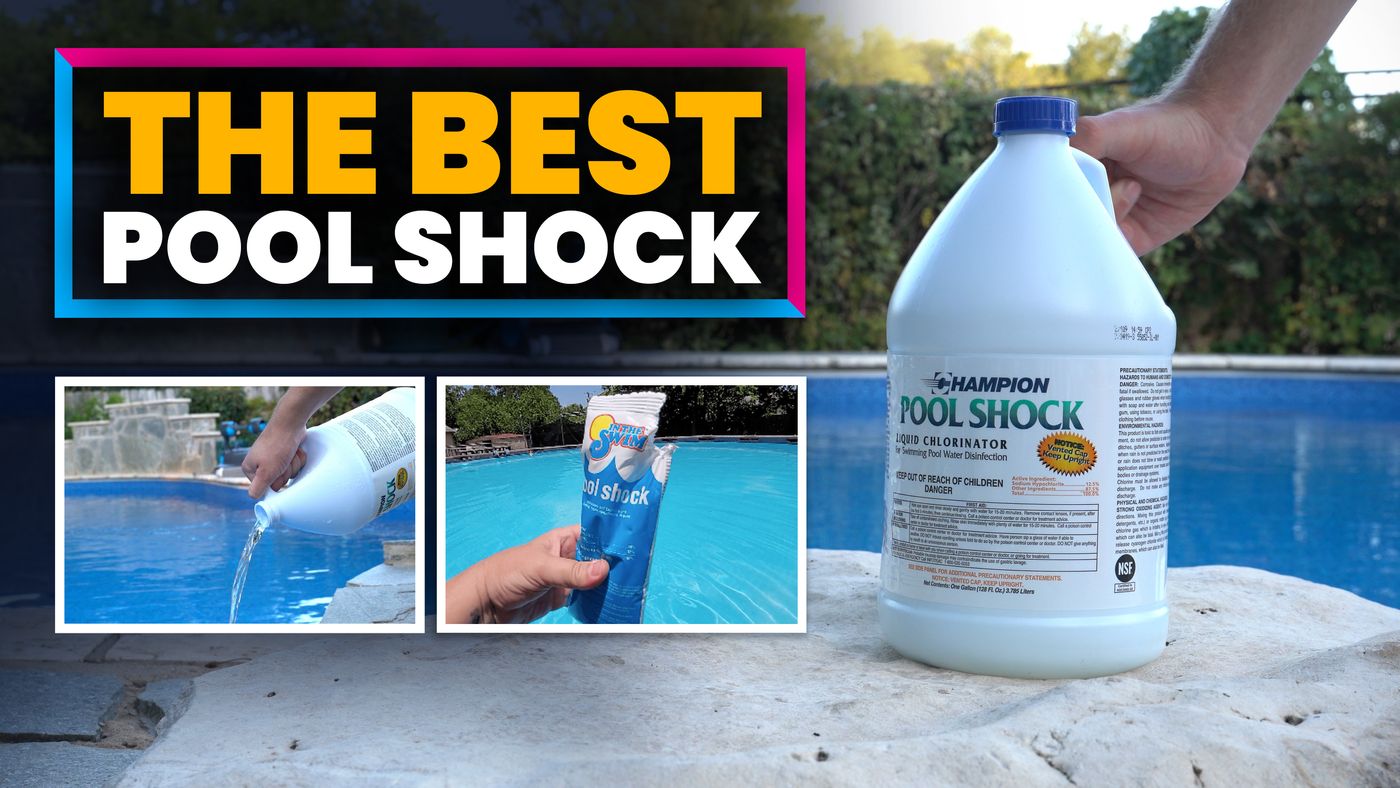
Introduction
Hey there, I'm Justin, your resident pool aficionado. Today we're unpacking the topic that confuses almost every new pool owner: pool shock.
Retail shelves run the gamut—cal-hypo, dichlor, non-chlorine, liquid shock—and it is easy to feel overwhelmed. The wrong product can stain a liner, push cyanuric acid (CYA) too high, or just drain your wallet with repeat doses that never quite fix the problem.
After years of testing equipment and maintaining our 8 × 20 Ecopool test pool, I've learned that picking shock is not rocket science—but you do need to know what you are buying and why. In this guide I'll break down every major type, give you clear Pool Nerd picks, and walk through a simple shocking workflow. I'll also tie in the gear that keeps us honest on chemistry—our ICO monitor (shop ICO), SpectraLight UV (shop SpectraLight) on the return line, and Dolphin Premier (shop Premier) for scrubbing and debris—so we use less shock while keeping the water clearer.
Best pool shock at a glance
- Green or heavy algae? → Cal-hypo (pre-dissolve for vinyl)—In The Swim cal-hypo or HTH cal-hypo.
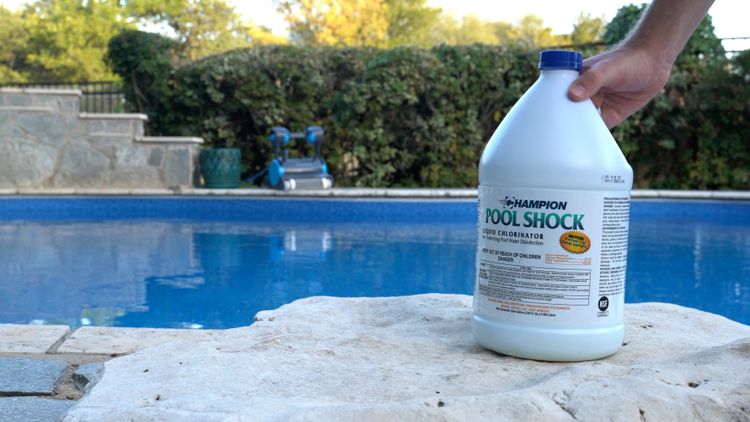
- Saltwater, high CYA, or high calcium? → Liquid chlorine—Champion 12.5% liquid chlorine; prioritize fresh stock because heat and age weaken it fast.
- Hot tub or need fast swim time? → Non-chlorine (MPS) for oxidation only—never as an algae fix. For a fast-dissolving chlorinated bag, Clorox Pool&Spa Shock XtraBlue (dichlor + algaecide) is swim-ready in about 15 minutes per the label.
- Need exact doses? → Use the pool shock calculator and the step-by-step how to shock a pool guide.
Best Pool Shock: What You Need Checklist
Test first, fix pH if needed, then pick shock by situation—liquid, cal-hypo, dichlor, or MPS—plus the gear that cuts how much shock you pour.

Taylor K-2005 Test Kit
What it is: A professional drop (titration) kit for chlorine, pH, alkalinity, calcium hardness, and cyanuric acid.
Why you need it: You can’t SLAM or balance blind—especially CYA, which handcuffs chlorine. This kit gives numbers you can trust, not strip guesswork.

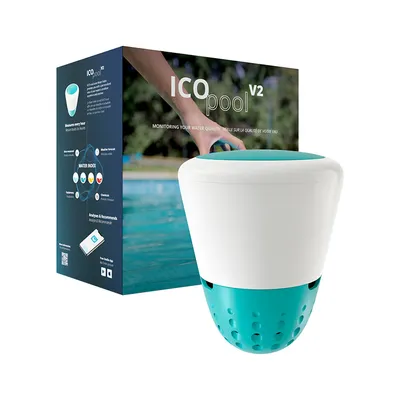
Ondilo ICO Pool Water Monitor
What it is: A floating smart monitor that samples pH, ORP (sanitizer effectiveness), and temperature on a schedule and sends trends to your phone.
Why you need it: You still need a real drop kit for parameters the ICO doesn’t replace (like TA and CYA), but hourly ORP/pH catches drift and dosing mistakes long before weekly strip checks do.

SpectraLight UV
What it is: Inline UV-C on the return line—knocks down pathogens and helps with chloramines as water passes the lamp.
Why you need it: Cleaner water with less organic load means you reach for shock less often while staying comfortable. Read the full SpectraLight review for sizing and install notes.

Dolphin Premier
What it is: A corded robotic cleaner with dual scrubbing brushes and strong filtration—built to pull debris and biofilm off surfaces so your sanitizer is not fighting mulch and leaves first.
Why you need it: Shock oxidizes what is in the water—leaves, pollen, and biofilm burn sanitizer too. A strong robot pulls debris off surfaces and into the filter so your chlorine works on algae and organics, not mulch. See the Dolphin Premier review for why it is our test-pool scrubber of choice.

Champion Muriatic Acid
What it is: Dilute hydrochloric acid—standard for lowering pH and, with the right method, total alkalinity.
Why you need it: High pH destroys chlorine efficiency. Always follow the label; never mix acid with chlorine.

In The Swim pH Reducer (dry acid)
What it is: Sodium bisulfate (dry acid)—lowers pH (and can pull TA down when used in controlled steps).
Why you need it: Easier to handle and store than jugs of muriatic acid for small, precise corrections; still an acid—never mix with chlorine, follow the label, and retest after circulation.

Champion Pool Shock (4 Pack)
What it is: A case of liquid pool chlorine (sodium hypochlorite)—not cal-hypo granules. Confirm strength on the listing and jug label (often around 10–12.5%).
Why you need it: Same upside as other liquid shock: no CYA from the product, easy to pour with the pump running—useful to keep stocked for openings, algae pushes, storms, or parties.
How to use: Treat it like any liquid shock (pour with circulation; big doses still work best at dusk). Store cool and shaded; opened jugs lose strength over time—plan to use them within a few weeks.

In The Swim Cal-Hypo Pool Shock
What it is: Calcium hypochlorite granular shock—high chlorine, adds calcium, no CYA.
Why you need it: Strong oxidizer for recovery and breakpoint; pre-dissolve; watch calcium if hardness is already high.

HTH Cal Hypo Pool Shock
What it is: Cal-hypo granular shock—same family as other cal-hypo products.
Why you need it: Alternative brand/size; compare % available chlorine and price per pound on the label.

Sodium dichlor (stabilized granular)
What it is: Stabilized chlorine shock—each dose adds CYA along with chlorine.
Why you might use it: Spas, very low-CYA pools, or occasional small doses when you want granules that dissolve fast.
Why to limit it: On a tab-fed or already-stabilized pool, dichlor stacks CYA fast—often you should prefer liquid or cal-hypo for shock instead.

Clorox Pool&Spa Shock XtraBlue
What it is: Fast-dissolving dichlor-based shock with added algaecide—kills bacteria and algae, and the label rates it swim-ready in about 15 minutes.
Why you need it: A convenient grab-a-bag option for quick mid-week boosts. Because it's stabilized (dichlor), every dose adds CYA—use it in moderation and watch your stabilizer number, especially on a tablet-fed pool.
What Is Pool Shock and Why Do You Need It?
Before we compare products, let's get one thing straight: shocking your pool is not the same as your everyday chlorine top-off.
When you shock, you are adding a large dose of oxidizer—often several times your normal chlorine level—to destroy contaminants routine sanitizing struggles with. Think of daily chlorine as the guard on patrol; shock is the heavy response when the pool is fighting a real load.
You reach for shock to:
- Kill algae blooms — green water rarely clears on maintenance doses alone.
- Eliminate chloramines — the "chlorine smell" and irritated eyes are usually combined chlorine, not "too much chlorine."
- Destroy bacteria — especially after heavy use, storms, or accidents.
- Break down organic waste — sunscreen, sweat, body oils, pollen, and debris.
That harsh smell at crowded public pools is usually chloramines—chlorine that is already tied up. Shock breaks them apart, but preventing the buildup (better filtration, UV, and not letting ORP crash) saves chemicals long term.
Pro Tip: How To Shock Less
One of the biggest upgrades we made to the test pool was adding SpectraLight UV sanitation on the return line. Ultraviolet light neutralizes many pathogens and helps control chloramines as water passes the lamp, which means we buy and pour less shock while keeping water comfortable.
If you are tired of fighting chemistry every weekend, UV is worth a serious look alongside good circulation and testing—not as a replacement for sanitizer, but as a way to stretch sanitizer and shock further.
SpectraLight UV
Shock Less, Swim Cleaner
UV on the return line cuts chloramines and organic load so you pour less chlorine and shock over the season—not a sanitizer replacement, but a serious upgrade next to good circulation and testing.
The 5 Types of Pool Shock (And Which One You Actually Need)
Let's break down each type so you know exactly what you are buying.
1. Calcium hypochlorite (cal-hypo) — the heavy hitter
What it is: Granular chlorine, typically about 65–73% available chlorine (check the label).
Cal-hypo is the most popular granular shock for a reason: it packs a strong punch per pound and is usually unstabilized, so it does not add CYA the way dichlor does—a big deal if you already run trichlor tablets.
The good
- Powerful and cost-effective for algae recovery and breakpoint chlorination.
- Unstabilized—no CYA creep from the shock itself.
- Excellent when you need to hammer algae or cloudy water tied to organics.
The bad
- Adds calcium—watch calcium hardness if you are in a hard-water area.
- Can bleach vinyl if dumped dry; pre-dissolve in a bucket of pool water for liners.
- Never mix with trichlor/dichlor or acids in a bucket—fire/explosion risk (more below).
Best for: Chlorine pools fighting algae, openings, and "we need serious oxidizer" moments.
Pool Nerd verdict: My go-to when the pool is green or fighting a heavy organic load. Shock at dusk, run the pump overnight, and brush or let a robot scrub so dead algae does not hide in biofilm.
Recommended products
-
In The Swim Cal-Hypo Pool Shock (compare % available chlorine on the label) — Check price on Amazon
-
HTH Cal Hypo Pool Shock (alternate brand/size—same family) — Check price on Amazon
Cal-hypo is powerful granular shock—dissolve it for vinyl and never mix it with other concentrates in a bucket // The Pool Nerd
2. Liquid chlorine (sodium hypochlorite) — the pro's choice
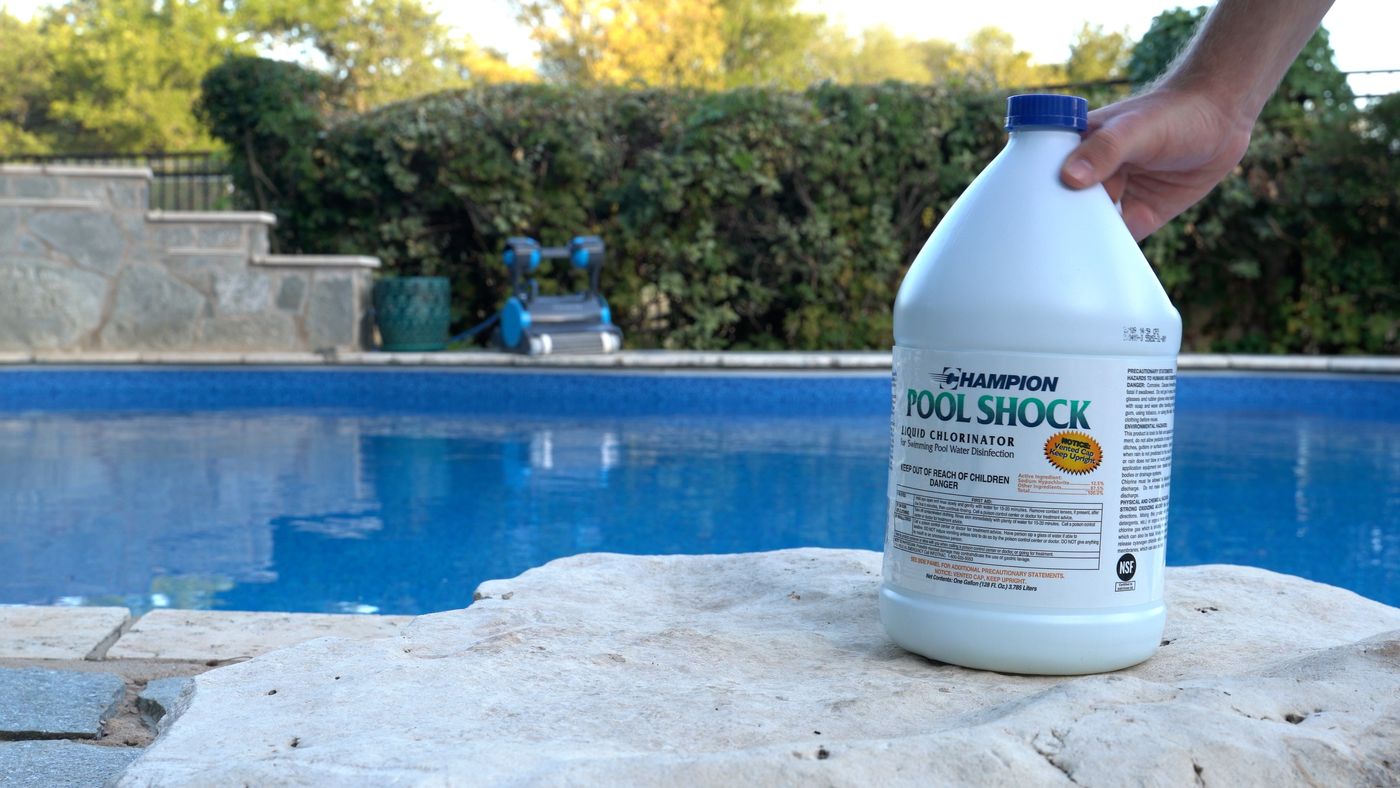
What it is: Chlorine in liquid form, usually about 10–12.5% available chlorine—essentially pool-grade bleach, the workhorse at many commercial pools.
The good
- Fully soluble—no granules, no residue on the floor if you pour with circulation.
- Adds no CYA and no calcium—ideal when stabilizer or hardness is already high.
- Excellent for saltwater pools (no extra load on the cell from cal-hypo hardness) and vinyl when poured correctly.
The bad
- Degrades in heat and age—buy fresh jugs and use them within roughly 4–8 weeks when possible; store cool and shaded.
- Bulky to haul; strength varies by batch and age, so retest after dosing.
Best for: Weekly chlorine boosts, saltwater pools, vinyl liners, and pools with high CYA or high calcium.
Pool Nerd verdict: If I could only keep one shock type on hand for a typical backyard pool, it would be liquid chlorine—fast, predictable distribution, and no stabilizer sneaking in. It is also the chemistry behind my favorite automation upgrade, the chlorine injection system, which doses it for you daily.
Where to buy: 12.5% (or close) liquid is widely sold in jugs, but hazmat shipping and regional rules mean delivery options vary—check labeled pool-grade liquid chlorine and other sellers for what ships to your ZIP. Always verify strength on the label and dose by testing.
3. Sodium dichlor (dichlor) — the "easy" granule
What it is: Stabilized granular chlorine—often roughly 56–62% available chlorine depending on formulation; every dose adds CYA.
The good
- Dissolves quickly, easy to handle, and generally liner-friendly when used as directed.
- Stabilized chlorine resists sunburn-off right after dosing—sometimes useful when you cannot wait until dusk (still prefer evening for big doses).
The bad
- CYA stacks fast. A common rule of thumb is on the order of ~9 ppm CYA per 10 ppm chlorine added (per 10,000 gallons)—verify with your label and testing. Above roughly 50–80+ ppm CYA, chlorine effectiveness can fall off a cliff unless you raise targets or dilute water.
Best for: Spas and hot tubs, small pools with low CYA, or occasional use—not a weekly crutch on a stabilized tablet pool.
Pool Nerd verdict: Useful in the right context; do not lean on dichlor every week on a pool already fed by trichlor tabs—you will eventually buy a partial drain to fix stabilizer.
Recommended products: Any reputable sodium dichlor labeled for pools—compare % available chlorine, price per pound, and ingredient list. The critical issue is how much CYA you are stacking, not the bag graphic; when you need a bag shipped, In The Swim sodium dichlor granules or Clorox Pool&Spa Shock XtraBlue (dichlor with added algaecide) is a solid starting point—use small doses and watch CYA.
4. Non-chlorine shock (MPS) — the quick swimmer
What it is: Potassium monopersulfate and similar non-chlorine oxidizers—great for oxidizing organics, not a primary algae sanitizer.
The good
- Swim-ready quickly—often ~15 minutes (always confirm on the product label).
- Useful for mid-week oxidation, bromine pools, or knocking down oils before a party.
The bad
- Does not replace chlorine for killing algae or full sanitization.
- Can interfere with some DPD combined-chlorine readings for a window after use—know your test method.
Pool Nerd verdict: A supplement, not the main weapon for a green pool.
Recommended products: Any labeled non-chlorine shock / MPS from a major pool brand—follow the label for dose and swim time (oxidation only—not for killing algae).
5. Lithium hypochlorite (legacy option)
What it is: Another granular chlorine source—fast-dissolving and low residue—but often expensive and harder to find than cal-hypo or liquid.
Pool Nerd verdict: If you see it at a fair price and like how it behaves in your water, fine—but most owners will stick to liquid + cal-hypo for economics and availability.
Pool Shock Quick Reference
| Situation | Best choice |
|---|---|
| Green water / algae | Cal-hypo (often 2×–4× maintenance dose; see SLAM guide) |
| Saltwater pool | Liquid chlorine (primary). MPS only for quick oxidation—not algae recovery |
| Weekly maintenance (chlorine pools) | Liquid chlorine and/or cal-hypo when water needs it—ORP/testing beats a blind calendar |
| Vinyl liner | Liquid chlorine (pour with circulation) or dichlor in small doses—pre-dissolve cal-hypo |
| High CYA (50+ ppm) | Liquid chlorine or cal-hypo—avoid dichlor until you dilute |
| Need to swim soon | Non-chlorine (MPS) for oxidation, or Clorox Shock XtraBlue (swim-ready ~15 min per label)—not MPS for killing algae |
Safety — never mix shock types. Mixing concentrates—especially cal-hypo with dichlor/trichlor or with acid—can cause fire or explosion. Add chemicals to the pool water separately, pre-dissolve only one product per bucket, and rinse gear between steps.
What to Buy (Supplies)
The what you need checklist earlier in this guide is the same shock treatment list we use on our other maintenance pages—test kit, acid if pH is high, liquid and granular shock options.
Case of liquid: Champion Pool Shock (4-pack) is liquid sodium hypochlorite in a multipack—confirm strength on the listing and label, pour with circulation (no cal-hypo pre-dissolve step), store cool and shaded, and use opened jugs within a few weeks.
How To Shock Your Pool the Right Way
Most owners overthink this. Here is the simple version I use:
1. Test first
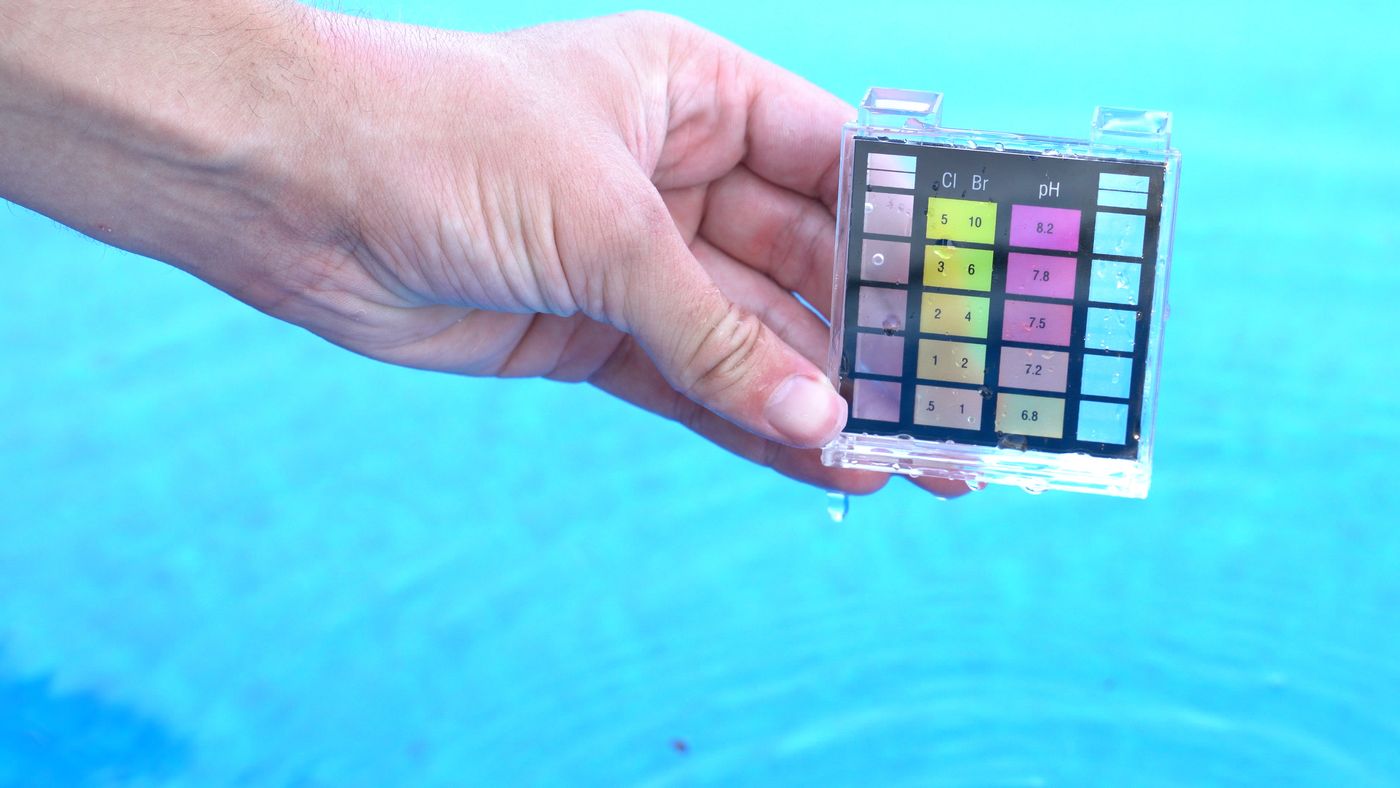
You cannot dose what you do not measure—at minimum pH and free chlorine, and ideally CYA context too. A proper drop kit is the benchmark—Taylor K-2005 is what we use in the chart below.
The easy way: I run an Ondilo ICO (shop ICO) so ORP, pH, and temperature hit my phone on a steady rhythm. When ORP slides toward the 600s mV, I know we are losing real sanitizing power before the water always looks wrong yet.
2. Clean the pool
Shock spends its first hours oxidizing what is in the water—leaves, pollen, and biofilm included.
The easy way: I drop in my Dolphin Premier before a heavy shock. Scrubbing and filtration pull debris off surfaces and out of suspension so sanitizer works on algae and organics, not mulch.

3. Balance pH
If pH is above ~7.6, chlorine loses a lot of punch. I aim for roughly 7.2–7.4 before a big shock. If you need help lowering it safely, start with how to lower pool pH—muriatic acid is the usual tool, or dry acid if you want easier handling (never mix either with shock in a bucket).
4. Calculate and add
Rule-of-thumb starting points (adjust for severity and label strength):
- Cal-hypo: about 1 lb per 10,000 gallons for a maintenance-style bump; multiply for algae.
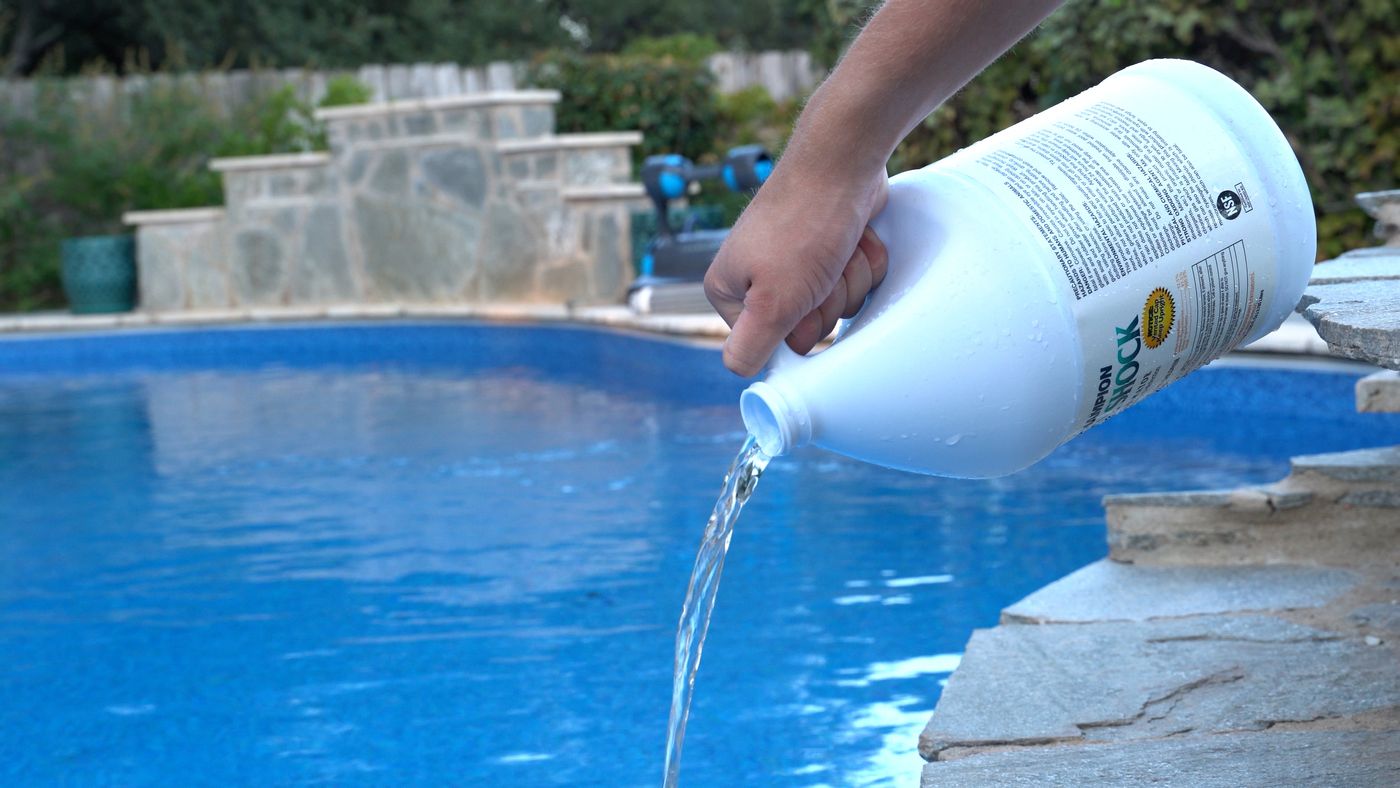
- Liquid (12.5%): about 1 gallon per 10,000 gallons for a similar maintenance-style bump; multiply for algae.
For precise targets, use the pool shock calculator and the photos workflow in how to shock a pool.
Always shock at dusk for unstabilized chlorine (liquid + cal-hypo). Sunlight tears down free chlorine fast; night gives chemistry time to work.
5. Run the pump
Keep water moving at least 8–12 hours—longer if you are clearing dead algae. Backwash/clean the filter if pressure climbs; dead algae has to leave the system somehow.
Frequently Asked Questions
Can I use bleach instead of pool shock?
Yes—with rules. Plain unscented household bleach is the same chemistry family as liquid pool chlorine, just usually weaker (~6% vs ~12.5%). Never use splashless, scented, or color-safe products—additives can foam or wreck chemistry. If you go this route, dose by strength math, not "a splash."
How long after shocking can I swim?
- Non-chlorine (MPS): Often ~15–30 minutes—confirm the label.
- Chlorine shock: Wait until free chlorine is back in a normal swim range and water is clear—often 12–24 hours for heavy doses. With high CYA, some pros use higher FC targets safely, but most homeowners should still wait until levels are sensibly low and the water is right.
Why is my pool still green after shocking?
Usually under-dosing, pH too high, filtration clogged, or algae living in biofilm on walls. That is why we SLAM—Shock Level And Maintain—instead of one-and-done. Read how to SLAM your pool and how to clean a green pool for the full sequence.
Can I mix different types of pool shock?
No. Keep concentrates apart, add to water separately, and never pre-mix in a bucket.
Final Thoughts
Pool shock stops being confusing when you match ingredient to problem:
- Saltwater or rising CYA/calcium? → Liquid chlorine.
- Green algae war? → Cal-hypo (dissolved for vinyl) plus circulation and cleaning.
- Need a fast oxidizer before guests? → MPS—but keep chlorine in charge of actual sanitizing.
The real "secret" is consistent maintenance: ICO (shop) or Taylor K-2005 so you shock when water needs it, Dolphin Premier (shop)-level cleaning so chemistry works on pests—not leaves, and SpectraLight UV (shop) if you want to stretch every gallon and bag further.
If you want the deep dives next, bookmark how to shock a pool, pool shock calculator, and SLAM pool guide—together they cover technique, math, and algae sieges end to end.



Comments
Loading comments…