
Pool Alkalinity Calculator
Calculate exactly how much baking soda or acid to adjust your pool's total alkalinity
Use the calculatorHow to use
Pool Alkalinity Calculator
Enter your pool details below for an instant chemical dosage recommendation.
Average residential pool: 10,000–20,000 gallons
Test with strips or liquid kit
Ideal range: 80–120 ppm
0 ppm 80 120 200+ ppm
What you need next
Baking soda up, acid down
Plain baking soda is the same sodium bicarbonate as pool-store alkalinity increaser, at grocery prices. Confirm TA with a drop kit first.


Products are picked independently. The Pool Nerd may earn a commission on orders placed through these links, at no extra cost to you. Learn more
What Is Total Alkalinity?
Total alkalinity (TA) is your pool water's ability to resist sudden changes in pH. Think of it as a buffer — when alkalinity is in the right range, your pH stays stable even when you add chemicals, rain hits the pool, or swimmers jump in. When it's off, your pH bounces around unpredictably, dragging chlorine effectiveness, surface integrity, and water clarity down with it.
The ideal total alkalinity for most residential pools is 80–120 ppm (parts per million). Saltwater pools tend to run best on the lower end of that range (70–80 ppm), while traditional chlorine pools perform well right at 100 ppm.
This is one of those parameters where I've learned the hard way that fixing it first saves hours of frustration later. Every time I've skipped the alkalinity check and gone straight to pH or chlorine, I've ended up re-dosing chemicals within two days because nothing held.
Why Total Alkalinity Matters
- pH stability — Proper alkalinity locks your pH in the ideal 7.2–7.6 window so you're not constantly chasing it
- Chlorine efficiency — When pH is stable, your sanitizer works at full strength instead of being wasted
- Equipment protection — Low alkalinity causes corrosive water that eats away at heaters, ladders, and pool surfaces
- Water clarity — High alkalinity leads to cloudy water and calcium scale buildup on tile lines and equipment
- Swimmer comfort — Balanced water means no stinging eyes or itchy skin
How to Test Total Alkalinity
You can test TA with liquid drop test kits or test strips. Liquid kits (like the Taylor K-2006, or the K-2006 Salt for salt pools) are more accurate, but strips get the job done for routine checks. Test your alkalinity at least once a week — more often during heavy use or after rain.
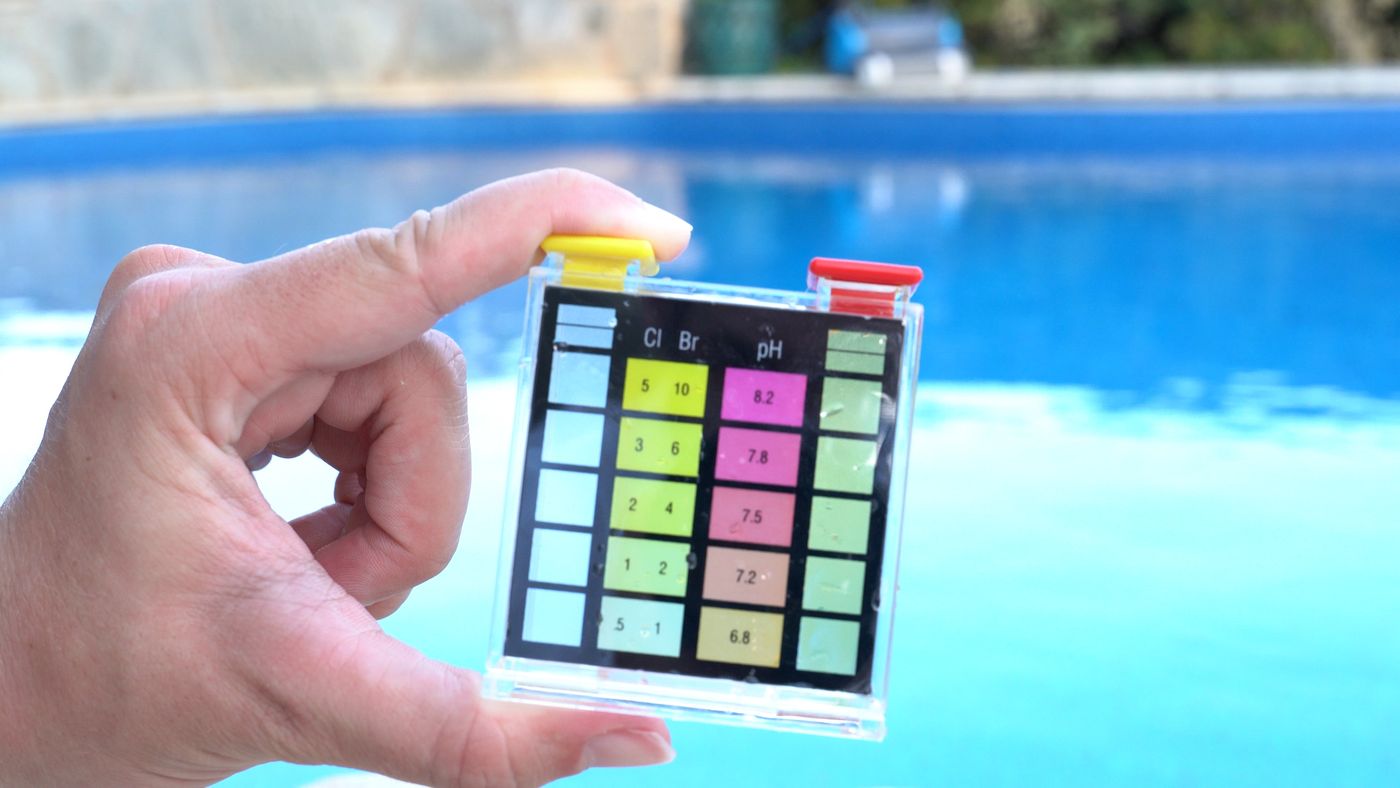
- Dip a test strip or fill a sample tube from elbow depth (not the surface)
- Compare the alkalinity pad color to the chart, or count drops until the color changes
- Record the reading and compare it to the 80–120 ppm ideal range
- If you're outside that window, use the calculator at the top of this page to find your exact dosage — then grab what it recommends from the product table right below it
How to Raise Pool Alkalinity
Key Takeaway
Read the full guide: How To Raise Alkalinity In Your Pool
Low alkalinity is the more common problem, and thankfully it's the easier one to fix. Sodium bicarbonate — plain baking soda — is the go-to chemical. It's cheap, safe, and available at every grocery store.
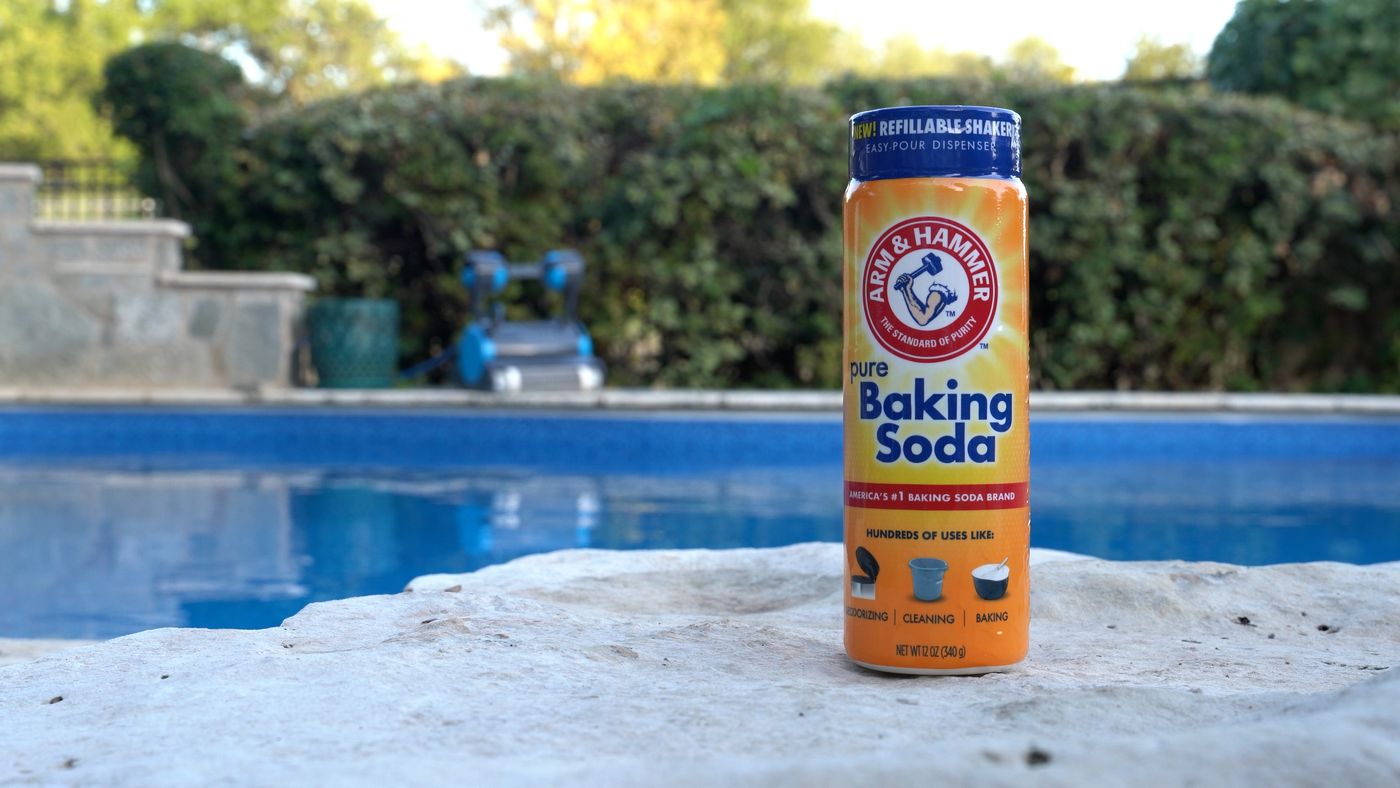
Step-by-Step: Raising Alkalinity with Baking Soda
- Test your pool water and note your current total alkalinity reading
- Enter your pool volume and current TA into the calculator above to get the exact dosage
- Turn your pool pump on so water is actively circulating
- Sprinkle the baking soda across the pool surface, focusing on the deep end
- Do not add more than 1.5 lbs per 10,000 gallons in a single dose
- Wait at least 6 hours before retesting
- Repeat if needed until you reach your target range
How Much Baking Soda to Add to a Pool
As a quick reference: 1.5 lbs of baking soda per 10,000 gallons raises total alkalinity by approximately 10 ppm. So if your 15,000-gallon pool reads 60 ppm and you want to hit 100 ppm, you need roughly 6 lbs of baking soda — but add it in stages, not all at once.
Baking Soda vs. Alkalinity Increaser
Pool stores sell "alkalinity increaser" or "alkalinity up" products at a premium. The active ingredient is the exact same thing — sodium bicarbonate. A 15 lb Arm & Hammer bag costs a fraction of the pool-branded version and works identically. For the lowest $/lb shipped, compare a USP pure 50 lb bucket. The only advantage of pool-branded products is the convenience of dosing charts on the label.
How to Lower Pool Alkalinity
Key Takeaway
Read the full guide: How To Lower Total Alkalinity In Your Pool
High alkalinity is trickier to correct because the same acids that lower TA also drop your pH. The strategy is to lower alkalinity with acid, then raise pH back up separately if needed.
Step-by-Step: Lowering Alkalinity with Muriatic Acid
- Test your water and record the current TA and pH readings
- Use the calculator above to determine how much acid you need
- With the pump running, slowly pour muriatic acid in one concentrated spot in the deep end
- Pouring in a single location creates an "acid column" that attacks alkalinity more than pH
- Do not lower TA by more than 10–20 ppm per treatment
- Wait 24 hours and retest both TA and pH
- If pH has dropped below 7.2, raise it with aeration (turn on water features or point a return jet at the surface)
Muriatic Acid vs. Dry Acid for Alkalinity
Muriatic acid (hydrochloric acid, 31.45%) is the most effective option and what most professionals use. It works fast, costs less per treatment, and you can control the pour location precisely. The downside: it produces fumes and requires gloves, goggles, and careful handling. Our pool acid calculator has a full comparison of acid types, concentrations, and dosage charts for both pH and alkalinity corrections.
Dry acid (sodium bisulfate) is safer to store and handle, produces no fumes, and comes in granular form. It's a good choice if you're uncomfortable with liquid acid, but it costs more per equivalent dose and doesn't create as effective an acid column for targeting alkalinity over pH.
Pool Alkalinity Dosing Charts
These charts give you a quick reference for common pool sizes. For exact dosing tailored to your pool, use the calculator at the top of this page.
Baking Soda Needed to Raise Alkalinity
| Pool Volume | Raise 10 ppm | Raise 20 ppm | Raise 30 ppm | Raise 40 ppm |
|---|---|---|---|---|
| 5,000 gal | 0.75 lbs | 1.5 lbs | 2.25 lbs | 3.0 lbs |
| 10,000 gal | 1.5 lbs | 3.0 lbs | 4.5 lbs | 6.0 lbs |
| 15,000 gal | 2.25 lbs | 4.5 lbs | 6.75 lbs | 9.0 lbs |
| 20,000 gal | 3.0 lbs | 6.0 lbs | 9.0 lbs | 12.0 lbs |
| 25,000 gal | 3.75 lbs | 7.5 lbs | 11.25 lbs | 15.0 lbs |
| 30,000 gal | 4.5 lbs | 9.0 lbs | 13.5 lbs | 18.0 lbs |
Muriatic Acid (31.45%) Needed to Lower Alkalinity
| Pool Volume | Lower 10 ppm | Lower 20 ppm | Lower 30 ppm | Lower 40 ppm |
|---|---|---|---|---|
| 5,000 gal | 13 fl oz | 26 fl oz | 39 fl oz | 52 fl oz |
| 10,000 gal | 26 fl oz | 52 fl oz | 78 fl oz | 104 fl oz |
| 15,000 gal | 39 fl oz | 78 fl oz | 117 fl oz | 156 fl oz |
| 20,000 gal | 52 fl oz | 104 fl oz | 156 fl oz | 208 fl oz |
| 25,000 gal | 65 fl oz | 130 fl oz | 195 fl oz | 260 fl oz |
| 30,000 gal | 78 fl oz | 156 fl oz | 234 fl oz | 312 fl oz |
All values are approximate starting points. Always retest and adjust incrementally rather than adding the full dose at once.
Alkalinity vs. pH Explained
Alkalinity and pH are closely related but not the same thing. Understanding the difference is critical because adjusting one almost always affects the other.
The Relationship Between TA and pH
Total alkalinity measures the concentration of bicarbonate, carbonate, and hydroxide ions in your water. It tells you how well your water can resist pH changes.
pH measures how acidic or basic the water is right now on a scale from 0 to 14.
Here's the practical relationship:
- Raising TA (adding baking soda) also slightly raises pH
- Lowering TA (adding acid) also lowers pH
- Raising pH without raising TA is possible using aeration — running fountains, waterfalls, or pointing return jets upward to increase CO2 off-gassing
- Lowering pH without significantly lowering TA can be done with small, distributed doses of acid rather than concentrated pours
The Correct Adjustment Order
Always fix alkalinity first, then adjust pH. Trying to fix pH while alkalinity is off is like building a house on sand — the pH will just drift again.
- Test both TA and pH
- Adjust TA to the 80–120 ppm range first
- Wait 24 hours and retest
- Then adjust pH to 7.2–7.6 if needed
- Retest after another 24 hours to confirm both are stable
What Happens When Both Are Off
| Alkalinity | pH | What to Do |
|---|---|---|
| Low | Low | Raise TA with baking soda (this will also raise pH) |
| Low | High | Raise TA with baking soda, then lower pH with acid if still high |
| High | Low | Add acid to lower both (this corrects TA and may fix pH too) |
| High | High | Add acid in a concentrated pour to target TA, then aerate if pH drops too low |
Common Alkalinity Problems and Fixes
Even if you know the chemistry, real-world pool ownership throws curveballs. Here are the most common alkalinity problems and how to handle them.
Why Does My Alkalinity Keep Dropping?
Several things consistently push alkalinity down:
- Heavy rain dilutes your pool water and typically has a TA near zero
- Acidic sanitizers like trichlor tablets slowly consume alkalinity over time
- Frequent acid additions — if you're constantly adding acid for pH, you're also burning through TA
- High bather loads introduce body oils, sweat, and sunscreen that affect water chemistry
Fix: If you use trichlor tablets as your primary sanitizer, expect to add baking soda regularly. Consider switching to liquid chlorine (sodium hypochlorite) which has a more neutral effect on alkalinity. Our pool chemical calculator covers the full relationship between different sanitizer types and their impact on your overall water balance.
Why Does My Alkalinity Keep Rising?
High alkalinity that keeps creeping back up usually has one of these causes:
- Calcium hypochlorite (cal-hypo) shock raises both TA and calcium hardness (track the calcium side with our calcium hardness calculator)
- High-alkalinity fill water — your tap water may have TA above 150 ppm
- Sodium hypochlorite (liquid chlorine) has a pH of ~13 and gradually raises TA with heavy use
Fix: Test your source water so you know your baseline. If your fill water has high alkalinity, account for it after every top-off.
Cloudy Water from High Alkalinity
When TA climbs above 120–140 ppm, dissolved calcium has trouble staying in solution. The result is cloudy or milky water and white calcium scale forming on your tile line, inside the heater, and on the salt cell.
Fix: Lower TA to the 80–100 ppm range using muriatic acid. Run the filter continuously until the water clears. Brush any visible scale deposits.
Low Alkalinity Corrosion Damage
Water with low alkalinity is aggressive. It actively dissolves metals and etches plaster and concrete surfaces. Signs include:
- Green staining from dissolved copper (heater elements, copper pipes)
- Pitting or roughness on plaster pool surfaces
- Deterioration of ladder rails, handrails, and metal fittings
- Heater failure from corroded heat exchangers
Fix: Raise TA immediately with baking soda and maintain it above 80 ppm. If you notice metal staining, add a metal sequestrant and address the source of the low alkalinity.
Alkalinity Lock (pH Keeps Rising Despite Normal TA)
Some pools experience a frustrating cycle: pH constantly drifts upward even though TA is in range. This is usually caused by TA being on the high side of "normal" (110–120 ppm) combined with any aeration source like waterfalls, spillovers, or SWG systems.
Fix: Lower your target TA to 70–80 ppm. This reduces the buffering capacity enough that pH stays stable without constant acid additions. This is especially common and recommended for saltwater pools.
Keeping your total alkalinity in the right range is one of the most impactful things you can do for your pool. It's the foundation that everything else — pH, chlorine, clarity, and equipment longevity — depends on. Use the calculator above, test weekly, and adjust in small steps.
For a complete picture of how alkalinity fits into your overall water balance, see our pool chemical calculator which covers all five key parameters and the correct order to adjust them. And if you're dealing with a broader issue like cloudy water or a green pool, those guides walk through the full troubleshooting process. Our weekly pool maintenance guide covers how to keep alkalinity stable with a consistent testing and treatment routine.
More Pool Calculators
All Calculators Chemistry Calculator Chemical Calculator Chlorine Calculator Volume Calculator Shock Calculator SLAM Calculator pH Calculator Acid Calculator Alkalinity Calculator Calcium Hardness Calculator LSI Calculator Salt Calculator CYA Calculator Borate Calculator Dilution Calculator Pump Size Calculator Pump Runtime Calculator Pump Schedule Calculator Filter Size Calculator Heater Calculator Salt Cell Calculator Fill Time Calculator Evaporation Calculator Winterizing Calculator Hot Tub Calculator Pool Cost Calculator Loan Calculator Maintenance Cost Calculator Pool Deck Calculator Resurfacing Calculator
More from The Pool Nerd
Keep Reading


Disclaimer: This information is for educational purposes only. Handling pool chemicals involves significant risks, and this calculator cannot cover every product, pool, or possible hazard. Always follow the manufacturer’s label, safety data sheet, and applicable requirements. Seek qualified help whenever you are uncertain.