
Pool pH Calculator
Find out exactly how much chemical to add to balance your pool's pH
Use the calculatorHow to use
Pool pH Calculator
Enter your pool details below for an instant chemical dosage recommendation.
Average residential pool: 10,000–20,000 gallons
Test with strips or digital meter
Ideal range: 7.2–7.6
What you need next
Everything the pH fix needs
Acid brings pH down, soda ash brings it up. Confirm the reading with a drop kit before you pour.


Products are picked independently. The Pool Nerd may earn a commission on orders placed through these links, at no extra cost to you. Learn more
pH Adjustments: What You Need Checklist
What you need
pH moves with acid (down) or soda ash (up)—confirm readings with a drop kit, not strips alone, before you pour.

Taylor K-2005 Test Kit
What it is: A professional drop (titration) kit for chlorine, pH, alkalinity, calcium hardness, and cyanuric acid.
Why you need it: You can’t SLAM or balance blind—especially CYA, which handcuffs chlorine. This kit gives numbers you can trust, not strip guesswork.

Champion Muriatic Acid
What it is: Dilute hydrochloric acid—standard for lowering pH and, with the right method, total alkalinity.
Why you need it: High pH destroys chlorine efficiency. Always follow the label; never mix acid with chlorine.

In The Swim pH Reducer (dry acid)
What it is: Sodium bisulfate (dry acid)—lowers pH (and can pull TA down when used in controlled steps).
Why you need it: Easier to handle and store than jugs of muriatic acid for small, precise corrections; still an acid—never mix with chlorine, follow the label, and retest after circulation.

In The Swim Soda Ash
What it is: Sodium carbonate—raises pH faster than baking soda with less alkalinity bump.
Why you need it: Use when pH is low and you need pH up without overshooting TA; check TA first.
What Is Pool pH and Why Does It Matter
Pool pH measures how acidic or basic your water is on a scale from 0 to 14. A pH of 7.0 is perfectly neutral, anything below that is acidic, and anything above is basic (alkaline). For swimming pools, the ideal pH range is 7.2 to 7.6, with 7.4 being the sweet spot that most pool professionals target. For a deeper look at why many pros actually aim lower, read our guide on the ideal pool pH level.
pH is the number I check first every time I test a pool because it tells me more about the water's condition than any other single reading. Getting it right isn't optional — it affects nearly every aspect of your pool's health and your comfort in it.
Chlorine Effectiveness
Chlorine is your pool's primary defense against bacteria and algae, but its killing power is directly tied to pH. At a pH of 7.2, about 65% of your chlorine is in its active form (hypochlorous acid). Bump that up to 8.0 and only about 22% is active. That means you could be dumping chlorine into your pool for nothing if your pH is out of range.
Swimmer Comfort
Human eyes and mucous membranes sit around a pH of 7.4. When your pool water matches that, swimmers experience less eye irritation, less skin dryness, and no chemical smell. Most "chlorine burn" complaints are actually caused by imbalanced pH, not too much chlorine.
Equipment Protection
Low pH water (below 7.0) is corrosive. It eats away at metal fixtures, pump seals, heat exchangers, and even vinyl liners. High pH water (above 7.8) causes calcium to fall out of solution and form scale on pool surfaces, inside pipes, and on salt cells. Either extreme costs real money in repairs.
Chemical Efficiency
Every chemical you add to your pool works within a pH-dependent window. Algaecides, clarifiers, stain removers — they all perform best when pH is in range. Balancing pH first means you spend less on every other chemical.
How to Test Your Pool pH
Accurate testing is the foundation of proper pH management. The quality of your test results directly determines whether your chemical adjustments will be right or a waste of product. Here are the most reliable methods, ranked by accuracy.
Digital pH Meters
Digital meters give you a precise numerical reading, typically accurate to 0.01 pH units. They're the gold standard for pool testing, but they need regular calibration with buffer solutions to stay accurate. If you invest in one, calibrate it at least once a month.
Liquid Test Kits (Phenol Red)
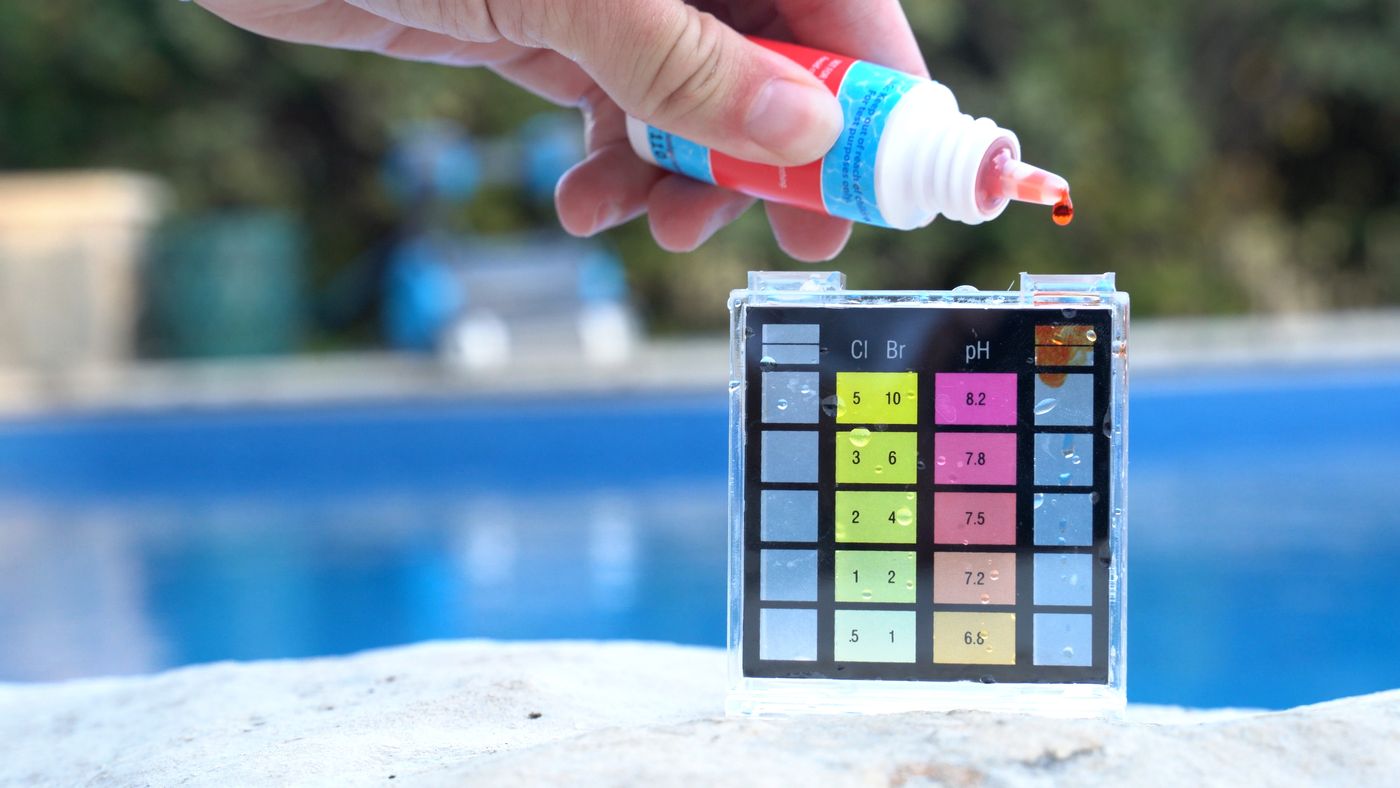
The Taylor K-2005 and similar dropper-based kits use phenol red reagent to produce a color that corresponds to pH. They're more accurate than test strips and cost-effective for weekly use. Fill the comparator to the line, add the drops, and compare the color in natural daylight — never under artificial lighting.
Test Strips
The fastest and cheapest option, but also the least accurate. Test strips give you a ballpark reading that's usually within 0.2–0.4 of the actual value. They're fine for quick checks between more accurate tests, but don't base large chemical additions on strip readings alone.
Testing Best Practices
- Test at least twice per week during swimming season
- Test elbow-deep away from return jets — surface water can give false readings
- Test before adding any chemicals, and 4–6 hours after making adjustments
- Don't test immediately after rain, heavy bather loads, or shocking — wait at least 8 hours
- Store test reagents out of direct sunlight and replace them annually
How to Lower Pool pH
Key Takeaway
Read the full guide: How To Lower pH In Your Pool
When your pH climbs above 7.6, your chlorine starts losing its punch, water gets cloudy, and calcium scale begins forming. Here's how to bring it back down safely using the two most common pool acids.
Muriatic Acid (Hydrochloric Acid)
Muriatic acid is the most popular choice for lowering pool pH. It's fast-acting, inexpensive, and available at any hardware or pool supply store. The standard concentration is 31.45% (also labeled as 20° Baumé).
How to add muriatic acid:
- Make sure the pump is running
- Hold the bottle close to the water surface near a return jet
- Pour slowly in a thin stream — never splash
- Allow the acid to circulate for at least 30 minutes before retesting
- If you need a large drop (more than 0.4), split the dose into two additions 4–6 hours apart
Safety precautions: Always wear chemical-resistant gloves and eye protection. Work upwind. Never mix muriatic acid with any other chemical. Store in a cool, ventilated area away from metals.
Dry Acid (Sodium Bisulfate)
Sodium bisulfate is a granular acid that's safer to handle and store than liquid muriatic acid. It's slightly more expensive per dose but eliminates the risk of acid splashes and produces less fume.
How to add dry acid:
- With the pump running, broadcast the granules across the deep end of the pool
- Avoid dumping in a single spot — this prevents localized acid damage to the surface
- Allow 30–60 minutes for full circulation before retesting
- For vinyl or fiberglass pools, pre-dissolving in a bucket of pool water is recommended
When pH Won't Stay Down
If your pH keeps bouncing back up within days of treatment, the most likely culprit is high total alkalinity. Total alkalinity acts as a pH buffer — when it's above 120 ppm, it constantly pushes pH upward. Lower your TA to the 80–100 ppm range first, and pH will become much easier to control. Our alkalinity calculator walks through the acid-and-aerate method for bringing TA down without crashing your pH.
For a more detailed breakdown of muriatic acid vs. dry acid, including concentration comparisons and safety handling, see our pool acid calculator.
How to Raise Pool pH
Key Takeaway
Read the full guide: How To Raise Your Pool's pH
Low pH (below 7.2) is corrosive and can damage equipment, etch plaster, and irritate swimmers. Raising it is straightforward with the right product.
Soda Ash (Sodium Carbonate)
Soda ash is the go-to chemical for raising pool pH. It's effective, affordable, and widely available. One thing to be aware of: soda ash also raises total alkalinity, which may or may not be what you want.
How to add soda ash:
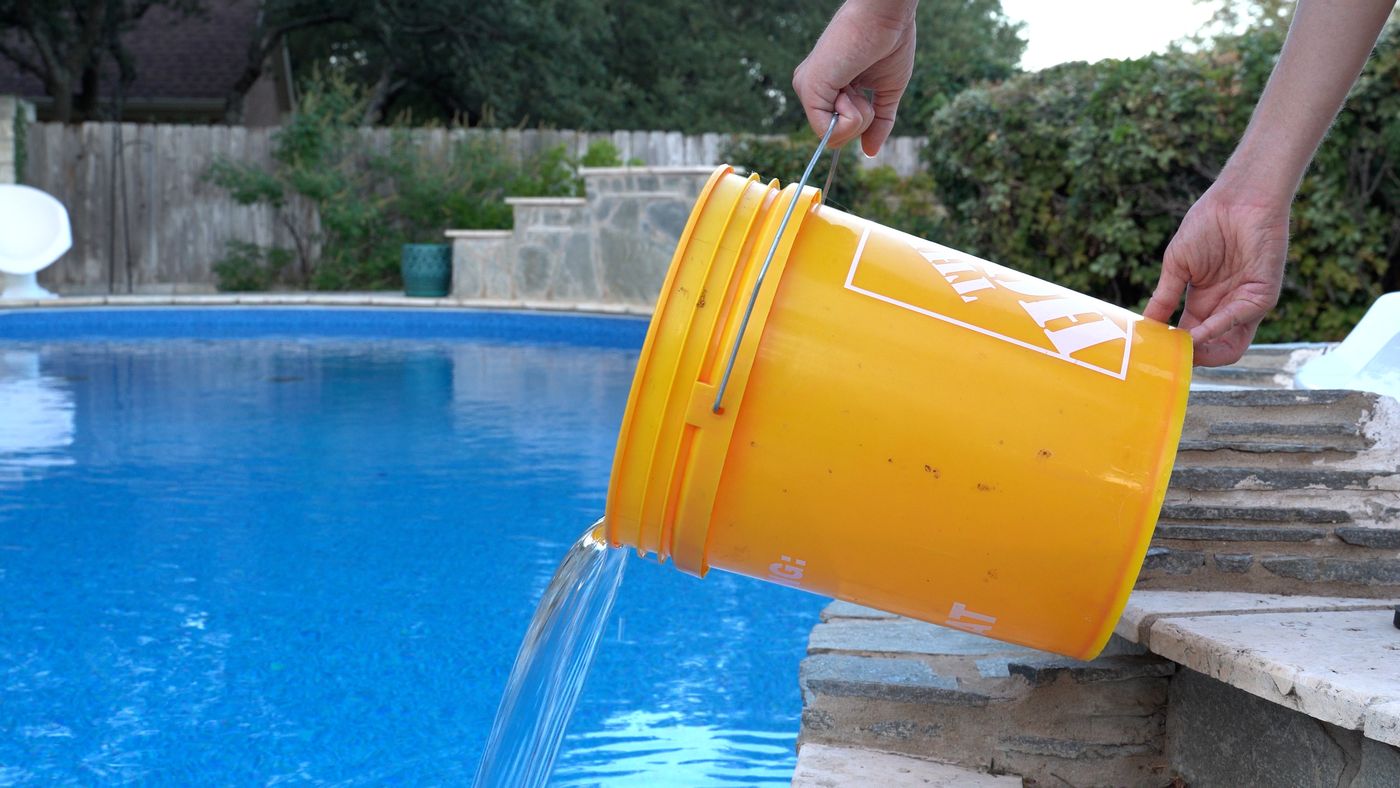
- Pre-dissolve the measured amount in a bucket of warm pool water — soda ash can cloud the water if added dry
- With the pump running, pour the solution near a return jet
- Run the pump for at least 1 hour
- Wait 4–6 hours and retest before making additional adjustments
- Add no more than 1 pound per 10,000 gallons in a single dose
Borax (Sodium Tetraborate)
Borax (commonly sold as 20 Mule Team Borax at the grocery store) raises pH with significantly less impact on total alkalinity than soda ash. This makes it ideal when you need to raise pH but your TA is already in the proper range or slightly high.
How to add borax:
- Pre-dissolve borax in a bucket of warm water
- Pour near a return jet with the pump running
- Borax dissolves slowly — give it 24 hours for a full reading
- Borax also adds a slight silky feel to the water and helps buffer pH stability
Aeration as a pH Raiser
Running water features, spa jets, waterfalls, or simply pointing return jets upward so they break the surface all raise pH naturally by off-gassing dissolved CO2. Aeration raises pH without raising total alkalinity — making it the perfect tool when you need to bring pH up while keeping TA in check.
Pool pH Dosing Charts
These charts give you a quick reference for common dosing scenarios. The calculator above handles the exact math, but these tables are useful for a fast sanity check or if you're away from your phone.
Muriatic Acid (31.45%) to Lower pH
| Pool Volume | pH 7.8 → 7.4 | pH 8.0 → 7.4 | pH 8.2 → 7.4 |
|---|---|---|---|
| 5,000 gal | 12.8 fl oz | 19.2 fl oz | 25.6 fl oz |
| 10,000 gal | 25.6 fl oz | 38.4 fl oz | 51.2 fl oz |
| 15,000 gal | 38.4 fl oz | 57.6 fl oz | 76.8 fl oz |
| 20,000 gal | 51.2 fl oz | 76.8 fl oz | 102.4 fl oz |
| 25,000 gal | 64.0 fl oz | 96.0 fl oz | 128.0 fl oz |
Dry Acid (Sodium Bisulfate) to Lower pH
| Pool Volume | pH 7.8 → 7.4 | pH 8.0 → 7.4 | pH 8.2 → 7.4 |
|---|---|---|---|
| 5,000 gal | 1 lb 3.2 oz | 1 lb 12.8 oz | 2 lb 6.4 oz |
| 10,000 gal | 2 lb 6.4 oz | 3 lb 9.6 oz | 4 lb 12.8 oz |
| 15,000 gal | 3 lb 9.6 oz | 5 lb 6.4 oz | 7 lb 3.2 oz |
| 20,000 gal | 4 lb 12.8 oz | 7 lb 3.2 oz | 9 lb 9.6 oz |
| 25,000 gal | 6 lb | 9 lb | 12 lb |
Soda Ash (Sodium Carbonate) to Raise pH
| Pool Volume | pH 7.0 → 7.4 | pH 6.8 → 7.4 | pH 6.6 → 7.4 |
|---|---|---|---|
| 5,000 gal | 6 oz | 9 oz | 12 oz |
| 10,000 gal | 12 oz | 18 oz | 24 oz |
| 15,000 gal | 18 oz | 27 oz | 36 oz |
| 20,000 gal | 24 oz | 36 oz | 48 oz |
| 25,000 gal | 30 oz | 45 oz | 60 oz |
All dosing values are approximate starting points. Always retest after adding chemicals and before making additional adjustments. Factors like total alkalinity, calcium hardness, and water temperature all influence how your pool responds to treatment.
Common Pool pH Problems and Fixes
Even with regular testing and careful dosing, pH issues can pop up. Here are the most common problems pool owners face and how to solve them.
pH Keeps Rising (pH Drift)
This is the single most common pH complaint. If your pH climbs back above 7.6 within a couple of days after lowering it, check these culprits:
- High total alkalinity — TA above 120 ppm constantly pushes pH upward. Lower TA to 80–100 ppm using muriatic acid with the aeration method.
- New plaster or concrete — Fresh cementitious surfaces leach calcium hydroxide into the water for 6–12 months, driving pH up. This is normal. Dose more frequently during the curing period.
- Salt chlorine generators — SWG cells produce sodium hydroxide as a byproduct of chlorine generation, which steadily raises pH. Many SWG pool owners add muriatic acid weekly as part of their routine. If you're running a salt system, our pool salt calculator helps you keep salt levels dialed in while you manage pH separately.
- Water features — Fountains, waterfalls, and spillovers agitate the surface and off-gas CO2, raising pH naturally.
pH Keeps Dropping
Persistent low pH is less common but can happen in certain situations:
- Acid overuse — If you're chasing a pH that keeps rebounding, you may be over-correcting. Wait the full 4–6 hours between doses.
- Organic acid buildup — Heavy bather loads, leaves, and pollen decompose into organic acids that lower pH. Keep the pool clean and shock regularly.
- Low total alkalinity — When TA drops below 60 ppm, there isn't enough buffer to hold pH stable. Raise TA with baking soda (sodium bicarbonate) to 80–100 ppm.
pH Reads Normal but Swimmers Complain
When your test shows 7.4 but swimmers still report irritation, the issue is usually combined chlorine (chloramines) rather than pH. Test your free chlorine vs. total chlorine — if the difference is greater than 0.5 ppm, shock your pool to break down chloramines. Our guide on how to shock a pool covers the full process.
pH and Alkalinity Are Both Off
When both readings need adjustment, always fix total alkalinity first. TA is the foundation that holds pH in place. Once TA is in the 80–100 ppm range, pH becomes much easier to dial in and keep stable.
Seasonal pH Patterns
- Spring opening: pH often reads high after winter because CO2 off-gasses from stagnant water. Plan to lower pH at opening.
- Peak summer: Heavy use, sunscreen, and sweat tend to lower pH. Test more frequently.
- Fall closing: Balance pH to 7.2–7.6 before closing to protect surfaces through the winter.
- Saltwater pools: Expect pH to climb 0.1–0.3 per week during heavy run times. Weekly acid additions are standard.
Understanding your pool's pH tendencies across seasons and responding proactively makes the difference between crystal-clear water and a constant chemical battle. Use the calculator above to get your dosing right the first time, and always retest before making a second adjustment.
For a complete walkthrough of how pH fits into your full water balance routine, our pool chemical calculator covers all five key parameters in the correct adjustment order. And our weekly pool maintenance guide lays out the testing schedule that keeps pH (and everything else) from drifting too far between checks.
More Pool Calculators
All Calculators Chemistry Calculator Chemical Calculator Chlorine Calculator Volume Calculator Shock Calculator SLAM Calculator pH Calculator Acid Calculator Alkalinity Calculator Calcium Hardness Calculator LSI Calculator Salt Calculator CYA Calculator Borate Calculator Dilution Calculator Pump Size Calculator Pump Runtime Calculator Pump Schedule Calculator Filter Size Calculator Heater Calculator Salt Cell Calculator Fill Time Calculator Evaporation Calculator Winterizing Calculator Hot Tub Calculator Pool Cost Calculator Loan Calculator Maintenance Cost Calculator Pool Deck Calculator Resurfacing Calculator
More from The Pool Nerd
Keep Reading

Disclaimer: This information is for educational purposes only. Handling pool chemicals involves significant risks, and this calculator cannot cover every product, pool, or possible hazard. Always follow the manufacturer’s label, safety data sheet, and applicable requirements. Seek qualified help whenever you are uncertain.