
Pool Chemistry Calculator
Balance your complete water test in the right order and get exact chemical doses
Use the calculatorHow to use
Pool Chemical Calculator
Select a chemical below, enter your pool details, and get a precise dosing recommendation.
Don't know? Use our pool volume calculator.
Ideal: 1–3 ppm (with CYA: 5–7% of CYA)
Ideal: 7.2–7.6
Ideal: 80–120 ppm
Ideal: 200–400 ppm. Surface-specific targets and drain math: calcium hardness calculator
Ideal: 30–50 ppm
What you need next
The products behind these doses
The first card swaps to whatever the calculator just told you to add. Test with a drop kit before and after every dose.




Matched to your result Raise calcium hardness · calcium chloride In The Swim Calcium Hardness Increaser
Buy Now 
Matched to your result Raise CYA · stabilizer / conditioner In The Swim Cyanuric Acid Stabilizer (25 lb)
Buy Now 

Products are picked independently. The Pool Nerd may earn a commission on orders placed through these links, at no extra cost to you. Learn more
| Parameter | Ideal Range |
|---|---|
| Free Chlorine | 1–3 ppm |
| pH | 7.2–7.6 |
| Total Alkalinity | 80–120 ppm |
| Calcium Hardness | 200–400 ppm |
| Cyanuric Acid (CYA) | 30–50 ppm |
Need to find your pool volume first? Try our Pool Volume Calculator. For more chlorine strengths, CYA-based targets, and metric units, use the Pool Chlorine Calculator. Looking to shock? Use the Pool Shock Calculator.
How To Balance Pool Water Chemistry
Pool water chemistry comes down to five numbers. Get them in the right range, in the right order, and your water stays clear with minimal effort. Get them wrong — or adjust them out of sequence — and you end up chasing problems that multiply on each other.
I test pool water multiple times a week and have run through just about every chemical imbalance there is. The patterns are always the same: owners who balance in the correct order spend less on chemicals and deal with fewer issues than those who just throw chlorine at every problem.
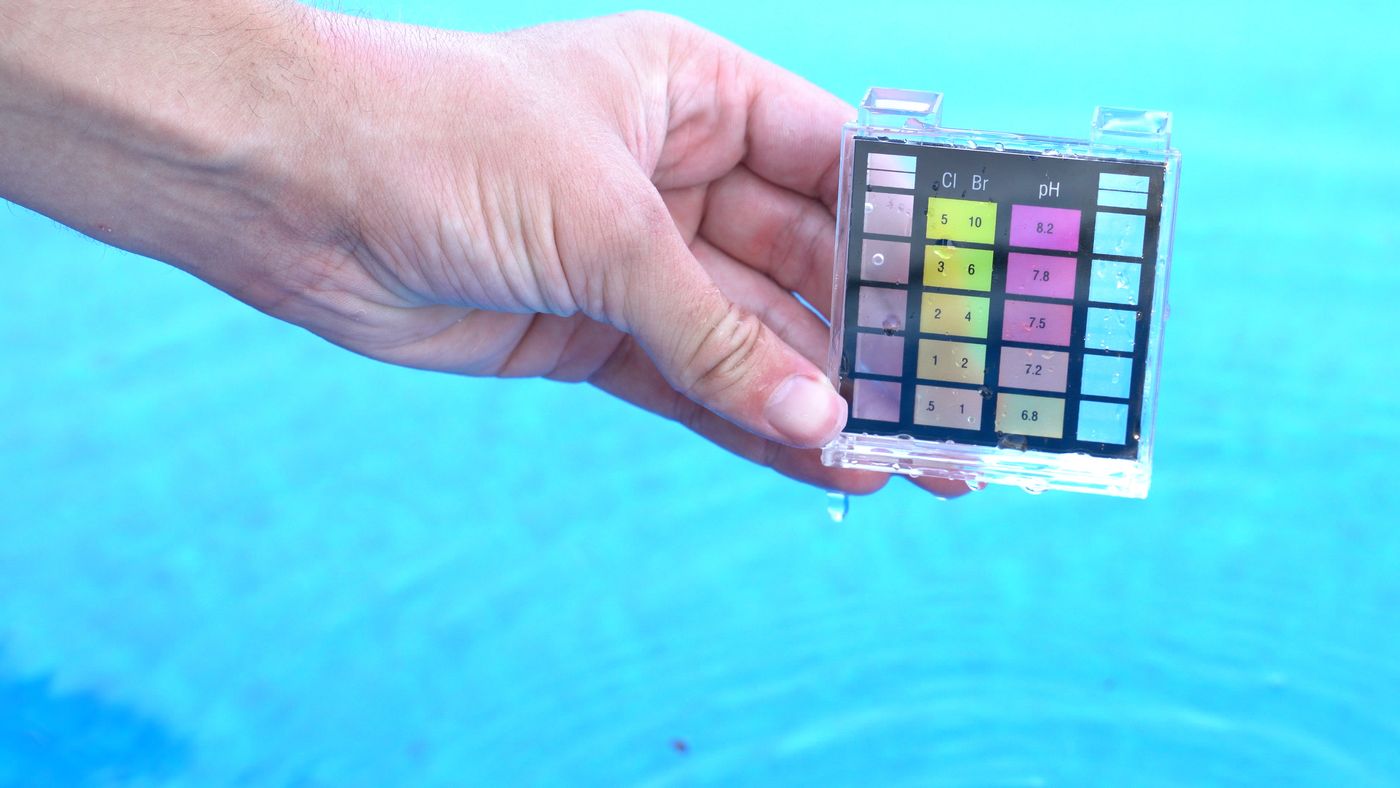
The five parameters that matter, in the order you should address them:
- Total Alkalinity — 80–120 ppm. This is your pH's anchor. Fix it first or nothing else stays put. Use our pool alkalinity calculator for exact baking soda or acid dosing.
- pH — 7.2–7.6. Directly controls how well your chlorine works. Our pool pH calculator gives you precise muriatic acid or soda ash amounts. Learn more about why pH matters and the ideal level.
- Calcium Hardness — 200–400 ppm. Protects your pool surfaces. Low calcium dissolves plaster; high calcium scales your equipment. Our pool calcium hardness calculator sets the target by surface type and works out the calcium chloride dose or the drain-and-refill percentage.
- Cyanuric Acid (CYA) — 30–50 ppm. Shields chlorine from UV destruction. Without it, outdoor pools burn through sanitizer in hours.
- Free Chlorine — 1–3 ppm (or 7.5% of your CYA level). Your last adjustment, not your first.
Use the calculator above to get dosing for each parameter. Enter your pool volume (don't know it? Use our pool volume calculator first), your current reading, and your target — the calculator handles the rest.
Once those readings are in range, read Pool LSI Explained to understand how they work together, then check the result with our pool LSI calculator. It combines pH, temperature, CYA-corrected alkalinity, calcium hardness, and TDS to show whether the water tends to etch calcium-based surfaces or form scale.
Pool Chemistry: What You Need Checklist
What you need
One serious test kit covers most residential pools; add acid, soda ash, baking soda, sanitizer, shock, and tablets as your routine needs them.

Taylor K-2005 Test Kit
What it is: A professional drop (titration) kit for chlorine, pH, alkalinity, calcium hardness, and cyanuric acid.
Why you need it: You can’t SLAM or balance blind—especially CYA, which handcuffs chlorine. This kit gives numbers you can trust, not strip guesswork.

Taylor K-2006 Test Kit
What it is: The FAS-DPD drop kit the pros carry—free and combined chlorine, pH, alkalinity, calcium hardness, and CYA, all from drops instead of guess-strips.
Why you need it: Use it every few weeks to confirm your smart monitor, and a couple times a season to check CYA—the one number the float doesn't track. Drops over strips, every time.
Pick your version: Taylor K-2006 (chlorine pools) or the K-2006 Salt (salt pools)—same kit, the salt version adds a salinity test.

Taylor K-2006 Salt Test Kit
What it is: The K-2006 line for salt pools—salt level plus the core tests you still need.
Why you need it: Wrong salinity means weak chlorine, cell alarms, and shortened cell life. Confirm salt and balance on paper, not vibes.
Pick your version: K-2006 Salt (salt pools) or the standard K-2006 (chlorine pools) if you don't need the salt test.

EASYTEST Pool Test Strips
What it is: Fast multi-parameter strips for quick checks.
Why you need it: Not as precise as a Taylor kit—use for mid-week spot checks (“did FC crash overnight?”) between full drop tests.

Champion Muriatic Acid
What it is: Dilute hydrochloric acid—standard for lowering pH and, with the right method, total alkalinity.
Why you need it: High pH destroys chlorine efficiency. Always follow the label; never mix acid with chlorine.

In The Swim pH Reducer (dry acid)
What it is: Sodium bisulfate (dry acid)—lowers pH (and can pull TA down when used in controlled steps).
Why you need it: Easier to handle and store than jugs of muriatic acid for small, precise corrections; still an acid—never mix with chlorine, follow the label, and retest after circulation.

In The Swim Soda Ash
What it is: Sodium carbonate—raises pH faster than baking soda with less alkalinity bump.
Why you need it: Use when pH is low and you need pH up without overshooting TA; check TA first.

Baking soda (alkalinity increaser)
What it is: Sodium bicarbonate—the same compound as pool-store “alkalinity increaser.” Arm & Hammer 15 lb is a practical mid-size bag; USP pure 50 lb bucket is the usual pick when you want the lowest $/lb; grocery or pool-store bags work if the label is plain bicarbonate.
Why you need it: It raises total alkalinity with a gentler pH bump than soda ash. Do not use soda ash here if you only need TA up.

USP Pure Baking Soda (50 lb bucket)
What it is: Sodium bicarbonate in a large sealed bucket—often labeled USP/food-grade pure bicarbonate.
Why you need it: When you correct TA often or run a big pool, the cost per pound usually beats small retail boxes. Same dosing rules as any pure bicarbonate: add in stages, circulate, and retest.

In The Swim Calcium Chloride (hardness increaser)
What it is: Calcium chloride—raises calcium hardness (CH) without messing with CYA the way some other products can.
Why you need it: Plaster and equipment are happier when CH sits in range; very soft fill water, new plaster, or winter dilution often needs a bump. Test CH before you dose.

Pool Mate 7 lb Cyanuric Acid Stabilizer
What it is: Granular CYA (chlorine stabilizer)—protects free chlorine from sunlight.
Why you need it: New fills, heavy rain dilution, or unstabilized liquid programs often land below ~30–50 ppm CYA; without it, the sun burns chlorine fast. Add slowly per label (skimmer or predissolve) and retest after circulation.

In The Swim Cyanuric Acid Stabilizer (25 lb)
What it is: Bulk granular stabilizer for larger pools or owners who prefer fewer restocks.
Why you need it: Same job as smaller bags—raise CYA into range so daily chlorine survives UV. Weigh or measure carefully; CYA is hard to remove without dilution.

Champion Pool Shock (4 Pack)
What it is: A case of liquid pool chlorine (sodium hypochlorite)—not cal-hypo granules. Confirm strength on the listing and jug label (often around 10–12.5%).
Why you need it: Same upside as other liquid shock: no CYA from the product, easy to pour with the pump running—useful to keep stocked for openings, algae pushes, storms, or parties.
How to use: Treat it like any liquid shock (pour with circulation; big doses still work best at dusk). Store cool and shaded; opened jugs lose strength over time—plan to use them within a few weeks.

In The Swim Cal-Hypo Pool Shock
What it is: Calcium hypochlorite granular shock—high chlorine, adds calcium, no CYA.
Why you need it: Strong oxidizer for recovery and breakpoint; pre-dissolve; watch calcium if hardness is already high.

In The Swim 3" Chlorine Tablets
What it is: Slow-dissolving sanitizer pucks (usually trichlor) for feeders/floaters—adds CYA over time.
Why you need it: Fine for steady maintenance when CYA isn’t already high; back off if CYA creeps up.
HTH 1" Chlorine Tablets
What it is: Smaller tablets for compact feeders or finer dosing control.
Why you need it: Same CYA rules as 3" tabs—pick the size that matches your chlorinator.
Clorox Pool Flocculant
What it is: Drops fine particles to the floor so you can vacuum to waste (per label).
Why you need it: When the filter won’t clear dead algae or ultra-fine dust, floc is often faster than clarifier alone.
Pool Chemistry Adjustment Order
The biggest mistake I see pool owners make is reaching for the chlorine jug before checking anything else. Here's why order matters and how skipping steps costs you money.
Why Alkalinity Comes First
Total alkalinity is a buffer — it absorbs small shifts in acidity and keeps your pH from swinging after every rainstorm, top-off, or chemical dose. When TA is below 80 ppm, adding a cup of acid can crash your pH from 7.8 to 6.8. When TA is above 140 ppm, your pH locks high and won't come down no matter how much acid you pour.
Fix TA with baking soda (to raise) or muriatic acid (to lower). Our pool alkalinity calculator gives you the exact amount. Wait 6 hours and retest before moving on.
Why pH Comes Second
Chlorine's killing power depends entirely on pH. At pH 7.2, about 63% of your free chlorine is in its active form (hypochlorous acid). At pH 8.0, only 21% is active. That means a pool at pH 8.0 needs roughly three times as much chlorine to achieve the same sanitation as one at 7.4.
If you add chlorine before fixing pH, you're burning through product for a fraction of the benefit. Use our pool pH calculator to dial in your muriatic acid or soda ash dose. For step-by-step instructions, see our guides on how to lower pool pH and how to raise pool pH.
Why Chlorine Comes Last
Once alkalinity and pH are stable, chlorine additions become predictable and efficient. You won't need to keep re-dosing because pH swings aren't eating your sanitizer.
For routine chlorine maintenance, the calculator above handles liquid chlorine, cal-hypo, dichlor, and trichlor dosing. For shock-level treatments (algae, post-party, opening), use our dedicated pool shock calculator which accounts for the higher target FC levels.
Pool Chemical Dosage Quick Reference
These rules of thumb are what I keep in my head when I'm testing and treating. They're based on per-10,000-gallon dosing and work for quick mental math when you're standing poolside.
Chlorine
| Chemical | Amount per 10,000 gal | Raises FC by |
|---|---|---|
| Liquid chlorine (12.5%) | 10 fl oz | 1 ppm |
| Cal-hypo granular (68%) | 2 oz | 1 ppm |
| Dichlor granular (56%) | 2.4 oz | 1 ppm |
| Trichlor tablets (90%) | 1.5 oz | 1 ppm (slow release) |
pH Adjustment
| Chemical | Amount per 10,000 gal | Effect |
|---|---|---|
| Muriatic acid (31.45%) | 6.4 fl oz | Lowers pH ~0.1 |
| Dry acid (sodium bisulfate) | 9.6 oz | Lowers pH ~0.1 |
| Soda ash (sodium carbonate) | 6 oz | Raises pH ~0.2 |
Need precise acid dosing for your specific situation? Our pool acid calculator accounts for acid concentration, pool volume, and whether you're targeting pH or alkalinity.
Alkalinity
| Chemical | Amount per 10,000 gal | Effect |
|---|---|---|
| Baking soda (sodium bicarbonate) | 1.5 lbs | Raises TA ~10 ppm |
| Muriatic acid (31.45%) | 26 fl oz | Lowers TA ~10 ppm |
Calcium Hardness and Stabilizer
| Chemical | Amount per 10,000 gal | Effect |
|---|---|---|
| Calcium chloride (77%) | 1.92 oz per 1 ppm | Raises CH |
| Cyanuric acid (stabilizer) | 13 oz | Raises CYA ~10 ppm |
There's no chemical that lowers calcium hardness or CYA. The only fix is a partial drain and refill with fresh water. The calcium hardness calculator estimates how much water to replace.
CYA and Chlorine — The Relationship Most Owners Get Wrong
This is the single most misunderstood aspect of pool chemistry, and getting it wrong leads to persistent algae, wasted chlorine, and frustration.
Cyanuric acid acts like sunscreen for your chlorine — it slows UV degradation so your sanitizer lasts longer in sunlight. Without CYA, outdoor pools lose 90% of their free chlorine within two hours of direct sun. With 30–50 ppm CYA, that loss drops to a manageable rate.
But CYA also locks up a portion of your chlorine, reducing how much is available to kill bacteria and algae. The higher your CYA, the more chlorine you need to maintain effective sanitation. The industry standard: keep free chlorine at a minimum of 7.5% of your CYA level.
| CYA Level | Minimum Free Chlorine | Status |
|---|---|---|
| 30 ppm | 2–3 ppm | Ideal range |
| 50 ppm | 4 ppm | Acceptable |
| 70 ppm | 5–6 ppm | Getting expensive to maintain |
| 100+ ppm | 8+ ppm | Chlorine lock territory — drain and dilute |
How CYA Creeps Up
If you use dichlor granules or trichlor tablets as your primary sanitizer, CYA increases with every dose. Trichlor tabs add about 6 ppm of CYA for every 1 ppm of chlorine per 10,000 gallons. Over a season, that adds up fast.
The fix: use liquid chlorine (sodium hypochlorite) or a salt chlorine generator for daily sanitation. Neither adds CYA. Reserve dichlor for occasional use or initial startup only.
If your CYA is already above 70 ppm, the only reliable solution is draining 30–50% of your pool water and refilling with fresh. No chemical breaks down CYA in a practical timeframe.
Seasonal Pool Chemistry Adjustments
Pool chemistry isn't static. Temperature, rain, bather load, and UV intensity all shift with the seasons, and your maintenance approach should shift with them.
Spring Opening
After months of dormancy, your water likely has:
- Zero free chlorine
- Elevated phosphates and organics from winter debris
- pH that's drifted high from CO2 off-gassing
Opening protocol: test everything, balance TA and pH first, then shock to 10–15 ppm FC. Brush the walls and floor, run the filter 24/7 for the first 48 hours, and vacuum out settled debris. This is also a good time to verify your pool volume with our pool volume calculator if you haven't already — accurate dosing starts here.
Peak Summer
Heavy use, intense UV, and warm water create the highest chlorine demand of the year. During summer:
- Test FC and pH 2–3 times per week
- Expect to add chlorine more frequently
- Watch CYA levels if using stabilized chlorine products
- Shock weekly or after any heavy use event
- Monitor your salt level monthly if running a saltwater system — use our salt calculator after rain or heavy top-offs
Fall Closing
Before covering your pool for winter:
- Balance all five parameters one final time
- Shock to 10 ppm FC
- Lower the water level below the skimmer
- Add winter algaecide per label directions
- Clean and store your pump and filter per manufacturer instructions
Year-Round Maintenance
No matter the season, the fundamentals stay the same: test regularly, adjust in the right order, and use the calculators on this site to remove the guesswork. For a complete walkthrough of routine pool care, see our weekly pool maintenance guide.
Pool Chemistry FAQ
What's the most important pool chemical to test?
Free chlorine and pH. They change the fastest and have the biggest impact on water quality and swimmer comfort. Test both at least twice a week during swim season.
Can I add all my chemicals at the same time?
No. Add one chemical at a time with at least 30 minutes of pump circulation between additions. Adding acid and chlorine simultaneously can produce toxic chlorine gas. Adding calcium chloride and soda ash together can cause immediate cloudiness.
How long should I run my pump after adding chemicals?
At least one full turnover cycle — typically 8 hours for most residential pools. This ensures the chemical disperses evenly. If you're not sure about your pump's turnover rate, our pump sizing calculator can help.
Why does my pool keep turning green even though I add chlorine?
Three common causes: your CYA is too high (chlorine lock), your pH is too high (chlorine loses effectiveness above 7.6), or you're under-dosing because your pool volume estimate is off. Check all three. If CYA is above 70 ppm, drain and refill. If pH is high, use our pH calculator to bring it down before adding more chlorine. Already green? Follow our guide on how to clean a green pool.
Is a saltwater pool easier to maintain chemically?
Salt pools still need balanced alkalinity, pH, calcium, and CYA. The main advantage is consistent chlorine production from the salt cell, which eliminates daily chlorine dosing. The main disadvantage is pH drift — salt cells produce sodium hydroxide as a byproduct, so you'll likely add muriatic acid weekly to keep pH in range.
How often should I do a full water test?
Do a comprehensive test (all five parameters) at least once a week. Test FC and pH 2–3 times per week during heavy use. After any major event — storms, parties, equipment changes — test everything before making adjustments.
When should I drain and refill my pool?
When CYA exceeds 70–80 ppm, calcium hardness exceeds 500 ppm, or total dissolved solids (TDS) make the water feel stale despite balanced chemistry. A partial drain (30–50%) and refill resets these parameters without the cost of a full drain. Most pools benefit from a partial water replacement every 3–5 years.
More Pool Calculators
All Calculators Chemistry Calculator Chemical Calculator Chlorine Calculator Volume Calculator Shock Calculator SLAM Calculator pH Calculator Acid Calculator Alkalinity Calculator Calcium Hardness Calculator LSI Calculator Salt Calculator CYA Calculator Borate Calculator Dilution Calculator Pump Size Calculator Pump Runtime Calculator Pump Schedule Calculator Filter Size Calculator Heater Calculator Salt Cell Calculator Fill Time Calculator Evaporation Calculator Winterizing Calculator Hot Tub Calculator Pool Cost Calculator Loan Calculator Maintenance Cost Calculator Pool Deck Calculator Resurfacing Calculator
More from The Pool Nerd
Keep Reading

Disclaimer: This information is for educational purposes only. Handling pool chemicals involves significant risks, and this calculator cannot cover every product, pool, or possible hazard. Always follow the manufacturer’s label, safety data sheet, and applicable requirements. Seek qualified help whenever you are uncertain.