
Pool Acid Calculator
Calculate exactly how much muriatic acid or dry acid your pool needs
Use the calculatorHow to use
Pool Acid Dosage Calculator
Enter your pool details below for precise acid dosing recommendations.
What do you need to lower?
Average residential pool: 10,000–20,000 gallons
Check your bottle's concentration — most hardware store brands are 31.45%
Test with strips or digital meter
Ideal range: 7.2–7.6
Test with a liquid test kit for accuracy
Ideal range: 80–120 ppm
What you need next
Grab these before you dose
The dosing math above assumes these exact products. Test first, then pour slowly with the pump running.


Products are picked independently. The Pool Nerd may earn a commission on orders placed through these links, at no extra cost to you. Learn more
Muriatic Acid & Dry Acid: What You Need
What you need
The calculator tells you how much—these are the products that pour it. Confirm pH and TA with a drop kit first, then dose with liquid acid (cheapest) or dry acid (easiest to handle).

Taylor K-2005 Test Kit
What it is: A professional drop (titration) kit for chlorine, pH, alkalinity, calcium hardness, and cyanuric acid.
Why you need it: You can’t SLAM or balance blind—especially CYA, which handcuffs chlorine. This kit gives numbers you can trust, not strip guesswork.

Champion Muriatic Acid
What it is: Dilute hydrochloric acid—standard for lowering pH and, with the right method, total alkalinity.
Why you need it: High pH destroys chlorine efficiency. Always follow the label; never mix acid with chlorine.

In The Swim pH Reducer (dry acid)
What it is: Sodium bisulfate (dry acid)—lowers pH (and can pull TA down when used in controlled steps).
Why you need it: Easier to handle and store than jugs of muriatic acid for small, precise corrections; still an acid—never mix with chlorine, follow the label, and retest after circulation.
How Much Muriatic Acid to Add to Your Pool
The amount of muriatic acid your pool needs depends on three things: your pool's volume in gallons, how far your pH or total alkalinity is above the target, and the concentration of acid you're using. Getting this calculation wrong is one of the fastest ways to damage pool surfaces, corrode equipment, or create unsafe swimming conditions — so precision matters here.
I've personally overcorrected with acid more times than I'd like to admit early on, and every time it happened, the fix was more expensive than just being patient with the math. The calculator above exists because I got tired of doing the long-hand version on my phone at the equipment pad.
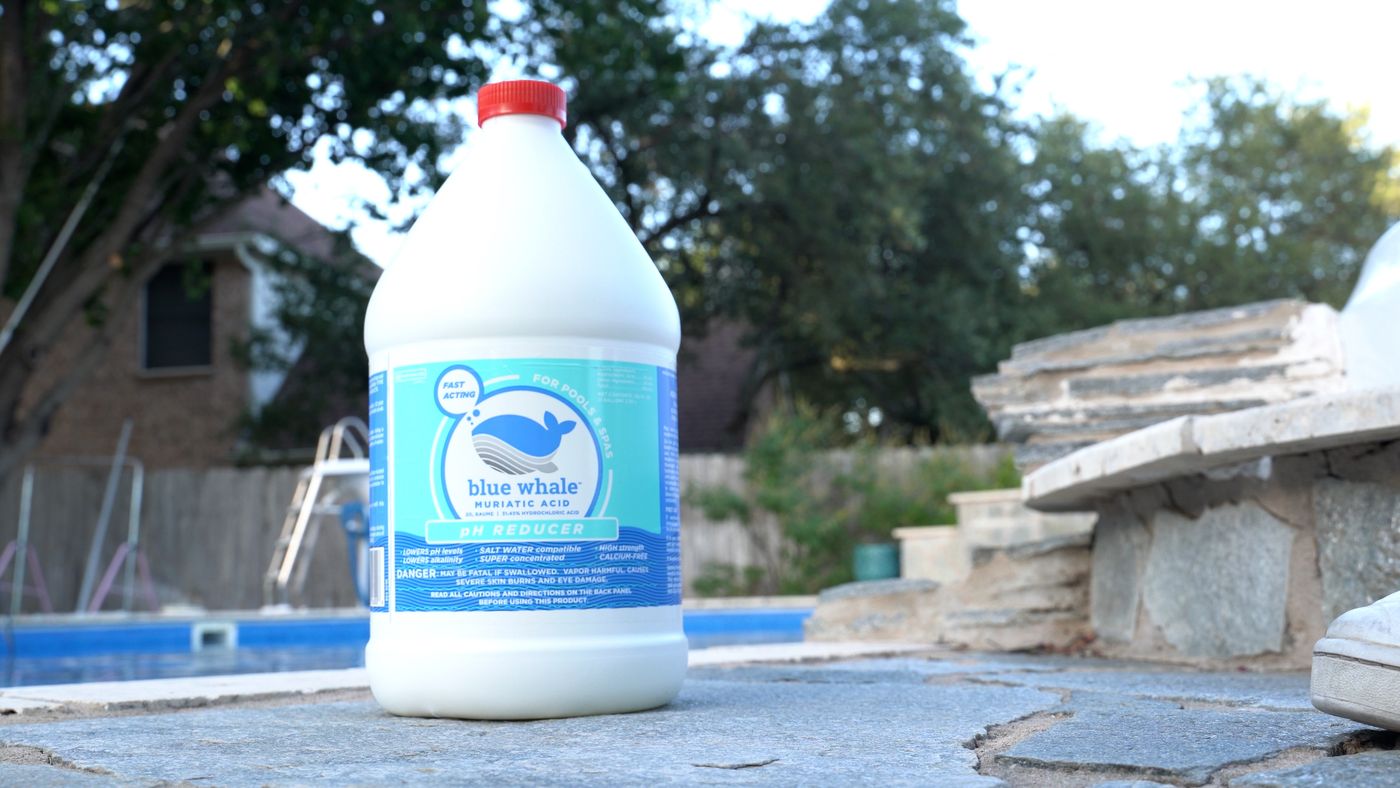
Quick Formula for Muriatic Acid (31.45% HCl)
For every 10,000 gallons of pool water:
- 6.4 fl oz lowers pH by approximately 0.1 points
- 25.6 fl oz (0.8 quarts) lowers total alkalinity by approximately 10 ppm
These figures assume standard 31.45% hydrochloric acid, which is the most common concentration sold at hardware stores and pool supply shops. If you're using a lower concentration (20% or 14.5% low-fume), you'll need proportionally more — our calculator above handles the math for all three concentrations.
If your goal is specifically to bring pH into the 7.2–7.6 range, our dedicated pH calculator walks through that process with additional context on how pH interacts with chlorine efficiency.
Quick Formula for Dry Acid (Sodium Bisulfate)
For every 10,000 gallons of pool water:
- 9.6 oz by weight lowers pH by approximately 0.1 points
- 25.6 oz by weight lowers total alkalinity by approximately 10 ppm
Why Pool Volume Matters So Much
A 10,000-gallon pool and a 20,000-gallon pool with the same pH of 7.8 need completely different acid doses. Double the water means double the acid. If you don't know your pool's exact volume, use our pool volume calculator first — guessing can lead to overcorrection that's harder to fix than the original problem.
This is one of those things where being off by even 5,000 gallons changes your dose enough to matter. I've seen pool owners add 30% too much acid because they assumed their pool was bigger than it actually was, and recovering from a pH crash takes longer than just measuring correctly up front.
Muriatic Acid vs Dry Acid: Which Should You Use?
Both muriatic acid and dry acid (sodium bisulfate) lower pH and total alkalinity, but they work differently and each has tradeoffs worth understanding before you pour anything into your pool.
Muriatic Acid (Hydrochloric Acid)
Muriatic acid is the go-to choice for most pool professionals and experienced pool owners. It's a liquid, it works fast, and it costs significantly less per treatment than dry acid.
Pros:
- Lowest cost per dose — roughly 50–70% cheaper than dry acid
- Works immediately on contact with pool water
- Available at every hardware store and pool supply shop
- Won't add unwanted byproducts to your water
- Preferred by pool professionals for its precision
Cons:
- Produces strong fumes that irritate eyes and lungs
- Can stain concrete or stone if spilled
- Requires careful handling and storage
- Available in different concentrations that affect dosing
Common concentrations:
| Label | HCl % | Availability | Best For |
|---|---|---|---|
| Full-strength | 31.45% | Hardware stores, pool supply | Experienced owners, large pools |
| Medium-strength | 20% | Pool supply, some hardware | General residential use |
| Low-fume | 14.5% | Pool supply | Small pools, sensitive users |
Dry Acid (Sodium Bisulfate)
Dry acid comes in granular form and is much easier to handle safely. If you're not comfortable working with liquid acid, dry acid is a solid alternative — literally.
Pros:
- No dangerous fumes
- Easy to measure and pour
- Safer to store — no spill risk
- Better for small adjustments
Cons:
- Costs 2–3x more per treatment than muriatic acid
- Dissolves more slowly, especially in cold water
- Adds sulfate to pool water, which can contribute to scaling over time with repeated use
- Slightly less precise for large corrections
The Bottom Line
Use muriatic acid if you're comfortable handling it and want the most cost-effective, fastest-acting option. Use dry acid if safety and ease of handling are your top priorities, or if you're making small adjustments.
Muriatic Acid Dosage Chart
These charts give you a quick reference for the most common pool sizes and pH correction scenarios. All values assume 31.45% muriatic acid. For 20% acid, multiply by 1.57. For 14.5% low-fume acid, multiply by 2.17.
Muriatic Acid to Lower pH (31.45% HCl)
| Pool Volume | pH 7.8 → 7.4 | pH 8.0 → 7.4 | pH 8.2 → 7.4 |
|---|---|---|---|
| 5,000 gal | 12.8 fl oz | 19.2 fl oz | 25.6 fl oz |
| 10,000 gal | 25.6 fl oz | 38.4 fl oz | 51.2 fl oz |
| 15,000 gal | 38.4 fl oz | 57.6 fl oz | 76.8 fl oz |
| 20,000 gal | 51.2 fl oz | 76.8 fl oz | 102.4 fl oz |
| 25,000 gal | 64.0 fl oz | 96.0 fl oz | 128.0 fl oz |
| 30,000 gal | 76.8 fl oz | 115.2 fl oz | 153.6 fl oz |
Muriatic Acid to Lower Total Alkalinity (31.45% HCl)
| Pool Volume | 120 → 80 ppm | 150 → 80 ppm | 180 → 80 ppm |
|---|---|---|---|
| 5,000 gal | 51.2 fl oz | 89.6 fl oz | 128.0 fl oz |
| 10,000 gal | 102.4 fl oz | 179.2 fl oz | 256.0 fl oz |
| 15,000 gal | 153.6 fl oz | 268.8 fl oz | 384.0 fl oz |
| 20,000 gal | 204.8 fl oz | 358.4 fl oz | 512.0 fl oz |
| 25,000 gal | 256.0 fl oz | 448.0 fl oz | 640.0 fl oz |
| 30,000 gal | 307.2 fl oz | 537.6 fl oz | 768.0 fl oz |
Dry Acid (Sodium Bisulfate) to Lower pH
| Pool Volume | pH 7.8 → 7.4 | pH 8.0 → 7.4 | pH 8.2 → 7.4 |
|---|---|---|---|
| 5,000 gal | 4.8 oz | 7.2 oz | 9.6 oz |
| 10,000 gal | 9.6 oz | 14.4 oz | 19.2 oz |
| 15,000 gal | 14.4 oz | 21.6 oz | 28.8 oz |
| 20,000 gal | 19.2 oz | 28.8 oz | 38.4 oz |
| 25,000 gal | 24.0 oz | 36.0 oz | 48.0 oz |
| 30,000 gal | 28.8 oz | 43.2 oz | 57.6 oz |
All values are starting-point estimates. Pool chemistry variables like temperature, CYA level, and calcium hardness affect real-world results. Always retest 4–6 hours after treatment.
How to Add Muriatic Acid to a Pool
Adding acid to your pool isn't complicated, but doing it wrong can etch plaster, damage vinyl, or create dangerous chlorine gas. Here's the step-by-step process that pool professionals use.
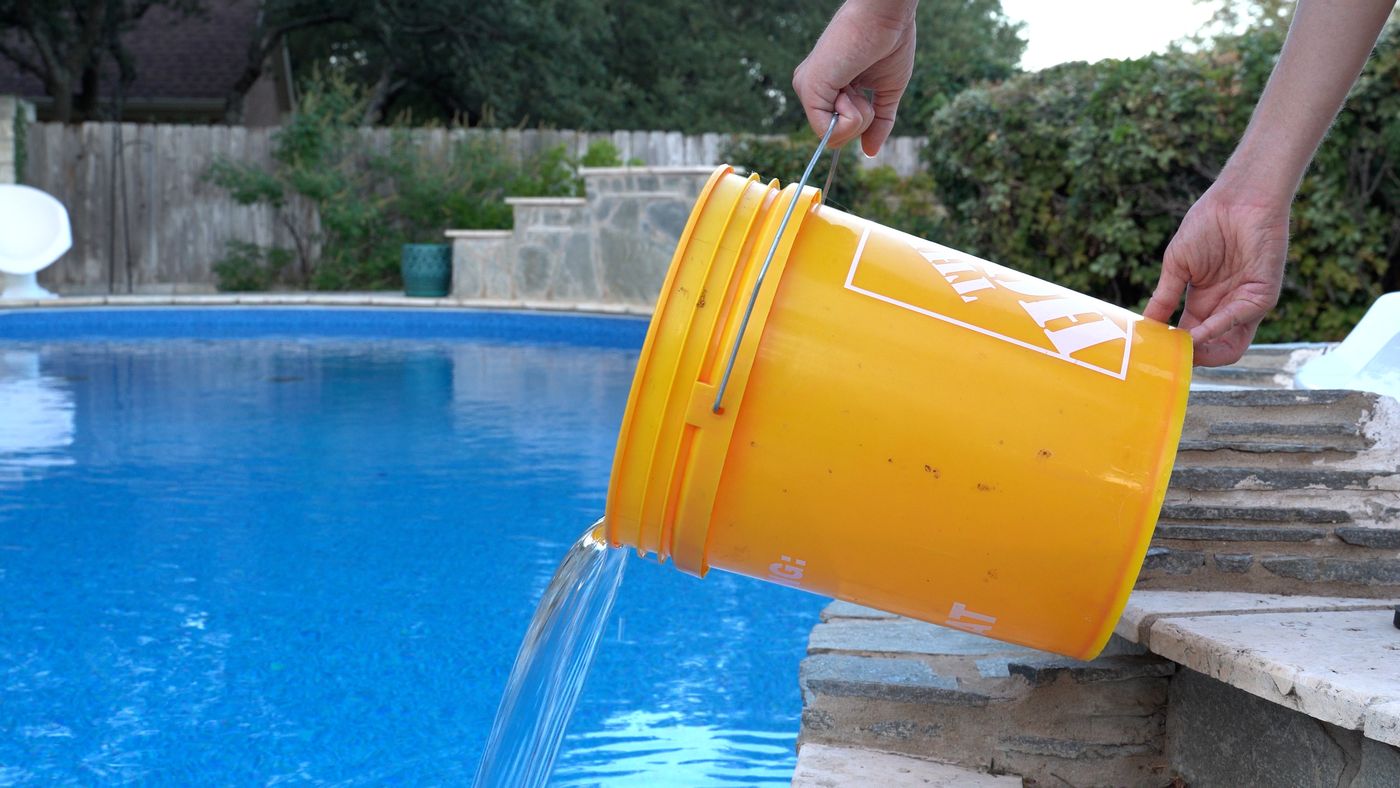
Step-by-Step: Adding Muriatic Acid
- Test your water first. Use a reliable test kit — liquid reagent kits (Taylor K-2006 or the K-2006 Salt for salt pools) are more accurate than strips for pH and alkalinity
- Turn on the pool pump. Your pump and filter system should be running to circulate the acid evenly throughout the pool
- Calculate your dose using the calculator above or the dosage charts
- Gear up. Wear chemical-resistant gloves, safety glasses, and clothes you don't care about. Work upwind of the pool
- Pour slowly at one return jet. Hold the bottle close to the water surface and pour in a slow, steady stream directly over a return jet. This disperses the acid quickly and minimizes fumes
- Never dump the full dose in one spot. For larger doses, walk around the pool's perimeter and pour along the way
- Wait and retest. Let the pump run for at least 30 minutes, but wait 4–6 hours for the most accurate retest reading
- Adjust if needed. If pH is still high, add another small dose. It's always safer to undershoot and add more than to overcorrect
Step-by-Step: Adding Dry Acid
- Test your water with a reliable kit
- Turn on the pump
- Calculate your dose
- Pre-dissolve the granules in a bucket of pool water — this prevents undissolved granules from settling on pool surfaces and causing bleach spots
- Pour the solution over the deep end of the pool
- Wait 4–6 hours and retest
What NOT to Do
- Never add acid to a pool with swimmers in it
- Never mix muriatic acid with chlorine — this produces toxic chlorine gas
- Never pour acid into a skimmer — concentrated acid will corrode your pump, heater, and filter
- Never add acid to still water — always run the pump first
Lowering Total Alkalinity With Acid
Total alkalinity (TA) acts as a pH buffer in your pool water. When it's too high, your pH will constantly drift upward no matter how much acid you add. The trick is that lowering TA also lowers pH — so you need a specific technique to bring alkalinity down without crashing your pH.
The Acid-and-Aerate Method
This is the standard technique pool professionals use to reduce TA independently of pH:
- Add your calculated acid dose in a single concentrated area — the deep end is ideal. Don't walk the perimeter for TA corrections. The localized acid concentration is more effective at reducing alkalinity
- Let the pump circulate for 1–2 hours
- Aerate the pool aggressively. Turn on water features, point return jets upward, use a fountain attachment, or even aim a garden hose spray into the pool. Aeration drives CO2 out of the water, which raises pH back up without raising TA
- Wait 24 hours and retest both pH and TA
- Repeat if needed. Lower TA by no more than 10–20 ppm per treatment cycle
Why Aeration Works
When you add acid, both pH and TA drop. But aeration selectively raises pH by off-gassing dissolved CO2, while leaving alkalinity unchanged. Over several cycles of acid addition followed by aeration, you can bring TA down to your target range while keeping pH stable.
Target Alkalinity Ranges
| Pool Type | Ideal TA Range |
|---|---|
| Plaster/gunite | 80–120 ppm |
| Vinyl liner | 80–120 ppm |
| Fiberglass | 60–80 ppm |
| Saltwater (SWG) | 60–80 ppm |
Fiberglass and saltwater pools run best with lower alkalinity because their surfaces and salt cells perform better when pH is more stable — and lower TA means less pH drift. If you're running a saltwater system, keeping alkalinity in check also extends the life of your salt cell — see our pool salt calculator for maintaining proper salt levels alongside your acid dosing.
For a deeper look at the relationship between alkalinity and pH and the best strategies for adjusting each independently, check out our pool alkalinity calculator which covers the acid-and-aerate technique in more detail.
Pool Acid Safety Guide
Muriatic acid is the most dangerous chemical most pool owners handle regularly. It's hydrochloric acid — the same acid found in your stomach, just much more concentrated. Treat it with the respect it deserves and you'll never have an issue.
Required Safety Gear
- Chemical-resistant gloves (nitrile or neoprene — not latex)
- Safety glasses or goggles (not sunglasses)
- Long sleeves and pants you're willing to sacrifice
- Closed-toe shoes — never handle acid in sandals
Muriatic Acid Storage
- Store in the original container with the cap tightly sealed
- Keep in a cool, dry, well-ventilated area away from direct sunlight
- Never store near chlorine, oxidizers, or metals — acid fumes corrode everything nearby
- Store on a concrete or plastic surface — never on metal shelving
- Keep away from children and pets at all times
Emergency Response
- Skin contact: Flush with large amounts of water for 15+ minutes. Remove contaminated clothing
- Eye contact: Flush eyes with water for 15–20 minutes. Seek medical attention immediately
- Inhalation: Move to fresh air. If breathing is difficult, seek medical attention
- Spill on deck: Neutralize with baking soda (sodium bicarbonate), then flush with water
The Golden Rule
Add acid to water — never add water to acid. Adding water to concentrated acid causes a violent exothermic reaction that can splash hot acid onto your skin and create a burst of toxic fumes. Always pour acid into the pool or into a bucket of water, not the other way around.
Common Pool Acid Mistakes
These are the acid-related mistakes I run into most often, both from my own experience and from troubleshooting other owners' water chemistry. Avoid them and you'll save yourself money, frustration, and potentially expensive surface repairs.
1. Guessing Your Pool Volume
The single most common dosing error. A pool that looks like 15,000 gallons could easily be 12,000 or 18,000. That margin of error means over- or under-dosing by 20–30%. If you haven't measured your pool's exact dimensions, use our pool volume calculator before reaching for the acid bottle.
2. Adding Too Much Acid at Once
More acid doesn't mean faster results — it means overcorrection. Dropping pH below 7.0 can etch plaster, corrode metal fixtures, and make chlorine hyper-aggressive. If you need a large correction, split it into multiple smaller doses spaced 4–6 hours apart.
3. Pouring Acid Into the Skimmer
This concentrates undiluted acid directly on your pump impeller, heater core, filter elements, and O-rings. It's the fastest way to destroy expensive pool equipment. Always add acid directly to the pool water.
4. Not Running the Pump
Adding acid to still water creates localized "acid pockets" that can etch your pool finish where the acid settles. The pump needs to be running to distribute acid evenly throughout the water.
5. Retesting Too Soon
Water chemistry takes time to stabilize after acid addition. Testing 10 minutes later will give you a false reading that makes it look like you didn't add enough. Wait at least 30 minutes for a rough check and 4–6 hours for a truly accurate reading.
6. Ignoring Total Alkalinity
pH and TA are connected. If your TA is high (above 120 ppm), your pH will continuously bounce back up after acid treatment. You'll find yourself adding acid every few days in an endless cycle. Fix TA first using the acid-and-aerate method, and pH will become much easier to manage.
7. Mixing Acid and Chlorine
Never add muriatic acid to a pool that was just heavily chlorinated, and never store them near each other. The combination produces toxic chlorine gas, which is dangerous even in small amounts. Wait at least 30 minutes between adding chlorine and acid, and always store them in separate locations with good ventilation between them.
Accurate dosing is the difference between crystal-clear water and a chemical rollercoaster. Use the calculator above, follow the safety guidelines, and always err on the side of adding less acid than you think you need — you can always add more, but you can't take it back out.
For a complete walkthrough of all pool chemistry parameters and how they interact, see our pool chemical calculator. If you're dealing with a broader water balance issue rather than just a pH or TA correction, that's a better starting point. And for the ongoing routine that keeps your water stable week to week, our weekly pool maintenance guide covers the full testing and treatment schedule.
More Pool Calculators
All Calculators Chemistry Calculator Chemical Calculator Chlorine Calculator Volume Calculator Shock Calculator SLAM Calculator pH Calculator Acid Calculator Alkalinity Calculator Calcium Hardness Calculator LSI Calculator Salt Calculator CYA Calculator Borate Calculator Dilution Calculator Pump Size Calculator Pump Runtime Calculator Pump Schedule Calculator Filter Size Calculator Heater Calculator Salt Cell Calculator Fill Time Calculator Evaporation Calculator Winterizing Calculator Hot Tub Calculator Pool Cost Calculator Loan Calculator Maintenance Cost Calculator Pool Deck Calculator Resurfacing Calculator
More from The Pool Nerd
Keep Reading


Disclaimer: This information is for educational purposes only. Handling pool chemicals involves significant risks, and this calculator cannot cover every product, pool, or possible hazard. Always follow the manufacturer’s label, safety data sheet, and applicable requirements. Seek qualified help whenever you are uncertain.