

Matched to your result Cal-hypo granules · 68%, strongest value per dose In The Swim Cal-Hypo Pool Shock
Buy Now How to use
Pool Shock Calculator
Raises free chlorine to ~10 ppm for regular sanitation.
Don't know? Use our pool volume calculator.
Amount of Shock Needed
--
What you need next
Shock, test, and fix pH first
The first card swaps to the shock type you chose above. Shock works best with pH at 7.2–7.6, so test and correct it before you pour.


Products are picked independently. The Pool Nerd may earn a commission on orders placed through these links, at no extra cost to you. Learn more
Best Pool Shock: What You Need Checklist
What you need
Test first, fix pH if needed, then pick shock by situation—liquid, cal-hypo, dichlor, or MPS—plus the gear that cuts how much shock you pour.

Taylor K-2005 Test Kit
What it is: A professional drop (titration) kit for chlorine, pH, alkalinity, calcium hardness, and cyanuric acid.
Why you need it: You can’t SLAM or balance blind—especially CYA, which handcuffs chlorine. This kit gives numbers you can trust, not strip guesswork.

Ondilo ICO Pool Water Monitor
What it is: A floating smart monitor that samples pH, ORP (sanitizer effectiveness), and temperature on a schedule and sends trends to your phone.
Why you need it: You still need a real drop kit for parameters the ICO doesn’t replace (like TA and CYA), but hourly ORP/pH catches drift and dosing mistakes long before weekly strip checks do.

SpectraLight UV
What it is: Inline UV-C on the return line—knocks down pathogens and helps with chloramines as water passes the lamp.
Why you need it: Cleaner water with less organic load means you reach for shock less often while staying comfortable. Read the full SpectraLight review for sizing and install notes.

Dolphin Premier
What it is: A corded robotic cleaner with dual scrubbing brushes and strong filtration—built to pull debris and biofilm off surfaces so your sanitizer is not fighting mulch and leaves first.
Why you need it: Shock oxidizes what is in the water—leaves, pollen, and biofilm burn sanitizer too. A strong robot pulls debris off surfaces and into the filter so your chlorine works on algae and organics, not mulch. See the Dolphin Premier review for why it is our test-pool scrubber of choice.

Champion Muriatic Acid
What it is: Dilute hydrochloric acid—standard for lowering pH and, with the right method, total alkalinity.
Why you need it: High pH destroys chlorine efficiency. Always follow the label; never mix acid with chlorine.

In The Swim pH Reducer (dry acid)
What it is: Sodium bisulfate (dry acid)—lowers pH (and can pull TA down when used in controlled steps).
Why you need it: Easier to handle and store than jugs of muriatic acid for small, precise corrections; still an acid—never mix with chlorine, follow the label, and retest after circulation.

Champion Pool Shock (4 Pack)
What it is: A case of liquid pool chlorine (sodium hypochlorite)—not cal-hypo granules. Confirm strength on the listing and jug label (often around 10–12.5%).
Why you need it: Same upside as other liquid shock: no CYA from the product, easy to pour with the pump running—useful to keep stocked for openings, algae pushes, storms, or parties.
How to use: Treat it like any liquid shock (pour with circulation; big doses still work best at dusk). Store cool and shaded; opened jugs lose strength over time—plan to use them within a few weeks.

In The Swim Cal-Hypo Pool Shock
What it is: Calcium hypochlorite granular shock—high chlorine, adds calcium, no CYA.
Why you need it: Strong oxidizer for recovery and breakpoint; pre-dissolve; watch calcium if hardness is already high.

HTH Cal Hypo Pool Shock
What it is: Cal-hypo granular shock—same family as other cal-hypo products.
Why you need it: Alternative brand/size; compare % available chlorine and price per pound on the label.

Sodium dichlor (stabilized granular)
What it is: Stabilized chlorine shock—each dose adds CYA along with chlorine.
Why you might use it: Spas, very low-CYA pools, or occasional small doses when you want granules that dissolve fast.
Why to limit it: On a tab-fed or already-stabilized pool, dichlor stacks CYA fast—often you should prefer liquid or cal-hypo for shock instead.

Clorox Pool&Spa Shock XtraBlue
What it is: Fast-dissolving dichlor-based shock with added algaecide—kills bacteria and algae, and the label rates it swim-ready in about 15 minutes.
Why you need it: A convenient grab-a-bag option for quick mid-week boosts. Because it's stabilized (dichlor), every dose adds CYA—use it in moderation and watch your stabilizer number, especially on a tablet-fed pool.
When To Shock Your Pool
Knowing when to shock is just as important as knowing how much. Shocking at the wrong time wastes chemicals and money, while skipping it when your pool actually needs it can lead to algae blooms, cloudy water, and unhappy swimmers. Here's exactly when your pool is telling you it's time for a shock treatment.
For a full step-by-step walkthrough of the shocking process with photos, check out our guide on how to shock a swimming pool. The calculator on this page gives you the dosing math — that guide covers the hands-on technique.
Routine Weekly Maintenance
Every pool benefits from a weekly shock treatment during swim season. Even if the water looks crystal clear, organic contaminants like sweat, sunscreen, and body oils build up over time and consume your free chlorine. A weekly shock oxidizes these combined chloramines and restores your sanitizer's killing power. The best time to shock is at dusk — UV light from the sun breaks down unstabilized chlorine quickly, so evening application gives the chemicals a full night to work.
After Heavy Swimmer Load
Threw a pool party over the weekend? Every swimmer introduces nitrogen-based compounds (sweat, urine, cosmetics) that react with free chlorine to form chloramines. If you notice that strong "chlorine smell" after a gathering, that's actually chloramines — a sign your pool desperately needs a shock. A good rule of thumb: shock after any event with more than double your usual swimmer count.
Following a Rainstorm
Heavy rain dilutes your chlorine levels and introduces phosphates, nitrates, dust, and organic debris from the air and surrounding landscape. After any significant rainfall, test your water and plan on a shock treatment. The combination of lowered sanitizer and introduced contaminants creates a perfect storm for algae growth if left untreated.
Visible Algae Growth
Green, yellow, or black spots appearing on your pool walls and floor mean algae has already taken hold. Our guide on how to clean a green pool covers the full recovery process. The severity determines how aggressively you need to shock:
- Light green tint: Early algae — target 20 ppm free chlorine
- Dark green or swamp-like: Moderate algae — target 30 ppm free chlorine
- Black algae spots: The toughest variety — brush affected areas first, then shock to 30 ppm and consider an algaecide follow-up
Pool Opening in Spring
After months of sitting dormant over winter, your pool water has accumulated organic matter, lost its residual chlorine, and potentially developed early algae. A strong opening shock (target 15 ppm) combined with thorough brushing and vacuuming sets the foundation for a clean swim season ahead.
Persistent Chloramine Odor
If your pool smells strongly of chlorine, the combined chlorine (CC) level is likely above 0.5 ppm. The fix is counterintuitive — you need to add more chlorine. Breakpoint chlorination requires raising your free chlorine to roughly 10× the combined chlorine reading, which destroys the chloramines causing the odor.
Types of Pool Shock Explained
Not all pool shock is created equal. Each type has distinct strengths, trade-offs, and ideal use cases. Choosing the right one depends on your pool surface, water chemistry, and the problem you're solving.
Calcium Hypochlorite (Cal-Hypo)
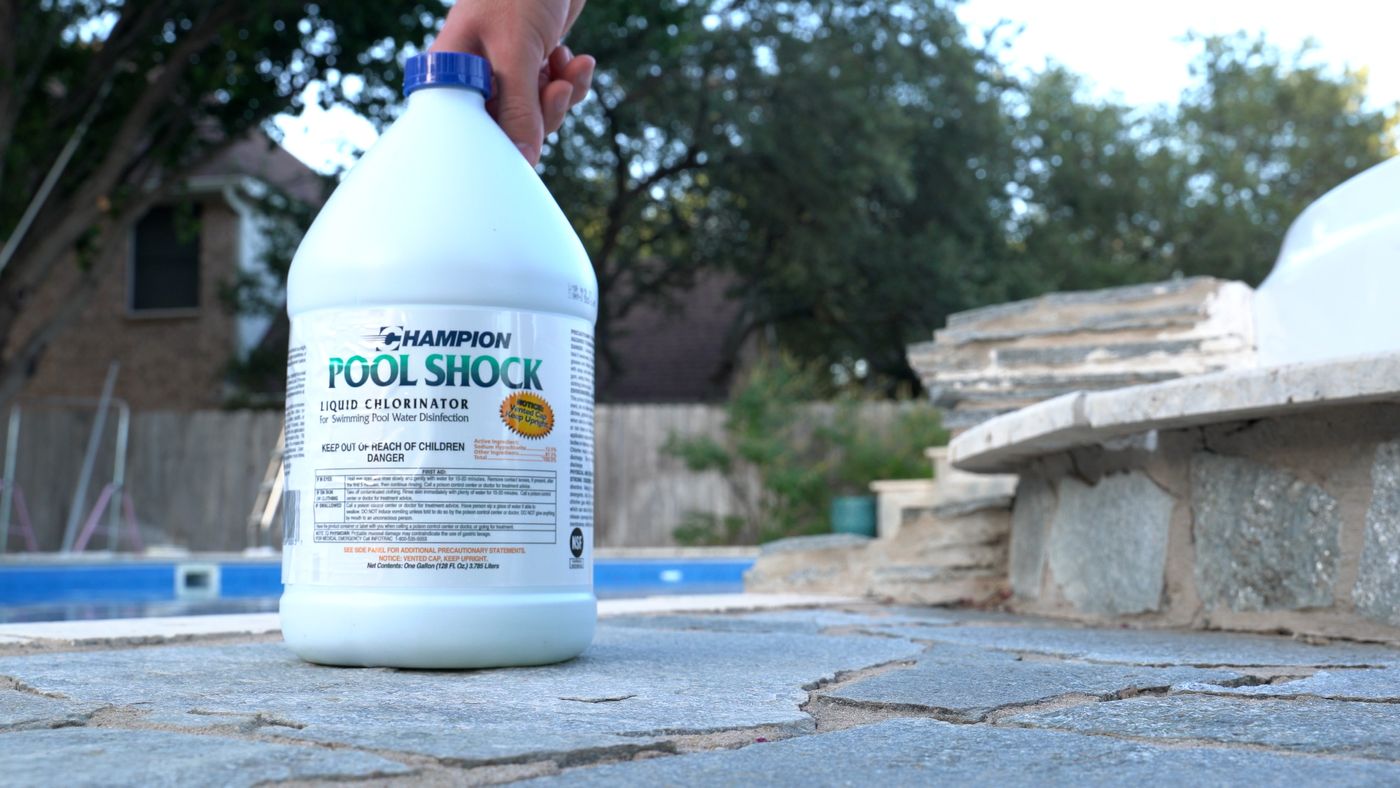
Cal-hypo is the workhorse of pool shock treatments and the most popular choice for good reason. At 65–73% available chlorine, it packs the strongest sanitizing punch per dollar of any granular shock.
Best for: Routine shocking, algae treatment, pool openings
Considerations:
- Raises calcium hardness slightly with each use — important if you already have hard water
- Must be pre-dissolved in a bucket of water before adding to vinyl-liner pools to prevent bleaching
- Unstabilized, so apply at dusk for maximum effectiveness
- Cannot be used with an automatic chlorinator — Cal-hypo and trichlor combined can cause a fire or explosion
Liquid Chlorine (Sodium Hypochlorite)
Liquid chlorine at 10–12.5% concentration is essentially industrial-strength bleach. It's the go-to for professionals and anyone who wants fast-acting, residue-free shock treatment.
Best for: Quick chlorine boost, salt water pools, vinyl-liner pools (no dissolving needed)
Considerations:
- Adds no calcium hardness or cyanuric acid to the water
- Slightly raises pH, so you may need to adjust afterward
- Has a limited shelf life — potency drops over time, especially in heat
- Heavier to handle since it's a liquid (about 10 lbs per gallon)
Dichlor (Sodium Dichloro-s-Triazinetrione)
Dichlor is a stabilized shock, meaning it contains cyanuric acid (CYA). This makes it convenient because the chlorine it adds is protected from UV degradation right out of the bag.
Best for: Small pools, hot tubs, situations where CYA is low
Considerations:
- Each use raises your CYA level — overuse leads to "chlorine lock" where sanitizer becomes ineffective
- More expensive per ppm of chlorine than cal-hypo or liquid
- Dissolves quickly and won't bleach surfaces, making it safe for all pool types
- At 56% available chlorine, it's less potent than cal-hypo but still effective for regular shocking
Non-Chlorine Shock (Potassium Monopersulfate)
MPS or non-chlorine shock is an oxidizer, not a sanitizer. It breaks down organic contaminants and chloramines without adding any chlorine to the water.
Best for: Routine oxidation in bromine pools, mid-week "tune-ups," swim-ready shocking
Considerations:
- Cannot kill algae — it has no sanitizing ability
- You can swim within 15 minutes of application
- Won't affect chlorine, CYA, or calcium levels
- Can cause false-high combined chlorine readings on DPD test kits for 24 hours after use
Pool Shock Dosage Chart
The amount of shock your pool needs depends on three things: pool volume, current free chlorine level, and target free chlorine level. The calculator above handles this math for you, but the charts below serve as a quick reference when you're out by the pool.
Calcium Hypochlorite (68%) Dosage
| Pool Size (gallons) | Routine Shock (10 ppm) | Algae Treatment (20 ppm) | Heavy Algae (30 ppm) |
|---|---|---|---|
| 5,000 | 6.3 oz | 12.5 oz | 1.2 lbs |
| 10,000 | 12.5 oz | 1.6 lbs | 2.3 lbs |
| 15,000 | 1.2 lbs | 2.3 lbs | 3.5 lbs |
| 20,000 | 1.6 lbs | 3.1 lbs | 4.7 lbs |
| 25,000 | 2.0 lbs | 3.9 lbs | 5.9 lbs |
| 30,000 | 2.3 lbs | 4.7 lbs | 7.0 lbs |
| 40,000 | 3.1 lbs | 6.3 lbs | 9.4 lbs |
Assumes starting free chlorine of 0 ppm. Reduce amounts proportionally if your current FC is above zero.
Liquid Chlorine (12.5%) Dosage
| Pool Size (gallons) | Routine Shock (10 ppm) | Algae Treatment (20 ppm) | Heavy Algae (30 ppm) |
|---|---|---|---|
| 5,000 | 40 fl oz | 80 fl oz | 120 fl oz |
| 10,000 | 80 fl oz | 1.25 gal | 1.9 gal |
| 15,000 | 120 fl oz | 1.9 gal | 2.8 gal |
| 20,000 | 1.25 gal | 2.5 gal | 3.75 gal |
| 25,000 | 1.5 gal | 3.1 gal | 4.7 gal |
| 30,000 | 1.9 gal | 3.75 gal | 5.6 gal |
| 40,000 | 2.5 gal | 5.0 gal | 7.5 gal |
Liquid chlorine loses potency over time. If your bottle has been sitting for months, increase dosage by 20–30%.
Dichlor (56%) Dosage
| Pool Size (gallons) | Routine Shock (10 ppm) | Algae Treatment (20 ppm) | Heavy Algae (30 ppm) |
|---|---|---|---|
| 5,000 | 7.5 oz | 15 oz | 1.4 lbs |
| 10,000 | 15 oz | 1.9 lbs | 2.8 lbs |
| 15,000 | 1.4 lbs | 2.8 lbs | 4.2 lbs |
| 20,000 | 1.9 lbs | 3.8 lbs | 5.6 lbs |
| 25,000 | 2.3 lbs | 4.7 lbs | 7.0 lbs |
| 30,000 | 2.8 lbs | 5.6 lbs | 8.4 lbs |
| 40,000 | 3.8 lbs | 7.5 lbs | 11.3 lbs |
Dichlor adds approximately 9 ppm of CYA per 10 ppm of chlorine added per 10,000 gallons. Monitor CYA and switch to cal-hypo or liquid if it exceeds 70 ppm.
How To Shock Your Pool Step by Step
Shocking your pool isn't complicated, but doing it in the right order makes a real difference in results. Follow these steps and you'll get clear water with minimal chemical waste.
1. Test Your Water First
Before adding anything, test your current free chlorine (FC), combined chlorine (CC), and pH levels. Your pH should be between 7.2 and 7.4 before shocking — chlorine is significantly more effective at lower pH. If your pH is above 7.6, bring it down with muriatic acid or dry acid first.
2. Calculate Your Dosage
Use the calculator at the top of this page or the dosage charts above. You need your pool's volume in gallons and your current free chlorine reading. The calculator accounts for the specific shock type you're using.
3. Pre-Dissolve Granular Shock (If Needed)
For cal-hypo and dichlor in vinyl-liner pools:
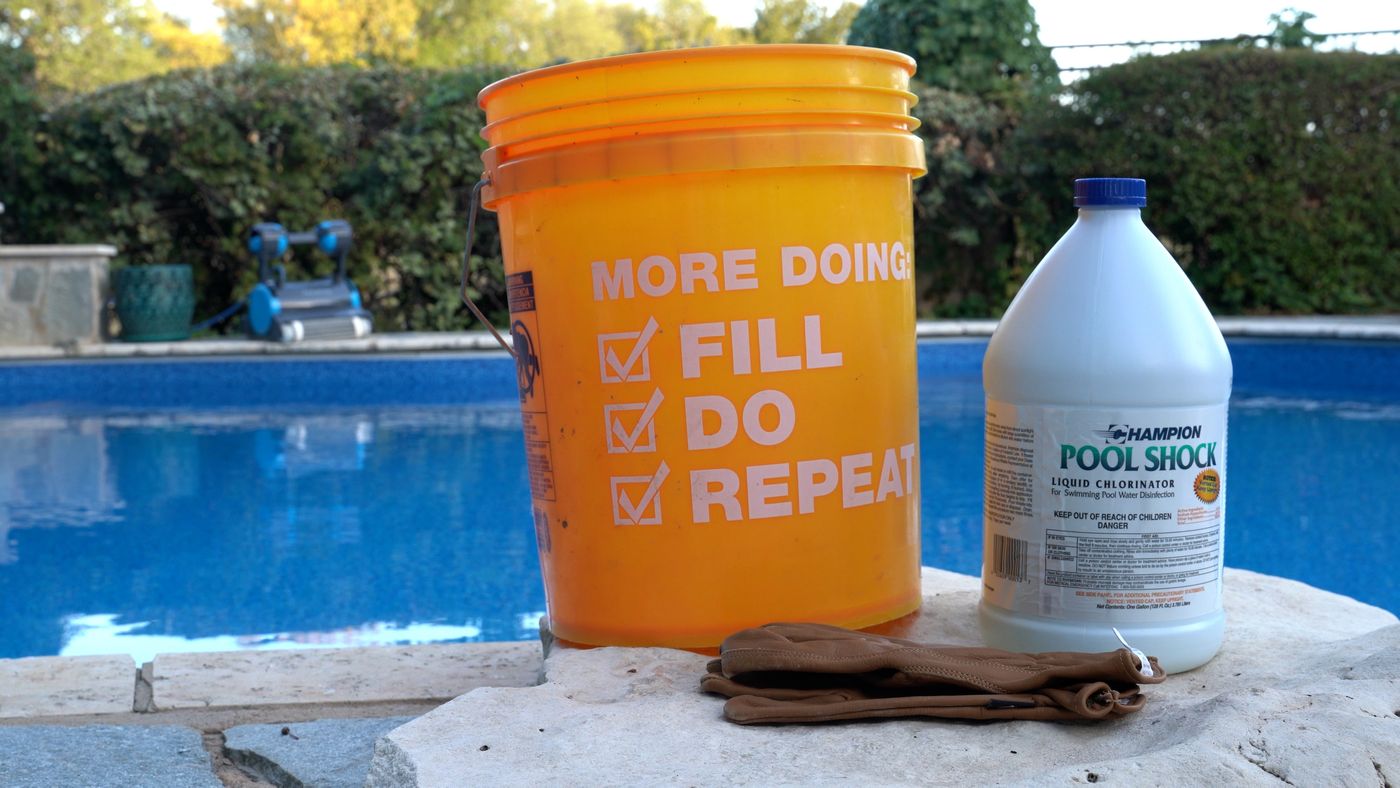
- Fill a 5-gallon bucket with pool water
- Slowly add the measured shock to the bucket
- Stir with a wooden stick or plastic paddle until fully dissolved
- Never add water to a bucket of shock — always shock to water
For liquid chlorine or gunite/plaster pools, you can broadcast granular shock directly over the water surface.
4. Apply at Dusk
Add the shock solution around the perimeter of the pool with the pump running. Pouring it near the return jets helps distribute the chemical faster. Evening application is critical for unstabilized shock (cal-hypo and liquid chlorine) because UV light destroys free chlorine at a rate of about 1 ppm per hour in direct sunlight.
5. Run the Pump for 8 Hours
Keep your pump and filter running continuously after shocking. Full circulation ensures the chlorine reaches every corner of the pool, including dead spots behind ladders, in steps, and near skimmer areas. If you shocked at dusk, running the pump overnight is ideal.
6. Test and Wait Before Swimming
Test free chlorine levels the next morning. The pool is safe to swim in once free chlorine drops below 5 ppm (ideally back to your normal maintenance range of 1–3 ppm for residential pools). After a heavy shock treatment for algae, this may take 24–48 hours.
Pool Shock Safety Tips
Pool chemicals are serious business. Every year, thousands of people visit emergency rooms due to pool chemical injuries. These safety rules aren't suggestions — they're essential.
Personal Protective Equipment
- Wear chemical-resistant gloves and safety goggles when handling any shock product
- Avoid wearing your best clothes — splashes of shock solution will permanently bleach fabric
- Work upwind to avoid inhaling dust or fumes
- Wash hands thoroughly after handling, even if you wore gloves
Chemical Storage and Handling
- Never mix different types of shock together — cal-hypo and trichlor/dichlor combined can ignite or explode
- Store shock products in a cool, dry, well-ventilated area away from direct sunlight
- Keep containers tightly sealed and off concrete floors (moisture causes caking and degradation)
- Never return spilled shock back into the original container — contaminants can cause a reaction
Application Safety
- Always add shock to water, never water to shock
- Never add shock through the skimmer if you use a trichlor tablet feeder — the concentrated chlorine can react with residual trichlor in the lines
- Keep children and pets away from the pool area during treatment
- Do not swim until free chlorine returns to safe levels (below 5 ppm)
Common Pool Shocking Mistakes
Even experienced pool owners make these errors. Avoiding them saves money and keeps your water balanced.
Shocking During the Day
Unstabilized chlorine (cal-hypo and liquid) loses up to 90% of its effectiveness within a few hours of direct sunlight exposure. Shocking at noon on a sunny day is essentially pouring money into your pool and watching UV light destroy it. Always shock at dusk or after dark.
Ignoring pH Before Shocking
At a pH of 7.2, roughly 66% of your free chlorine is in its active killing form (hypochlorous acid). At pH 8.0, that drops to around 21%. Shocking a pool with high pH means you need roughly three times as much product to achieve the same sanitation. Test and adjust pH before adding shock.
Under-Dosing for Algae
The most common reason an algae treatment fails is not using enough shock. Algae needs to be overwhelmed — hitting it with a light dose just feeds the survivors and wastes your chemicals. If you have visible green algae, commit to at least 20 ppm. For black algae, go to 30 ppm and brush the affected surfaces before and after treatment.
Using Old or Degraded Product
Cal-hypo loses about 5–10% of its available chlorine per year in ideal storage conditions, and much faster in heat or humidity. Liquid chlorine degrades even more rapidly — a jug stored in a hot garage can lose half its strength in a month. Check product dates and store properly.
Over-Relying on Dichlor
Dichlor is convenient, but each shock treatment adds CYA to your water. Once CYA exceeds 70–80 ppm, chlorine becomes increasingly ineffective regardless of how much you add. This "chlorine lock" problem is one of the most common issues pool owners face. If your CYA is already above 50 ppm, use cal-hypo or liquid chlorine for shock treatments instead.
Not Running the Pump Long Enough
Dumping shock into still water creates hot spots of high chlorine concentration while leaving the rest of the pool untreated. The pump needs to run for a full turnover cycle (typically 8 hours) after shocking to properly distribute the chemical. If your circulation is poor, brush the walls and floor to help mix the treated water.
Proper shock treatment is one of the most important things you can do to protect your pool. Use the calculator above to take the guesswork out of dosing, and follow the guidelines on this page to get it right the first time.
Shocking is part of a bigger maintenance picture. If you're dealing with persistent water clarity issues after shocking, the problem may be pH or alkalinity related — both affect how effectively chlorine works. Our pool chemical calculator covers the full water balance and the correct order to address each parameter. For the complete week-by-week routine that keeps your water clear between shock treatments, see our weekly pool maintenance guide.
More Pool Calculators
All Calculators Chemistry Calculator Chemical Calculator Chlorine Calculator Volume Calculator Shock Calculator SLAM Calculator pH Calculator Acid Calculator Alkalinity Calculator Calcium Hardness Calculator LSI Calculator Salt Calculator CYA Calculator Borate Calculator Dilution Calculator Pump Size Calculator Pump Runtime Calculator Pump Schedule Calculator Filter Size Calculator Heater Calculator Salt Cell Calculator Fill Time Calculator Evaporation Calculator Winterizing Calculator Hot Tub Calculator Pool Cost Calculator Loan Calculator Maintenance Cost Calculator Pool Deck Calculator Resurfacing Calculator
More from The Pool Nerd
Keep Reading

Disclaimer: This information is for educational purposes only. Handling pool chemicals involves significant risks, and this calculator cannot cover every product, pool, or possible hazard. Always follow the manufacturer’s label, safety data sheet, and applicable requirements. Seek qualified help whenever you are uncertain.