
 Justin D.
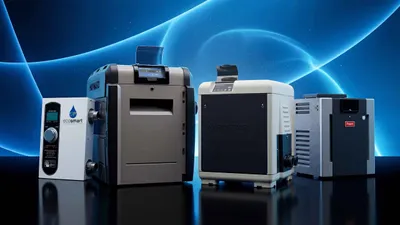
Hey there, and welcome back to The Pool Nerd. If you want to stretch your swim season, ditch the gas bill, or just keep your pool sitting at a comfortable 84°F without thinking about it, a pool heat pump is hard to beat. In this guide, I'm walking through 6 heat pumps you can actually buy on Amazon right now — from a compact 28K BTU inverter for plunge pools and spas all the way up to 140K BTU workhorses built for big in-ground pools.
I've broken these down by use case so you can skip straight to the one that fits your setup. Big in-ground pool? I've got you. Plunge pool or spa? Got that too. Cold spring mornings in the Northeast? There's a pick for that. Let's get into it.
Best Pool Heat Pumps at a Glance


What Is a Pool Heat Pump (and Why You Probably Want One)
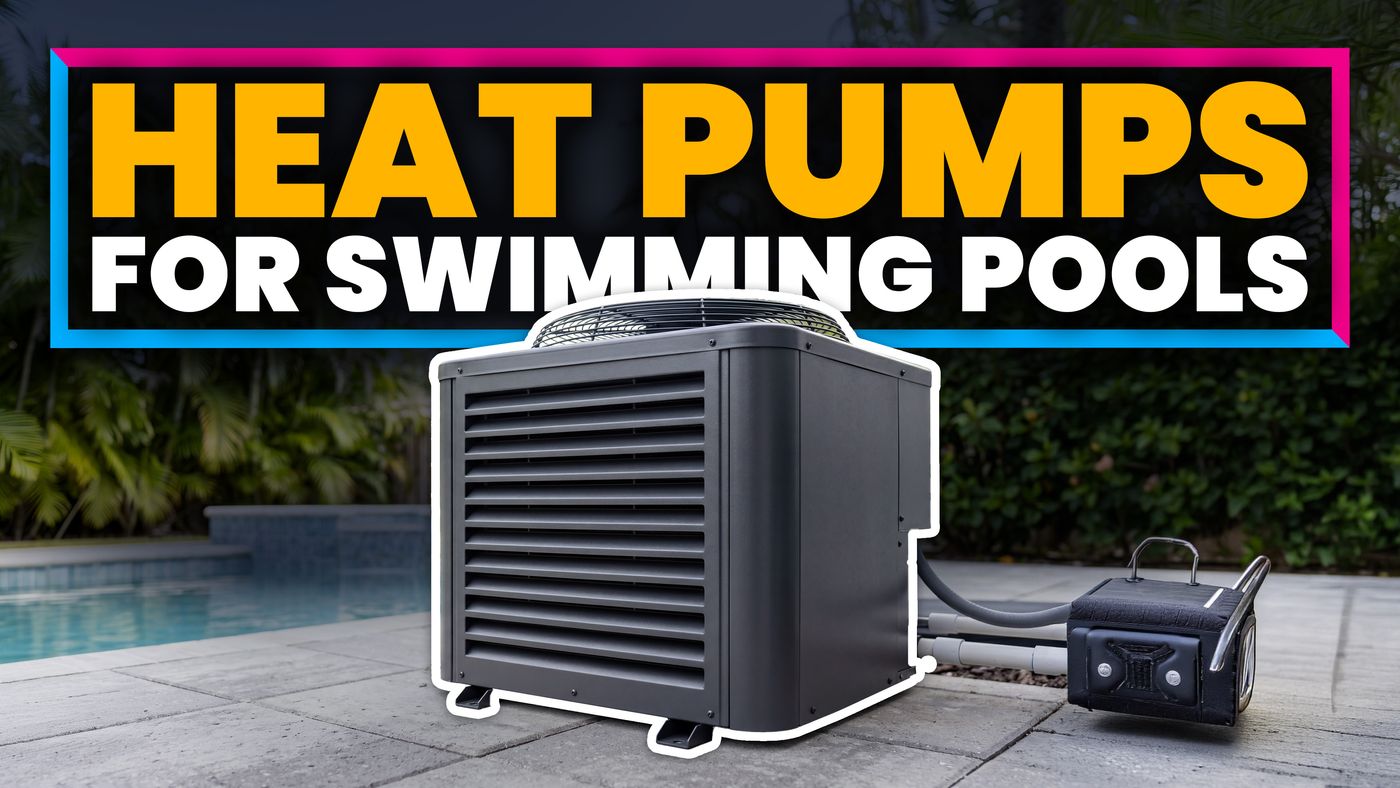
A pool heat pump is basically a reverse air conditioner. Instead of burning gas, it uses electricity to grab heat out of the surrounding air and shove it into your pool water through a titanium heat exchanger. That's it. The magic is in the efficiency — a good heat pump can deliver 5 to 7 units of heat for every 1 unit of electricity it pulls from the wall. That's why the operating cost lands closer to a buck an hour instead of the $5–$9 an hour a gas heater can chew through.
The trade-off? Heat pumps warm water gradually. Expect a 1–3°F rise per hour depending on size and weather. They're built for maintaining pool temp, not heating a cold pool from 60°F to 88°F over a Saturday afternoon. The Department of Energy also notes that pool heat pump efficiency drops as outdoor air drops, especially below the 45–50°F mark, so climate matters.
If you live somewhere mild and you swim a lot, this is the cheapest way to keep the pool warm. Period.
Heat Pump vs Gas Heater: The Quick Take
Gas heaters heat fast in any weather but burn money. Heat pumps cost a fraction to run but slow down when the air gets cold. If you swim daily during the season, a heat pump pays for itself fast. If you only fire up the pool occasionally on weekends, gas might still make sense. Some folks even run both — heat pump as the daily driver, gas heater for the cold snaps.
For most pool owners in moderate climates, a heat pump is the move. If you land on the gas side of the fence, check out my full Best Pool Heaters guide.
What to Look for in a Pool Heat Pump
Before we get to the picks, here's what actually matters when you're shopping.
COP (Coefficient of Performance). This is the efficiency rating. A COP of 6 means the unit puts out 6x the heat energy it consumes in electricity. The catch: COP is rated at specific test conditions (usually 80°F air, 80% humidity, 80°F water — the AHRI 80/80/80 standard). A COP of 5–7 at AHRI conditions is excellent. Be skeptical of marketing-only "peak COP" claims like 15+ — those numbers come from cherry-picked best-case conditions and don't compare apples-to-apples with AHRI specs.
BTU output. This is how much heat the unit can pump per hour. As a rough sizing guide:
- 10,000–15,000 gallons → 50,000–85,000 BTU
- 15,000–25,000 gallons → 85,000–125,000 BTU
- 25,000+ gallons → 125,000–140,000+ BTU
Bigger pool, cooler climate, or no cover? Size up. An undersized heat pump runs nonstop and never quite catches up.
Titanium heat exchanger. Non-negotiable. Titanium handles chlorinated and saltwater chemistry without corroding. Every unit I'm recommending uses one.
Inverter vs single-speed. Inverter heat pumps modulate their compressor speed to match demand. They're quieter, more efficient at maintaining temp, and handle a wider range of conditions. Single-speed units are either fully on or fully off — cheaper upfront but less efficient over time. If you can swing the inverter, you'll usually like it better.
Heat-only vs heat/cool. Heat-only is exactly what it sounds like. Heat/cool units can also chill your pool in summer (great for hot Texas afternoons or spas that get too warm) and they typically include an active defrost cycle for cold-weather use.
Warranty. Look for at least 2 years on labor and 5–10 years on parts or the heat exchanger. The brands below all carry meaningful warranties.
What to Avoid
A few traps to skip on your way out the door:
No-name bargain units with no support. If a 120K BTU heat pump is half the price of a Hayward, ask yourself who's going to fix it when the board fries in year two. Stick to brands with US support.
Marketing-only COP numbers. A "COP 15.8" claim usually means the unit hit that under one specific condition that doesn't apply to your backyard. Look for AHRI 80/80/80 ratings and a 50°F performance number if you can find it.
Heat-only units in cold climates. If you plan to run into the 40s, you need a heat/cool model with active defrost. Otherwise the coil will ice up.
Gimmicks over fundamentals. Wi-Fi apps and fancy displays are nice, but a great heat pump is a quiet, durable, efficient one with a real warranty. Get the basics right first.
Now let's get to the picks.
The 6 Best Pool Heat Pumps of 2026
1. Hayward HeatPro W3HP21404T – Best Established Brand for In-Ground Pools
If you want the safe pick from a brand that's been making pool gear for a century, this is it. The Hayward HeatPro W3HP21404T is a 140,000 BTU, 230V heat-only unit built for in-ground pools, with a titanium heat exchanger and Hayward's Ultra Gold corrosion-resistant evaporator fin coating. That coating is a big deal if you live near the coast or run a saltwater pool — corrosion is the silent killer of pool heat pumps.
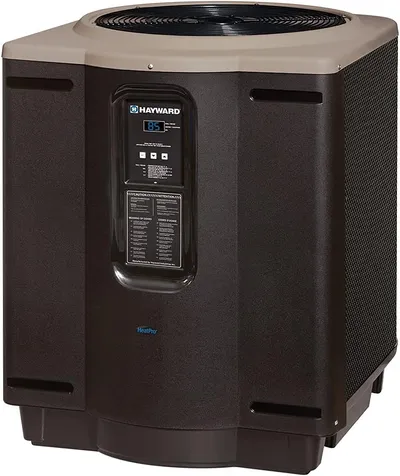
It's AHRI-certified, runs 30–75 GPM water flow, carries a 3-year parts warranty, and earns its "whisper-quiet" reputation from a profiled fan blade and a scroll compressor mounted on isolation grommets. Minimum operating air temp is 50°F, so this is a warm-season unit, not a winter unit.
Pros: Trusted brand, killer corrosion resistance, quiet, strong warranty support network.
Cons: Heat-only, single-speed, not cheap, and that 50°F floor means it's not built for cool spring mornings.
Who it's for: Pool owners who want a known brand they can get serviced anywhere in the country.
2. GulfStream HE125 – Best Pro-Grade Heat-Only Pick
The GulfStream HE125 is what I'd call a serious pool owner's heat pump. Amazon lists it at 117,000 BTU, while GulfStream's own spec sheet for the HE 125-R-A family quotes 125,000 BTU at AHRI 80/80/80 with a 6.6 COP, 109,000 BTU at 80/63/80, and 74,000 BTU at 50/63/80. That last number is the one I always look for — it tells you what the unit actually does on a cool morning.
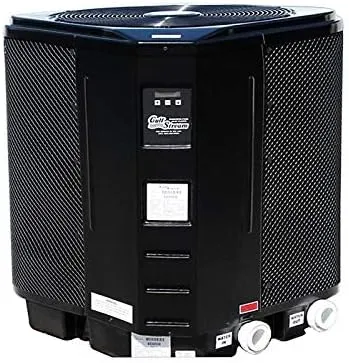
You get a titanium heat exchanger, an LCD control panel, and a quiet conventional design. No app, no inverter — just a serious workhorse with strong AHRI-rated performance.
Pros: Real AHRI-verified performance data, titanium exchanger, big output, quiet.
Cons: Amazon's spec block is thin, the model suffix matters (heat-only vs heat/cool varies), and you'll want a pool pro to verify electrical and sizing.
Who it's for: Owners of medium-to-large pools who want pro-grade performance and don't care about app gimmicks.
3. Raypak Crosswind V 8550 – Best Smart Heat Pump for Large Pools
The Raypak Crosswind V (model TWPH-8550EHT08) is the smart, large-pool pick. Raypak's own spec table puts it at 138,000 BTU/hr with a 6.0 COP, running on 208–230V at 60 GPM max flow. The Amazon listing emphasizes free Wi-Fi and fleet monitoring through Raypak's Raymote app, plus a hybrid heating mode if you want to pair it with a gas heater.
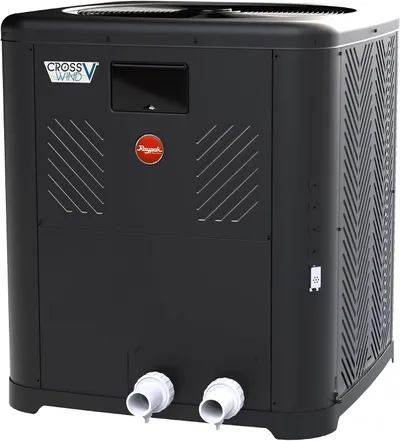
Build quality is what you'd expect from Raypak — DuraSteel powder-coated cabinet, titanium tube heat exchanger, swept-blade fan for low noise. The "V" version is the more modern option compared to the classic 8450.
Pros: Big 138K output, Wi-Fi monitoring, hybrid-ready, durable cabinet, great for large pools.
Cons: Pricier than the older 8450, and the EHT (heat-only) vs EHC (heat/cool) model distinction trips up buyers — verify before you click buy.
Who it's for: Owners of 25,000+ gallon pools who want remote monitoring and Raypak's modern feature set.
4. Raypak 8450 – Best Heavy-Duty Workhorse
The Raypak 8450 is the no-frills 140,000 BTU bruiser. Titanium heat exchanger, 208/230V, COP around 5.6, scroll compressor, swept-wing fan, and a durable steel cabinet that shrugs off weather. Amazon lists it at 44" x 30" x 30" and 422 lbs, so plan for a freight delivery.
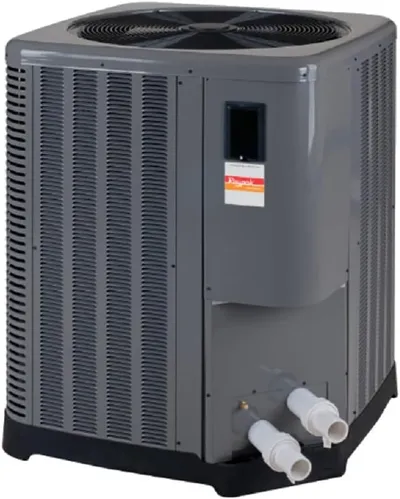
This is the unit to pick if you want big BTU output without inverter complexity or app stuff. Just plug it into your automation system (or use the digital thermostat directly) and let it heat.
Pros: Strong 140K output, simple operation, durable build, quieter than you'd expect for the size.
Cons: Heavy freight item, heat-only on the standard model, no smart controls, getting overshadowed by the Crosswind V.
Who it's for: Buyers who want a proven 140K Raypak without paying for inverter or Wi-Fi features they won't use.
5. Raypak Crosswind 40i – Best Compact Heat/Cool for Pools Up to 9,000 Gallons
The Crosswind 40i fills the small-but-serious slot. 33,000 BTU, 208/230V hardwired, Wi-Fi, heat and cool, titanium heat exchanger, inverter compressor, low-speed fan, LCD control. Raypak rates it for above-ground and in-ground pools up to 9,000 gallons. COP up to 5.0.
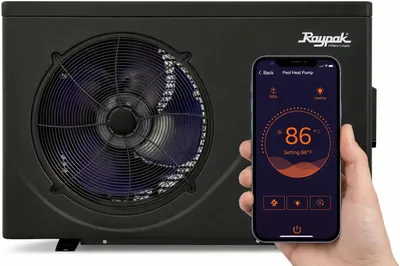
Heads up — this is a hardwired unit, not plug-in. The Amazon price has been swinging lately, so double-check before you click. When it's at the lower end, this thing is a steal for what you get.
Pros: Compact footprint, heat and chill, inverter, Wi-Fi, titanium exchanger, Raypak's 3-year parts and labor warranty.
Cons: Hardwired install, not for big pools, Amazon rating is more mixed than other picks.
Who it's for: Small in-ground pools, plunge pools, and above-ground pools where the owner wants real Raypak quality and inverter tech.
6. Raypak Crosswind 30i – Best Smallest Raypak for Plunge Pools and Spas
The 30i is the baby of the Crosswind inverter family. 28,000 BTU, 208/230V hardwired, Wi-Fi, heat and cool, titanium heat exchanger, inverter compressor, LCD control, rated for pools up to 7,500 gallons. Same warranty as the 40i (3 years parts and labor), same build quality, just a smaller output.
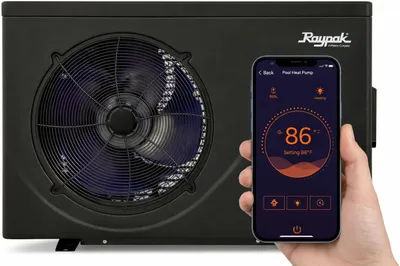
Amazon shows it at 39" x 13.4" x 25.9", 4.1 stars from 36 reviews. If you've got a small pool and you've been eyeing those sub-$1,000 import heat pumps, the 30i is the Raypak alternative — a couple hundred more, but you get a real warranty and a brand that'll be there next year.
Pros: Smallest Raypak in the lineup, heat and chill modes, compact, inverter, Wi-Fi, real Raypak warranty.
Cons: Hardwired, not plug-and-play, too small for full-size pools.
Who it's for: Plunge pools, small spas, very small in-ground pools where the owner wants a name-brand inverter.
Quick Picker: Match Your Setup to a Pump
Skip the spec dive — here's the cheat sheet:
- Plunge pool, small spa, or pool under 7,500 gallons, wants Raypak quality → Raypak Crosswind 30i
- Small pool up to 9,000 gallons, wants heat/cool with Wi-Fi → Raypak Crosswind 40i
- Large in-ground pool, wants the safest established brand → Hayward HeatPro 140K
- Large pool, wants pro-grade heat-only with real AHRI specs → GulfStream HE125
- Large pool, wants smart Raypak with hybrid features → Raypak Crosswind V 8550
- Large pool, wants a no-frills 140K workhorse → Raypak 8450
Comparison Table
| Model | Best For | BTU | COP | Inverter | Heat/Cool |
|---|---|---|---|---|---|
| Hayward HeatPro W3HP21404T | Established brand | 140,000 | ~5.5–5.8 | No | Heat only |
| GulfStream HE125 | Pro-grade heat-only | 125,000 | 6.6 (AHRI) | No | Heat only |
| Raypak Crosswind V 8550 | Smart large pool | 138,000 | 6.0 | No | Varies by SKU |
| Raypak 8450 | Heavy-duty workhorse | 140,000 | ~5.6 | No | Heat only |
| Raypak Crosswind 40i | Compact heat/cool | 33,000 | 5.0 | Yes | Both |
| Raypak Crosswind 30i | Smallest Raypak | 28,000 | ~5.0 | Yes | Both |
All units use titanium heat exchangers. Prices vary by retailer and seasonal promos — check ThePoolNerd.com/Deals for current pricing and any open-box options before you pull the trigger.
Final Take
If I had to pick one for the average pool owner with a typical in-ground pool in a moderate climate, I'd point most folks toward the Hayward HeatPro for the brand support and corrosion resistance, or the GulfStream HE125 if they want the highest AHRI-verified efficiency at this size. Cold-climate buyers should look at the Raypak Crosswind V 8550. Small-pool and spa owners should grab the Raypak Crosswind 30i or step up to the 40i for a bit more output.
Match the pump to your pool, your climate, and your install situation — and you'll be swimming in 84°F water for pennies on the dollar compared to gas.
Pool Heat Pump FAQ
How much does it cost to run a pool heat pump?
Roughly $0.60–$1.50 per hour, depending on your electric rate and the unit's efficiency. Compare that to $3–$9/hour for gas.
What size heat pump do I need?
Rough sizing: 50–85K BTU for pools up to 15K gallons, 85–125K BTU for 15–25K gallons, 125–140K+ BTU for 25K+ gallons. Cooler climate or no cover? Size up.
Do heat pumps work in cold weather?
They work efficiently down to about 50°F. Below that, output drops. If you need to run into the 40s, pick a heat/cool model with active defrost like the Crosswind V or an inverter unit.
How long does it take to heat a pool?
1–3°F per hour depending on size and weather. Plan on 1–2 days from a cold start — but they hold temp easily after that.
Are pool heat pumps loud?
Most quality units sit in the 50–60 dB range. Inverter models are even quieter at low speeds.
Do I need a pool cover?
Strongly recommended. A solar or thermal cover cuts overnight heat loss and makes the heat pump's job way easier.
Can I use a heat pump with a saltwater pool?
Yes, as long as it has a titanium heat exchanger. Every pick on this list does.
How long do pool heat pumps last?
10–15 years with decent maintenance. Keep the coil clean and protect it from flooding and freezing.
Heads up — before you buy, check ThePoolNerd.com/Deals for certified open-box units, current discounts, and authorized dealer pricing. You can sometimes catch one of these top picks at a serious savings.



Comments
Loading comments…