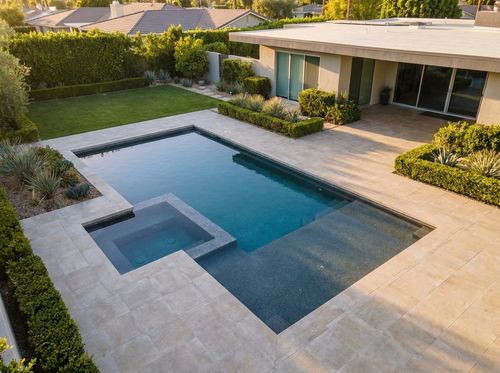
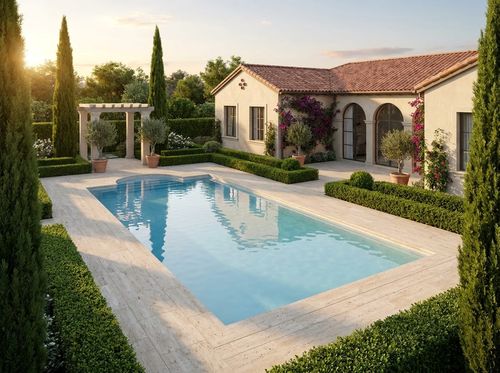
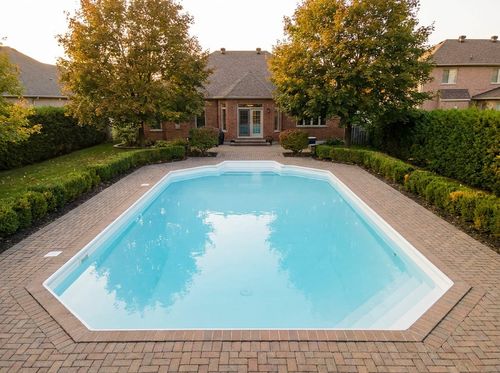
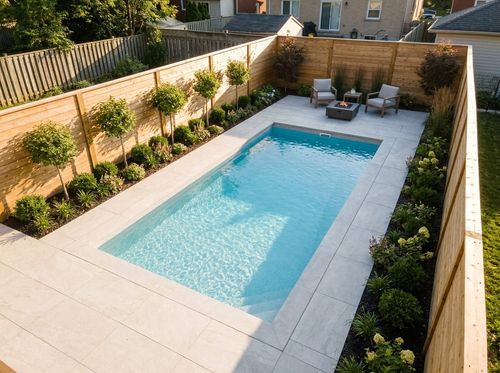
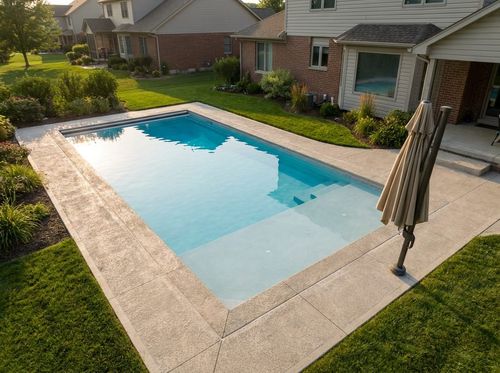
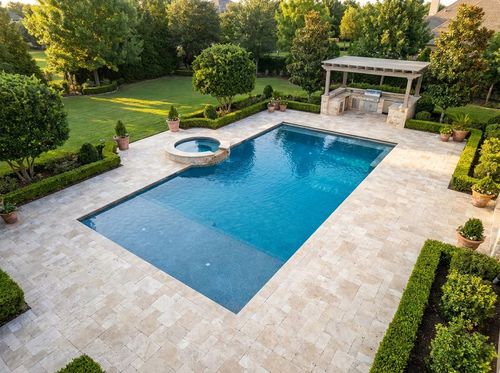
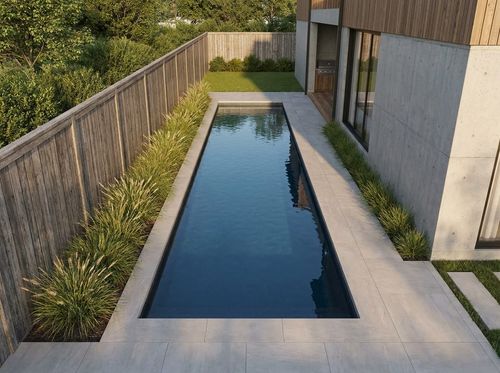
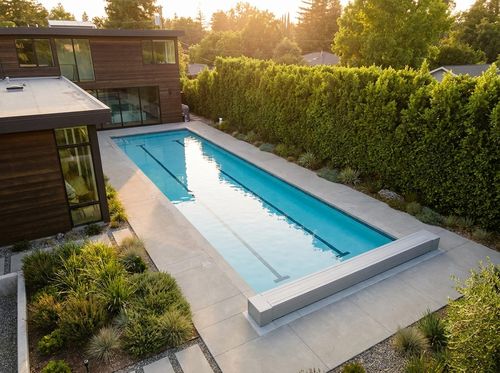
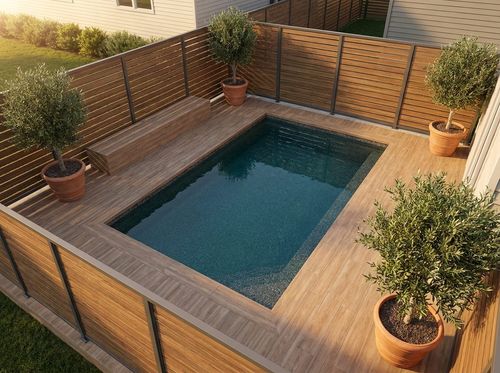
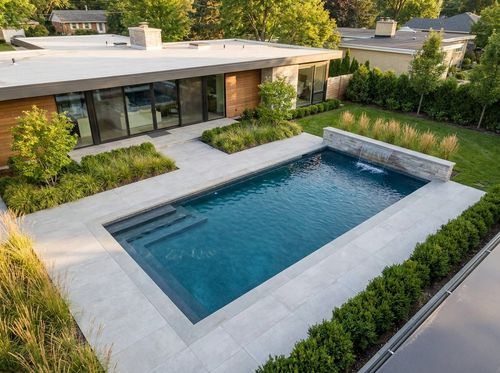
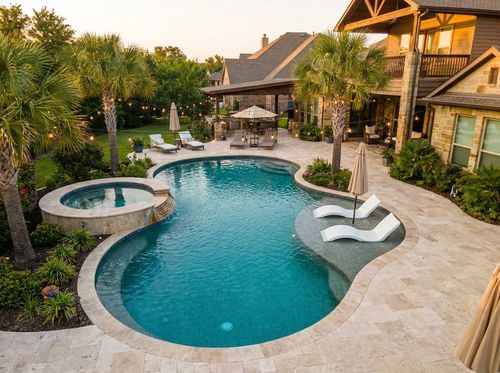
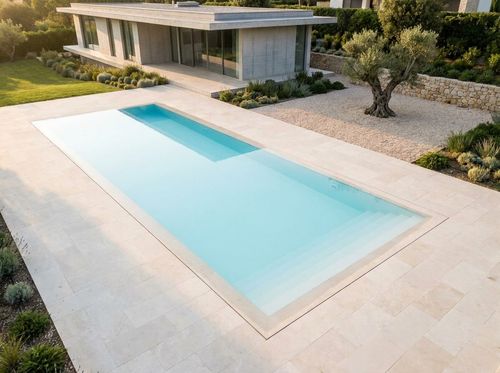
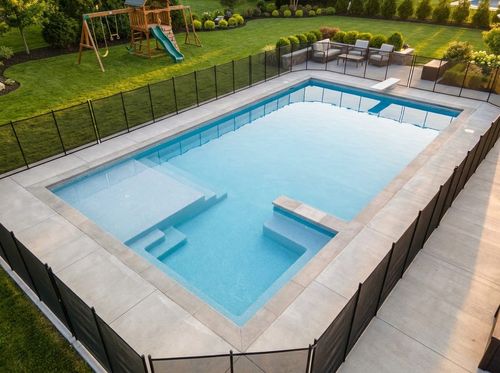
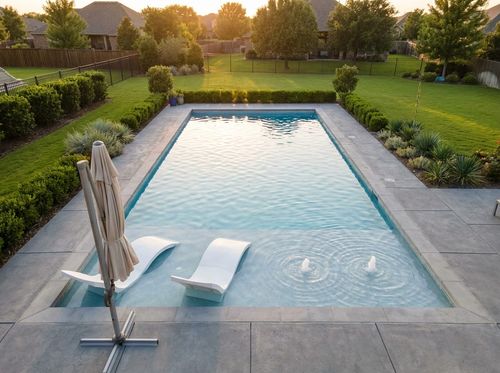
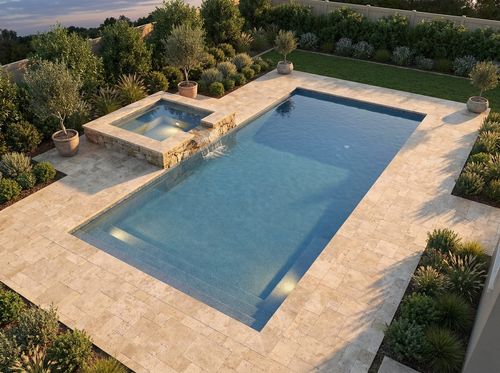
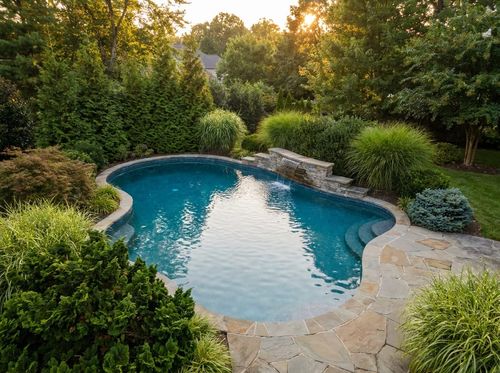
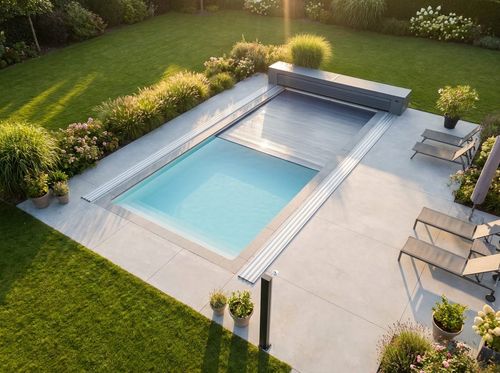
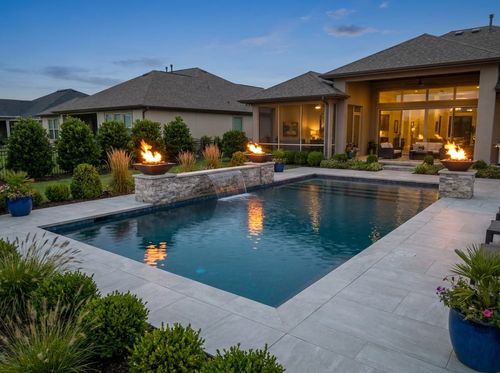
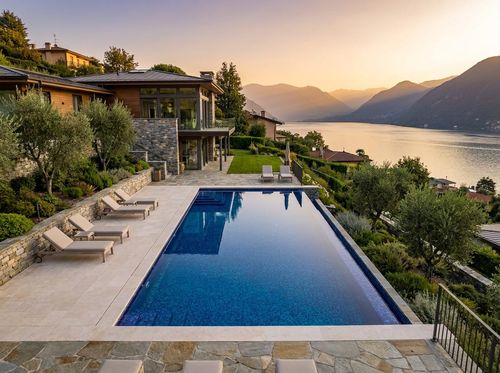
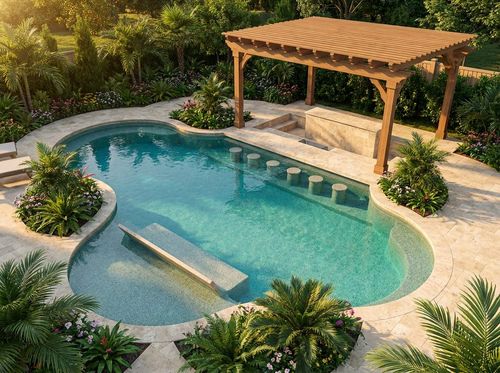
These are good starting points. Your builder still needs to confirm what fits the yard.
29 designsFilters0
No designs match every filter you picked. Loosen one of them, or .
Pool Designs by Shape
Shape changes how the pool swims, covers, cleans, and fits the yard, so it is a useful first filter.
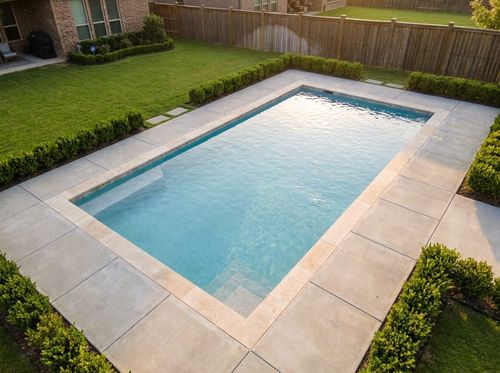
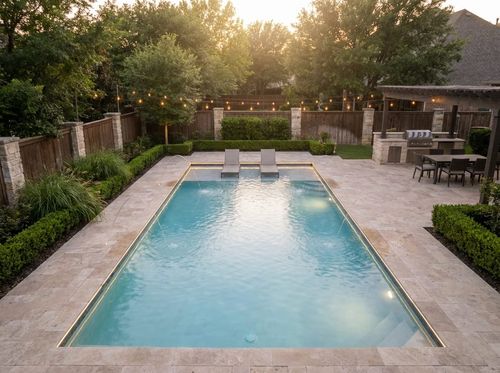
Pool Nerd PickRectangle PoolA practical starting shape with plenty of usable water.16 × 32 ftMid-range costLower upkeepSee details
Why it works
A rectangle gives you clear swimming length, an easy deck layout, and the best chance of a simple automatic cover. Because the shape is quiet, you can see exactly what every step, ledge, and feature takes away.
Best for
Families
Swimming laps
Automatic covers
Modern and traditional homes
What you give up
Can feel generic when the deck and landscape are treated as leftovers.
Corners and step recesses still need a deliberate circulation and cleaning plan.
An irregular buildable area may fit a restrained custom outline better.
What defines it
Straight walls
Easy to cover
Lap-friendly
Works with most decks
A size to try
Lay out 14 × 28, 16 × 32, and 18 × 36 feet in the yard. Add the steps, ledges, deck, fence, access, and equipment before deciding what really fits.
Equipment to plan early
This layout usually needs no special feature pump. Ask for a variable-speed pump, a generously sized filter, easy service access, and lighting that does not shine back at the house.
2D layout
Loading the layout…
This is a starting sketch. Open it in the designer to change the size, shape, or features.
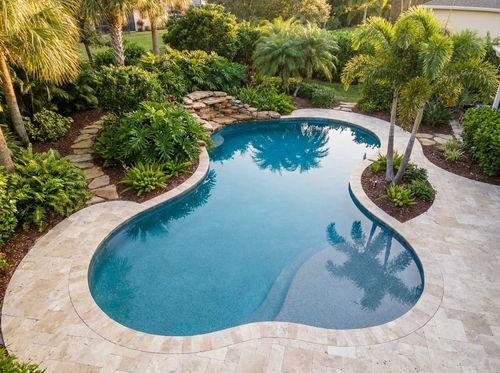
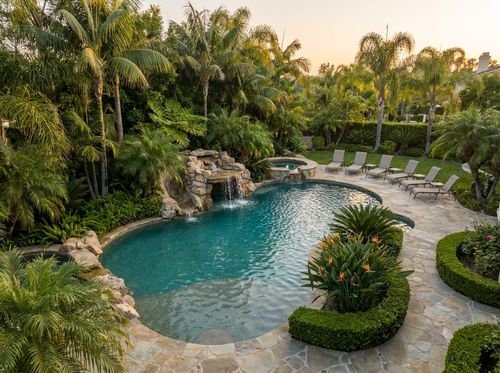
Freeform PoolCurves that follow the yard instead of fighting it.18 × 34 ft overallPremium costModerate upkeepSee details
Why it works
A good freeform pool follows an odd lot, garden edge, slope, or curve in the house more naturally than a rectangle. A few broad curves can also create separate places to swim and lounge.
Best for
Irregular buildable areas
Natural or tropical landscapes
Projects with an early custom-cover strategy
What you give up
Powered and removable cover systems need early specialist coordination.
Curved coping, tile, forming, and deck cuts can add labor.
Tight lobes and necks reduce clear swimming width and complicate cleaning.
What defines it
Organic curves
Hides lot lines
Pairs with rock and planting
Harder to cover
A size to try
Measure the narrowest parts and the longest uninterrupted swim as well as the outside dimensions. Draw every step and seat inside that usable water.
Equipment to plan early
Curves create quiet pockets. Ask how the returns and skimmers will move water through every lobe, and check the cleaner's access to them.
2D layout
Loading the layout…
This is a starting sketch. Open it in the designer to change the size, shape, or features.
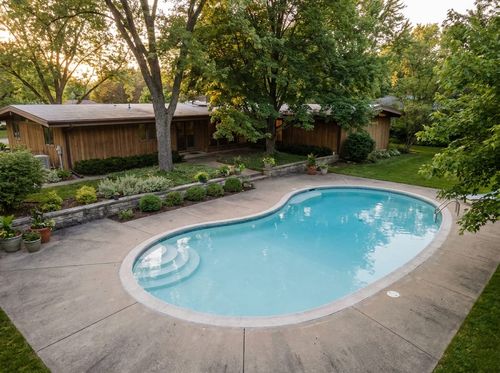
Kidney PoolOne easy curve for a softer backyard.16 × 32 ftMid-range costLower upkeepSee details
Why it works
One broad curve softens the pool and suggests two areas without all the bumps of a full freeform shape. It feels especially at home beside ranch and mid-century houses.
Best for
Ranch and mid-century homes
Simple shallow-to-deep layouts
Owners who want curves without the freeform price
What you give up
Cover tracks and housings need a custom strategy.
The waist shortens clear lap width.
The shape looks intentional only when it relates to the house and landscape.
What defines it
Gentle single curve
Natural shallow and deep zones
Simpler than full freeform
Retro appeal
A size to try
Start around 16 × 32 feet, then measure the narrow waist after the steps and benches are drawn. Make sure both sides are wide enough to use.
Equipment to plan early
Put the skimmer where the wind naturally sends debris and aim water through the inside curve. Check that the cleaner can handle the bend and steps.
2D layout
Loading the layout…
This is a starting sketch. Open it in the designer to change the size, shape, or features.
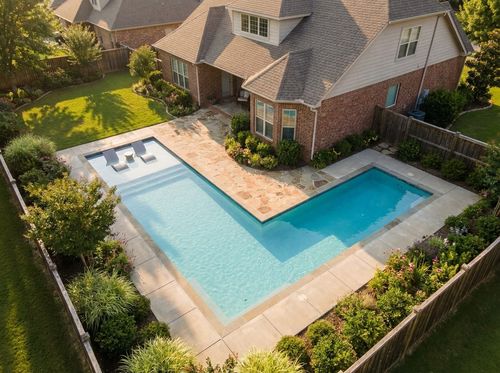
L-Shaped PoolA lap lane and a play area in one pool.18 × 36 ft overallPremium costModerate upkeepSee details
Why it works
The long leg can handle swimming while the short leg holds steps, seating, or shallow play. It also wraps neatly around a patio when the house already creates the corner.
Best for
Families with young kids and lap swimmers
Corner lots
Pools that wrap a patio
What you give up
More perimeter can increase shell, coping, tile, and cover complexity.
The inside corner needs extra attention to water movement and cleaning.
Two zones are valuable only when the household uses both regularly.
What defines it
Separate shallow leg
Long straight run
Non-diving concept
Wraps a patio
A size to try
Give each leg a job and size it for that job. Draw the corner, steps, standing area, deck path, and cover instead of copying someone else's dimensions.
Equipment to plan early
Both legs need water movement and light. Ask how the inside corner will stay clean and whether the cleaner can reach the short leg.
2D layout
Loading the layout…
This is a starting sketch. Open it in the designer to change the size, shape, or features.
Look at the water and the deck together. A bigger pool is not better if it leaves nowhere to sit.
Pool Nerd PickSmall Backyard PoolA compact pool that leaves room for deck and yard.12 × 24 ftValue costLower upkeepSee details
Why it works
A 12 × 24 rectangle leaves more of the yard for chairs, plants, walking, and construction access. At roughly 9,000 to 11,000 gallons, there is also less water to heat and treat.
Best for
Small lots
Couples and small families
Cooling off and floating
Lower running costs
What you give up
Too short for uninterrupted lap swimming.
Large ledges or steps consume a noticeable share of the water.
The same safety, structure, sanitation, electrical, and drainage work still applies.
What defines it
Under 300 sq ft
Compact-lot potential
Lower water volume
Deck-first layout
A size to try
Compare 10 × 20 and 12 × 24 feet with the steps, seats, swimming room, deck furniture, fence, access, and equipment all drawn in.
Equipment to plan early
Small pools need smaller equipment, not guesswork. Ask your builder to size the pump, filter, sanitizer, heater, and lights for this exact pool.
2D layout
Loading the layout…
This is a starting sketch. Open it in the designer to change the size, shape, or features.
Pool Nerd PickMedium PoolA useful middle size for everyday family life.16 × 32 ftMid-range costLower upkeepSee details
Why it works
At 16 × 32 feet, there is room for steps, a modest ledge, shallow play, and useful swimming length without automatically turning the project into an estate pool.
Best for
Families
Regular mixed use
Medium and larger buildable yards
What you give up
The full project still needs substantial deck and site area.
Heating and covering nearly 500 sq ft of surface deserve a deliberate plan.
Feature creep can turn a straightforward reference into a complex system.
What defines it
Around 500 sq ft
Room for a ledge and steps
Swims comfortably
Familiar equipment choices
A size to try
Start around 16 × 32 feet, then grow or shrink it around the activities, depth change, deck, fence, access, and surveyed property limits.
Equipment to plan early
This is a common size, but the equipment still depends on the plumbing, features, climate, and distance to the pad. Ask to see the sizing behind the quote.
2D layout
Loading the layout…
This is a starting sketch. Open it in the designer to change the size, shape, or features.
Large PoolMore room to use—and more pool to pay for.20 × 40 ftLuxury costModerate upkeepSee details
Why it works
A 20 × 40 can hold a ledge, deeper water, and a clear swim lane at the same time. Larger groups can spread out instead of standing shoulder to shoulder.
Best for
Big families
Entertaining
Serious swimmers
Large lots
What you give up
The configuration shown is about 25,000 gallons; the same shell without its ledge would be closer to 30,000.
The deck, fence, construction access, drainage, and utilities grow with the pool.
A large pool is poor value when everyday use stays in one small area.
What defines it
800 sq ft shell
Tanning ledge
Attached spa
Carefully sized equipment
A size to try
Compare 18 × 36 and 20 × 40 feet. Assign a regular use to each additional area of water and deck.
Equipment to plan early
A pool this large needs carefully sized plumbing, filtration, sanitation, heat, and lighting. Do not let anyone size it by horsepower alone.
2D layout
Loading the layout…
This is a starting sketch. Open it in the designer to change the size, shape, or features.
Lap PoolLong, narrow, and planned around regular exercise.10 × 50 ftPremium costModerate upkeepSee details
Why it works
Clear length, room to turn, and the right depth make this an exercise pool first. Its narrow width can also rescue a side yard that would otherwise go unused.
Best for
Swimmers
Fitness-focused owners
Long lots
What you give up
The shell, cover, and service route consume a long strip of property.
A depth chosen for exercise may not serve play or diving.
Large exposed surface relative to volume makes heat-loss and evaporation planning important.
What defines it
40 ft or longer
Constant depth
Lane-friendly
Straightforward cover path
A size to try
Choose the length around the swimmer and workout, then try widths from 8 to 12 feet. Have the builder confirm the final depth before anything is built.
Equipment to plan early
Long pools need water movement, lights, and cleaner coverage from end to end. A cover matters even more if you plan to heat it.
2D layout
Loading the layout…
This is a starting sketch. Open it in the designer to change the size, shape, or features.
Pool Nerd PickPlunge PoolA little pool with a clear job: cool off, soak, or swim in place.8 × 16 ftValue costModerate upkeepSee details
Why it works
A plunge pool puts the whole experience into a tiny footprint. It can be practical to heat, and one long bench gives people a comfortable place to soak and talk.
Best for
Tiny yards
Cooling off
Warm soaking
Courtyards
What you give up
No conventional lap swimming unless you add a swim current.
Deep water in a small pool means it is not a kids' wading pool.
Steps eat a big share of the floor.
What defines it
Under 200 sq ft
Compact water volume
Optional heating
Bench-focused layout
A size to try
Try 8 × 16 feet and 4.5 to 5.5 feet deep. A bench along one wall turns it into a comfortable soaking pool.
Equipment to plan early
Everything can be smaller, but it still has to be sized correctly. Small pools also react quickly to chemical mistakes, so keep the water-care plan simple.
2D layout
Loading the layout…
This is a starting sketch. Open it in the designer to change the size, shape, or features.
Most of the look comes from the finish, deck, landscaping, and how the pool lines up with the house.
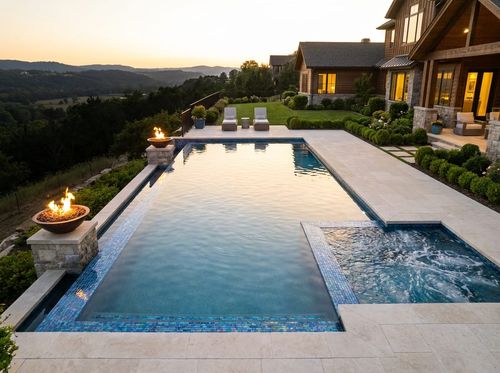
Modern PoolStraight lines, quiet materials, and no visual clutter.16 × 36 ftPremium costModerate upkeepSee details
Why it works
Modern style comes from good proportions, materials that line up, clean edges, and a strong connection to the house. The simple water shape lets the deck and lighting do the talking.
Best for
Contemporary homes
Owners who want calm, not spectacle
Automatic covers
What you give up
Flush edges and large-format materials expose layout or settlement errors.
Dark finishes change visibility and show some water-condition issues differently.
Hiding equipment too far away can make it harder to service and less efficient to run.
What defines it
Flush or cantilever coping
Large-format decking
Dark or light monochrome water
One restrained water feature
A size to try
Compare a classic 2:1 rectangle with a slightly longer one, then line up the pool edges with important walls, doors, and views.
Equipment to plan early
The details are part of the look. Plan skimmer lids, the cover box, drains, lights, controls, and equipment access before the deck pattern is locked in.
2D layout
Loading the layout…
This is a starting sketch. Open it in the designer to change the size, shape, or features.
Resort-Style PoolLedges, loungers, and a spa. Bring the hotel home.20 × 40 ft freeformLuxury costHigher upkeepSee details
Why it works
A resort pool gives people choices: shallow lounging, in-water seats, a spa, and a generous dry terrace. The best versions make all of those areas feel like one backyard.
Best for
Entertaining
Warm climates
Large lots
Owners with a service plan
What you give up
Every seating feature is a spot where swimming area used to be.
Spa, spillover, and features need their own pumps, valves, and controls.
High evaporation and heat loss from big shallow areas.
What defines it
Big tanning ledge
Attached spa
Multiple seating areas
Lots of lighting
A size to try
Size each area around the chosen furniture and typical group size, then total the water, deck, equipment, utilities, and service. A resort feeling does not require 800 square feet of water.
Equipment to plan early
This pool has a lot going on. Ask for one clear equipment diagram, automation that is easy to use, and a simple way to run things if the controls fail.
2D layout
Loading the layout…
This is a starting sketch. Open it in the designer to change the size, shape, or features.
Pool Nerd PickMinimalist PoolA quiet rectangle of water with almost nothing extra.14 × 32 ftPremium costLower upkeepSee details
Why it works
A simple water shape, a short material list, hidden-but-reachable equipment, and careful alignment make the pool feel like it belongs with the house. Fewer features also mean fewer things to maintain.
Best for
Architects' houses
Quiet yards
Owners who value simplicity
What you give up
Precision construction is expensive.
Nowhere to hide a skimmer lid or a cover box; plan them early.
Few built-in zones for play or lounging.
What defines it
Zero-edge coping
Single deck material
Screened, reachable equipment
No water features
A size to try
A 14 × 32 foot pool at a constant 4.5 feet is a clean place to start.
Equipment to plan early
Keep the pad simple: variable-speed pump, cartridge filter, salt or liquid chlorine, straightforward lighting, and a robotic cleaner.
2D layout
Loading the layout…
This is a starting sketch. Open it in the designer to change the size, shape, or features.
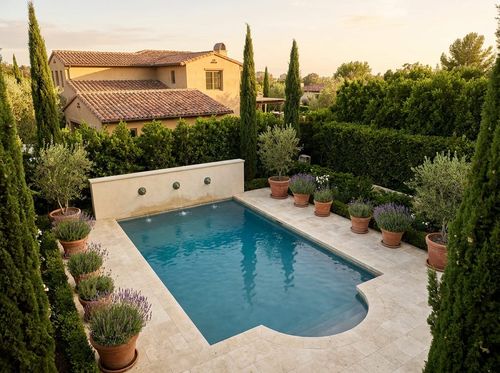
Mediterranean PoolRounded ends, warm stone, and a little Old World character.16 × 36 ft romanPremium costModerate upkeepSee details
Why it works
The deck and walls create the style, so the pool itself can stay simple. One controlled wall feature can add water sound without taking over the design.
Best for
Stucco and tile-roof homes
Formal gardens
Sunny climates
What you give up
Wall outlets need controlled flow, accessible openings, and scale management.
Natural stone varies in heat, wet traction, porosity, and climate suitability.
Roman ends complicate many cover systems.
What defines it
Roman or rectangle outline
Travertine or terracotta deck
Raised wall with a water feature
Formal planting
A size to try
Try 16 × 36 feet with broad, 8-foot-radius ends.
Equipment to plan early
Choose the wall outlet before sizing its flow, then decide whether it shares the main pump and how it turns down or off.
2D layout
Loading the layout…
This is a starting sketch. Open it in the designer to change the size, shape, or features.
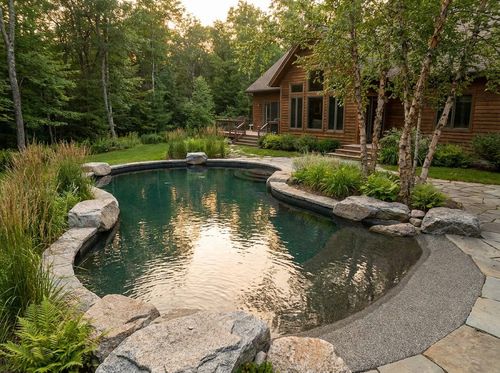
Natural-Looking PoolLooks like a pond, filters like a pool.18 × 34 ft freeformPremium costModerate upkeepSee details
Why it works
A dark finish makes the water look deep green or black, while boulder coping softens the edge. Underneath the natural look, it still runs like a normal chlorinated pool.
Best for
Wooded lots
Rustic homes
Owners who dislike bright blue water
What you give up
Dark water hides debris and swimmers, which matters for supervision.
Boulder coping can be hot, uneven, and expensive to place.
Beach entries lose a lot of area to shallow water.
What defines it
Dark pebble or aggregate finish
Boulder coping
Beach entry
Native planting
A size to try
Keep the curves and beach entry modest enough to leave clear swimming water, cleaning access, and a realistic way to cover or skim the pool.
Equipment to plan early
Keep the equipment simple and choose a robot that can handle curves and an uneven floor. We would skip an in-floor system here.
2D layout
Loading the layout…
This is a starting sketch. Open it in the designer to change the size, shape, or features.
Pool Nerd PickFamily PoolEasy to see, easy to share, and built for everyday play.16 × 34 ftMid-range costModerate upkeepSee details
Why it works
A clear shallow area, visible steps, a simple shape, and a useful deck work for different ages without turning every activity into a permanent feature.
Best for
Young kids
Teens
Grandparents
Everyday use
What you give up
No depth makes a child safe; barriers and supervision remain essential.
A large shallow zone reduces deep-water use and changes heat and evaporation.
Mixed-age needs change, so permanent play equipment deserves scrutiny.
What defines it
Large 3.5 ft shallow area
Corner steps and a bench
Optional ledge
Straightforward barrier and cover layout
A size to try
Try 16 × 34 feet, then choose every depth for the people who will use it. Draw the steps, seats, fence, and the view from the main supervision spot.
Equipment to plan early
Start with the safety layers: barrier, controlled access, clear water, good lighting, and a cover or alarm where it makes sense. Then choose a cleaner that fits the pool.
2D layout
Loading the layout…
This is a starting sketch. Open it in the designer to change the size, shape, or features.
Add a feature because you will use it—not just because it looked good in a rendering.
Pool Nerd PickPool With Tanning LedgeA ledge people can use without swallowing the whole pool.16 × 34 ft with an 8 × 16 ft ledgeMid-range costLower upkeepSee details
Why it works
A ledge gives you a place for chairs, supervised shallow play, pets, or an easier way into the water without adding a separate spa.
Best for
In-water lounging
Supervised shallow play
Dogs
Warm climates
What you give up
It consumes clear swim length.
Shallow sunlit water needs deliberate circulation and cleaning.
Furniture, umbrella sleeves, bubblers, depth, and step edges all need coordination.
What defines it
Baja shelf
In-water loungers
Umbrella sleeve
Bubblers optional
A size to try
Put the exact chairs on the plan and leave a clear path around them. Check what share of the pool the ledge takes, then set the depth for those chairs and users.
Equipment to plan early
Give the ledge its own water movement and make sure the cleaner can reach it. Plan umbrella sleeves, bubblers, and lights before the concrete is finished.
2D layout
Loading the layout…
This is a starting sketch. Open it in the designer to change the size, shape, or features.
Pool With SpaA hot place to sit, with a spillover for the view.16 × 32 ft pool + 7 ft spaPremium costModerate upkeepSee details
Why it works
A spa gives the backyard a second use when the pool water is too cold. Building it with the pool can share some equipment and create a spillover feature.
Best for
Cool-weather use
Evening use
Sore muscles
Households that use hot water regularly
What you give up
How quickly you want hot water decides the heater and utility size.
Spa suction, jets, valves, controls, water care, and sometimes a blower add a lot of equipment.
Raised edges add structure, waterproofing, steps, and visibility details.
What defines it
Attached or raised spa
Spillway
Shared equipment
Built for warm-water use
A size to try
Size the seats for the people who will use them, then check the water depth, steps, handholds, jets, cover, spillover, and service access.
Equipment to plan early
Ask the builder to show you pool mode and spa mode. The heater, valves, controls, jets, sanitizer, and cover should all be included in that explanation.
2D layout
Loading the layout…
This is a starting sketch. Open it in the designer to change the size, shape, or features.
Pool Nerd PickPool With Automatic CoverLess debris, evaporation, and heat loss with one button.16 × 36 ft rectanglePremium costLower upkeepSee details
Why it works
A cover used routinely can keep out debris and reduce evaporation, chemical loss, and heat loss. Choosing it early lets the steps, coping, deck, box, tracks, and drainage fit together cleanly.
Best for
Families with small kids
Heated pools
Leafy yards
Cold climates
What you give up
The fabric and mechanism need cleaning, service, and eventual replacement.
Rainwater on top has to be removed.
Only a safety-rated cover used correctly should be treated as a safety device.
What defines it
Key-switch cover
Recessed track
Heat retention
Can be safety-rated
A size to try
Rectangles are usually easiest, but the exact cover decides which steps, ledges, spas, corners, and dimensions will work. Choose it with the cover installer.
Equipment to plan early
Plan the cover box, tracks, rainwater removal, controls, heater, cleaner storage, and service access together.
2D layout
Loading the layout…
This is a starting sketch. Open it in the designer to change the size, shape, or features.
Pool With Infinity EdgeFor a view lot and a builder who has done one before.18 × 40 ftLuxury costHigher upkeepSee details
Why it works
A vanishing edge can connect the water to an open horizon or turn a drop in the property into the main design idea.
Best for
Hillside lots
Water or valley views
Luxury builds
What you give up
Adds very precise construction, another basin, more plumbing, controls, drainage, and automatic water-level equipment.
Wind and swimmers change how much water reaches the lower basin.
The effect is weak without an open view or drop in the land.
What defines it
Vanishing edge
Catch basin
Second pump
Autofill
A size to try
Let the view, structure, lower basin, water sheet, sound, and wind decide the edge length—not a generic minimum.
Equipment to plan early
Have an experienced infinity-pool builder design the edge flow, catch basin, water level, drainage, heat, sanitizer, controls, and cleaner plan together.
2D layout
Loading the layout…
This is a starting sketch. Open it in the designer to change the size, shape, or features.
Pool Designed for EntertainingMore room for people, shade, food, and long evenings outside.18 × 38 ftPremium costModerate upkeepSee details
Why it works
A good party pool is really a good backyard. Seating, shade, food, a nearby bathroom, lighting, and dry gathering room matter at least as much as the water.
Best for
Hosts
Large families
Warm-climate evenings
What you give up
Large or premium decks can rival the shell cost depending on site, market, and assembly.
Shallow, sun-exposed water changes heating and sanitizer demand.
Layered lighting adds fixtures, controls, conduit, and service points.
What defines it
Generous deck on three sides
Large ledge
Layered lighting
Outdoor kitchen adjacency
A size to try
Lay out your usual group with full-size furniture, walking paths, shade, wet and dry areas, steps, and the fence. Let that decide how much water and deck you need.
Equipment to plan early
Parties create a big short-term load on the water. Size the sanitizer for busy days and make the lights, heat, cleaning, and features easy to control.
2D layout
Loading the layout…
This is a starting sketch. Open it in the designer to change the size, shape, or features.
Design guideHow to choose the right pool Shapes, sizes, features, equipment, mistakes, and FAQs
Our take—not a popularity contest
What we'd keep—and what we'd skip
A feature earns its place when it makes the pool better to use or easier to own. Here is where we think the money is usually well spent.
Ideas with a practical payoff
These still have to fit your yard, budget, and routine.
A ledge sized around the chairs. Draw the furniture and a clear walking path, then look at the swimming room left over. If your family will use it every week, it earns the space.
A simple shape with one strong idea. An offset spa, clean step detail, material change, or alignment with the house can give a rectangle character without making it hard to build or cover.
A cover planned from day one. It is much easier to hide the box, align the tracks, drain it, and leave service room before the pool is built.
Equipment with service room. Clear labels, reachable valves, drainage, and space to replace parts matter every time something needs attention.
Lighting that can be repaired. Pool, path, step, and landscape lights should work together without glare. Plan the wiring and replacement path while the yard is already open.
Materials tested underfoot. Stand on the sample wet and hot. How it feels, drains, freezes, and repairs matters more than how it looked in the rendering.
Ideas that need a stronger case
None is automatically bad. We just want a better reason than “it looked cool.”
Three different kinds of moving water. Every waterfall and jet needs flow, controls, drainage, winter care, and cleaning. If nobody can explain that clearly, simplify. See our pool-buying mistakes.
A giant shelf copied from a photo. Work out how much of the pool it takes and how much clear swimming length remains.
Every complicated system at once. A spa, infinity edge, in-floor cleaning, chemical controller, and fire can work together. They also create a small mechanical room and a bigger service bill. Put the whole system in the pool budget.
Permanent features used twice a year. Slides, diving boards, swim-up structures, and fire features take space and maintenance even when they sit idle.
A pool pushed to every property line. A larger shell can leave nowhere to sit, walk, drain water, or reach the walls for cleaning. Draw the dry space first.
Expensive finishes on bargain equipment. Protect the plumbing, sanitizer, electrical work, fence, drainage, and service access first. Our equipment mistakes guide explains why.
How to Choose a Pool Design
Pool photos are great for finding a look. They rarely show the tradeoffs: how much swimming room the ledge takes, where party guests will sit, or how much equipment is hiding behind that spa. Make the practical choices first. Add the style second.
1. Give the pool one main job. Is it mostly for cooling off, kids, exercise, lounging, a spa, or parties? It can do more than one thing, but trying to give all six equal space usually creates an expensive, crowded design.
2. Find the buildable part of the yard. A survey and local rules decide the setbacks, easements, utilities, drainage, and barriers. Then look at excavation access, slope, afternoon sun, privacy, wind, leaves, the view from the house, and a sensible place for the equipment.
3. Budget for the whole backyard. The pool shell is only one line. Add the finish, deck, drainage, utilities, equipment, fence, permits, landscaping, and money to repair the route construction equipment takes through the yard. Our guide to how much a pool costs explains why a cheap shell price can still become an expensive project.
4. Be realistic about maintenance. Every spa, pump, valve, spillway, shelf, and disappearing edge gives you one more thing to clean or service. If you want an easy pool, keep the plumbing simple, leave room around the equipment, plan for a cover, and choose a cleaning routine that suits you. See how we reduced annual pool costs for the ownership side of that decision.
Once you know those four things, compare two or three designs above and open your favorites in the Pool Designer. The best one is usually the design that still feels right after you see the yard, the full price, and the weekly cleaning routine.
Best Pool Shape for Your Backyard
Shape changes more than the look. It affects how much water you can use, how easily the pool covers and cleans, and how the deck meets the house. Start with the simplest outline that works.
Rectangle. The practical default for swimming, simple decking, and automatic covers. Straight walls are usually easier to build and finish. The only catch: a rectangle can feel generic if the deck and landscaping get no attention.
Freeform and kidney. Curves make sense when the yard, house, or landscaping gives them a reason to be there. Too many little bends eat up swimming room and make the coping, deck, and cover harder. One broad curve usually looks better than a wiggly outline.
L-shaped. Useful when you truly want one leg for swimming and another for shallow play. You pay for more wall and coping, and the inside corner needs extra attention to water movement and cleaning. Solve the cover early.
Geometric. Think of it as a rectangle with one or two confident moves—an angled end or a notch for the spa. It feels custom without giving up all the practicality. One good angle beats five.
Roman and Grecian. Traditional variations that soften a rectangle's ends or corners. They suit formal and Mediterranean architecture, but the altered perimeter may require a custom cover approach.
Oval. Common in above-ground and some semi-in-ground systems. An oval encloses about 79 percent of the area of a same-length, same-width rectangle, so compare actual water area rather than the outside dimensions alone.
If an automatic cover matters, involve the cover company while the pool is still being designed. Rectangles usually make the tracks and box easiest, though some other shapes can work. A cover can keep out debris and reduce evaporation and heat loss. It does not replace the code-required barrier or supervision.
How Big Should Your Pool Be?
A bigger pool can be useful, but each extra foot adds shell, finish, water to heat and treat, and floor to clean. Equipment sizing should come from the finished pool and plumbing, not a rule based only on length.
Planning references below assume simple shapes and typical residential depths. They are deliberately approximate:
8 × 16 plunge pool: about 4,000 gallons at 4.5 ft deep. A compact cooling or soaking reference with far less water to heat or chill than a full-size pool.
12 × 24 small rectangle: roughly 9,000 to 11,000 gallons across common depth profiles. Suitable for cooling off, play, and short swims.
16 × 32 family rectangle: often around 17,000 to 20,000 gallons before subtracting steps and shelves. Large enough to divide into activity zones without overwhelming many suburban yards.
20 × 40 large rectangle: often around 30,000 to 36,000 gallons. The circulation, filtration, sanitation, heating, and deck plan should be designed for the actual use and site rather than copied from a smaller pool.
Use the pool volume calculator to compare ideas, then recalculate the gallons from the finished dimensions. Before choosing a size, stake the waterline in the yard. Mark the steps, ledge, benches, cover box, chairs, walking paths, and equipment too. A 16 by 32 pool with an 8-foot ledge leaves about 24 feet beyond the ledge. Marking it on the ground makes that tradeoff easy to see.
Pool Design vs Pool Construction Type
The design is what you want the pool to do. The construction type decides how it can be built, finished, and repaired. Compare complete quotes and the quality of local installers—not just material names.
Concrete (often gunite or shotcrete) gives you the most freedom with shape, depth, ledges, benches, spas, and overflow edges. It usually takes longer to build and the interior finish needs more care than a factory shell. Ask exactly which finish is included and get its care and warranty terms in writing.
Fiberglass arrives as one finished shell and is set into the ground. The surface is smooth and installation can move quickly, but you choose from the manufacturer's existing shapes, steps, ledges, and depths. Make sure the shell can reach your backyard and ask how the installer handles groundwater and backfill.
Vinyl liner pools use panel walls and a liner you can replace later. They can cost less up front and feel smooth underfoot. Ledges, benches, unusual shapes, fittings, and groundwater all need the right system and an experienced installer. Ask how your choices affect the liner warranty and future replacement.
Above-ground and semi-in-ground pools are usually round, oval, or rectangular with a simple depth. The exact model decides how much it can be buried, backfilled, or connected to a deck. Never bury or alter a standard above-ground wall unless the manufacturer clearly says you can. Our above-ground pool guide explains what to compare.
Plunge and container-style pools give up swimming length to fit a smaller space. They still need a code-compliant barrier, safe entry, daily water care, a sound structure, and professional electrical work. Read the guides to plunge pools and container pools before assuming either one is a shortcut.
If the budget, access, or schedule is tight, first learn which pool types local installers support well. If one custom feature is the main reason for the project, confirm that the chosen pool type supports it before perfecting the design.
How Pool Features Affect Maintenance
For every feature, ask what it does to the swimming room, construction scope, equipment pad, and maintenance routine.
Attached spa: adds a heater, jets, valves, controls, and sometimes a blower. Ask the builder to show you exactly what happens in pool mode and spa mode—and make sure all of that equipment is in the quote.
Water features: need enough water flow, a way to turn them down or off, and a cleaning plan. Bigger waterfalls may need another pump. Wind, splash, scale, noise, and evaporation matter just as much as the rendering.
Tanning ledge: uses a lot of water area but usually very little extra equipment. Give it good water movement and expect to brush or clean it.
Infinity or vanishing edge: usually adds a second basin, more plumbing, water-level controls, and very precise construction. Hire a builder who can show you several finished examples that still run well.
In-floor cleaning: hides the cleaner by building pop-up heads into the floor. It can work, but repairing buried plumbing is not as simple as replacing a robot.
Fire features: add a gas line, ignition, clearances, drainage, controls, inspections, and maintenance. That is substantial work for a visual feature.
Automatic cover: can keep out debris and reduce evaporation and heat loss. Plan the box, tracks, drainage, controls, and replacement access before the shell is built. Only a safety-rated cover used correctly counts as a safety layer, and it never replaces supervision.
Lighting: changes how safe and inviting the pool feels at night. Placement matters more than sheer brightness. Plan the wiring, controls, glare, and replacement access before the shell is finished.
All of those features meet at the equipment pad. Prioritize a correctly sized pump and filter, reliable sanitation, clearly labeled valves, good drainage, and enough room to reach every part. Our weekly pool maintenance guide shows the routine your design needs to support.
How Much Space Should You Leave Around a Pool?
A pool needs much more room than the water itself. A survey and your local rules determine setbacks, easements, fences, gates, and alarms. Get those numbers in writing before you start arranging the deck.
Beyond compliance, draw the activities that must fit:
A clear path around the pool. Leave enough slip-resistant space to brush the walls, pull out the cleaner, handle the cover, and walk without squeezing behind chairs.
Furniture and gathering space. Draw loungers, dining chairs pushed back from the table, an outdoor kitchen if planned, door swings, and the traffic path between the house and pool. Furniture symbols tell you more than a blank deck rectangle.
Open space at every entry. Steps, rails, ladders, spa exits, and gates should never be blocked by furniture.
Drainage that works. Slope the deck and handle roof runoff so dirty water does not wash into the pool or the neighbor's yard.
Service room at the equipment pad. Leave space to open the filter, remove pump lids, replace the heater or salt cell, and drain equipment. Also account for sound, ventilation, and flooding.
The whole cover system. The box, tracks, motor, drainage, controls, and service access all need a home. Solve them before the pool shape is final.
Walk the yard when you expect to swim. Note sun, shade, reflected heat, prevailing wind, privacy from windows, leaf drop, and nighttime sightlines. Those observations often place the shallow area and living deck more convincingly than a trend photo can.
Designing for Kids vs Entertaining vs Exercise
Different uses pull the same footprint in different directions. Choose the primary use before choosing the deep end or feature list.
For a family: keep the pool easy to see, control who can reach it, use slip-resistant surfaces, make the steps obvious, and choose depths for the actual swimmers. Shallow water can be useful, but no depth makes a young child safe. Fences, gates, covers, alarms, and supervision all have different jobs. Our pool alarm guide covers one layer, not the whole safety plan.
For entertaining: the gathering usually needs more dry space than water features. Lay out seating, shade, food service, routes to the house, nighttime lighting, and a place for wet towels before enlarging the pool. Standing-depth water, a modest shelf, or a bench may get more use than several decorative systems.
For exercise: be specific about the workout. Lap swimmers want clear length, room to turn, and a depth that suits their stroke. Water walking needs something different. A swim current can make a short pool useful, but it adds plumbing or electrical equipment that needs professional design.
For a mixed-use household, compare a simple family rectangle with one more specialized option. Note what each added zone costs in open water, deck space, budget, and maintenance.
Pool Equipment You Should Plan Before Construction
Some choices are painfully expensive to change after the shell and deck are finished. Put these in the brief before builders price the job:
Pump, pipes, and filter. Ask how the builder sized the pump and pipes instead of accepting a horsepower guess. A well-sized variable-speed pump can run slowly for lower-flow jobs, and more filter area generally means less frequent cleaning. Use our pump guide and pump size calculator to prepare your questions.
Water care. Decide how chlorine will get into the pool every day. A saltwater chlorine generator still makes chlorine; liquid chlorine injection needs a safe place for the tank. Either way, you still test the water.
Heating and cooling. Gas heaters, heat pumps, and solar all need different utilities, space, and warm-up expectations. Plan those before the pad and electrical work are finished. Compare the heater guide and heat-pump guide.
Returns, skimmers, and suction outlets. Their number and location should come from the actual pool shape, wind, plumbing, and safety design—not a universal formula. Ask how every line can be adjusted, tested, winterized, and serviced.
Lighting and electrical. Choose where you want light and where you do not want glare. A licensed electrician and the builder should plan the fixtures, conduit, transformer, controls, bonding, protection, and replacement access before the finish goes in.
Automation. Write down what you want to control: pump, spa, temperature, lights, cover, features, or chemistry. A simple pool may only need the pump's timer. A pool and spa are much easier to live with when one clear system controls them.
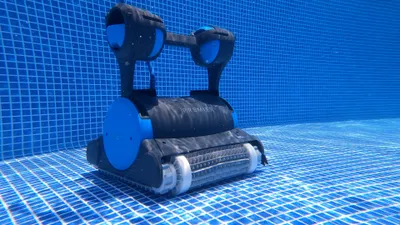
Cleaning. A robotic cleaner works mostly on its own, but it needs storage and, depending on the model, a code-compliant outlet or charging area. Choose pressure-side, suction-side, or in-floor cleaning before construction because those options change the plumbing.
Cover. Pick the exact cover before finalizing the shape, steps, spa, coping, and deck. Powered covers need tracks, a box, drainage, controls, and room for service.
UV and other extras. A UV system only treats water while it passes through the unit. It can be an extra layer, but it does not replace chlorine in the pool.
Our must-have pool equipment guide goes deeper. Use it to ask better questions, then let your builder and licensed trades size and install the final system.
Common Pool Design Mistakes
The most expensive mistakes are rarely one bad product. They are usually choices nobody planned together:
Sizing for the rare event. Design around normal use, then confirm the deck and utilities can handle occasional guests.
Choosing the outline before mapping the site. Survey, access, grade, drainage, easements, utilities, barriers, and cover strategy can settle the shape before style does.
Counting a shelf as swim space. Draw ledges, steps, benches, spas, and floor transitions inside the waterline so the remaining clear water is obvious.
Buying finishes before the pool can run. Protect the budget for plumbing, water care, electrical work, drainage, service access, and the equipment that works every day. Our costly pool mistakes guide explains why.
Hiding the equipment at any cost. Distance, elevation, turns, sound, ventilation, flooding, and service room all matter. Let the plumbing math and product instructions decide where it can go.
Ignoring the yard throughout the day. Sun, shade, wind, privacy, roof runoff, and debris patterns change how the pool and deck feel and how often they need attention.
Leaving no maintenance access. Every wall, cover component, drain, skimmer, and piece of equipment needs a practical service path.
Comparing incomplete prices. Ask each builder to identify deck, utilities, barriers, drainage, permits, allowances, access restoration, landscaping, startup, and exclusions. See the pool-buying mistakes guide.
Adding features without adding their systems. Require the flow, power or fuel, controls, drainage, winterization, cleaning, and repair plan for each one.
Waiting on choices that get built into the shell. Covers, spas, heaters, lights, cleaners, and spare conduit are much easier to plan before digging, even if some equipment comes later.
Build the first version on paper, compare it in the Pool Designer, then study the closest example pool plan. Expect the layout to change after a site visit; added detail does not have to mean added features.
Pool Design FAQ
What pool shape is the best starting point?
There is no best shape for every yard, but a rectangle is the practical default. It uses space well, works for swimming, and is usually easier to cover. A 16 by 32 foot pool is a useful family-size reference, but the site, budget, and daily use should decide the final dimensions.
What is the best pool shape for a small backyard?
Usually the simplest shape that fits the usable part of the yard. A small rectangle, narrow pool, or plunge pool often leaves more room for the deck than a complicated curve. Check setbacks, access, drainage, barriers, and the equipment location before falling in love with a size.
How big should a backyard pool be?
Size it for the people who will use it most often. A 12 by 24 foot pool can be plenty for cooling off; 16 by 32 feet is a useful family reference; regular lap swimmers usually want more length. More water also costs more to build, heat, cover, and clean.
Are freeform pools more expensive than rectangular pools?
Often, but not always. Curves usually mean more layout work, coping cuts, and a harder cover. Soil, access, finishes, decking, and local labor may matter even more, so compare itemized quotes for the same pool.
What pool features are worth the money?
Spend first on the things you will notice every week: well-designed circulation, enough filter area, reliable water care, easy equipment access, lighting, and a useful cover. A ledge or spa can be worth it if your family will use it. For everything else, ask how much room, plumbing, power, cleaning, and repair it adds.
Should I design my pool before talking to a builder?
Yes. Make a clear wish list first, then expect the builder to adjust it after seeing the property. Giving every builder the same starting idea makes quotes much easier to compare. Our Pool Designer is for that conversation; it is not a construction plan.
What should I decide first when designing a pool?
Start with two things: where the full project can fit, and what you want to do in the pool most. Check access, sun, drainage, privacy, and equipment space. Then decide whether the pool is mainly for play, exercise, lounging, entertaining, or spa time. The shape and features get much easier after that.
The Pool Nerd
Your resident pool aficionado.
For over 5 years, The Pool Nerd has been a leading independent source in the swimming pool industry. With years of hands-on experience testing pool products and owning a swimming pool, our goal is to help make pool ownership easier.
30+ Products Tested 2.8M+ YouTube Views 5+ Years Testing
Three ways to plan
Start with an idea. Leave with a builder brief.
Browse designs, test your choices in the 2D tool, and compare the closest example plans. Everything here is free and works without an account.