
 Justin D.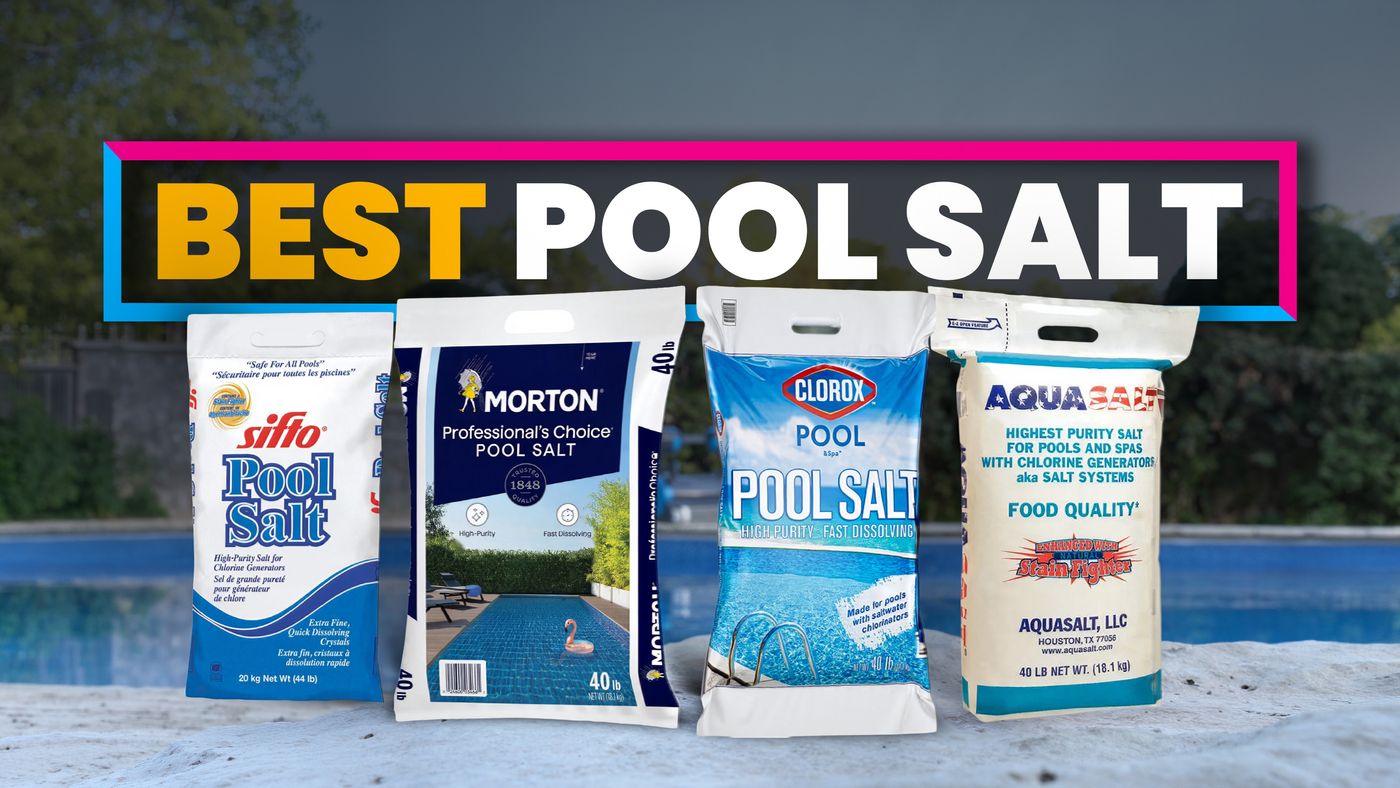
The wrong bag of salt can turn a cheap chemical purchase into an expensive cell or finish problem. A salt generator wants high-purity sodium chloride. Iodine, anti-caking agents, deicing blends, and mystery minerals have no business going into the pool unless the equipment manual expressly permits them.
Morton Pool Salt is my best overall pick because its additive-free formula is clearly documented. Aqua Joe is a practical 40-pound option once its current purity label checks out. AQUASALT needs closer scrutiny because of conflicting additive documentation, while Aromasong's 5-pound bag is easier to measure and store for a compatible saltwater spa.
Before opening any of them, test the water and use the salinity target in your own cell manual. A saltwater pool is still a chlorine pool: the cell converts dissolved salt into sanitizer, but salt alone does nothing to disinfect the water. If you need the generating equipment too, start with my best salt chlorine generators guide.
The Best Pool Salt: Our Picks


1. Morton Pool Salt — Best Overall Pool Salt
Morton takes the top spot because its formulation checks the important boxes: high-purity sodium chloride intended for pools, with no iodine or anti-caking agents. That is exactly what most salt-cell manuals ask owners to buy.
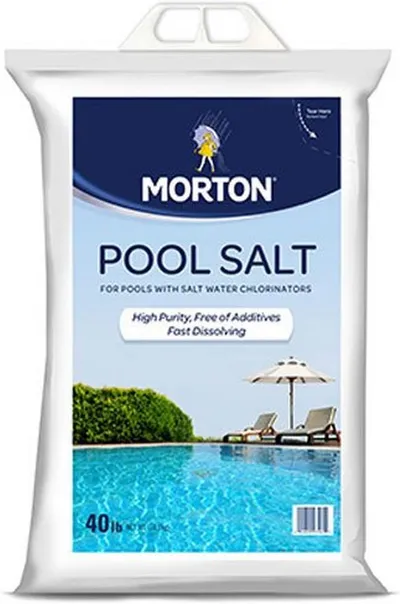
The linked option is a 40-pound bag, a useful size for pool startups and larger corrections. Morton's carry, open, and pour features also make a difference when several bags have to move from the driveway to the water.
Check the current label against your generator's minimum purity requirement, then compare the delivered price per pound. Pool salt is a commodity purchase once the formula is right, so there is no reason to pay extra for vague promises about softer or "healthier" water.
Check Morton Pool Salt on Amazon →
2. Aqua Joe 40-lb Pool + Spa Salt — Best for Routine Pool Top-Ups
Aqua Joe AJ-PS40 is sold for chlorine generators and automatic sanitizing systems. Its most useful specification is practical: one 40-pound bag raises salinity by approximately 480 ppm in 10,000 gallons.
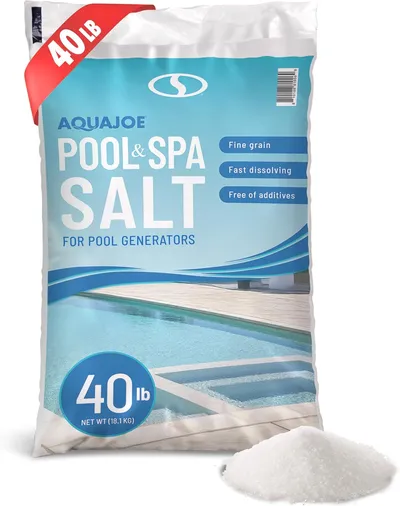
That works out to roughly 480 ppm by standard salt-dose math, so the bag size is easy to plan around. It is still only a planning reference. Test the water and calculate the actual shortfall before opening the bag; a controller's low-salt light is not a dosing measurement.
Aqua Joe's product page does not state a numerical purity percentage. If your cell requires 99.8% sodium chloride or better, confirm that number on the current bag before buying. Choose a salt with a clearly stated purity when the label cannot confirm your equipment's minimum.
The fast-dissolving claim describes how quickly the crystals disappear, not how quickly the entire pool mixes or the cell updates its reading. Aqua Joe is a solid top-up option when the formula checks out and its delivered price is competitive.
Check Aqua Joe Pool Salt on Amazon →
3. AQUASALT Pool Salt — Best Evaporated Option, Pending Compatibility
AQUASALT is produced in the United States with an evaporated food-grade process and sold in 40-pound bags. United Salt describes it as greater than 99% sodium chloride for pool and spa chlorine generators.
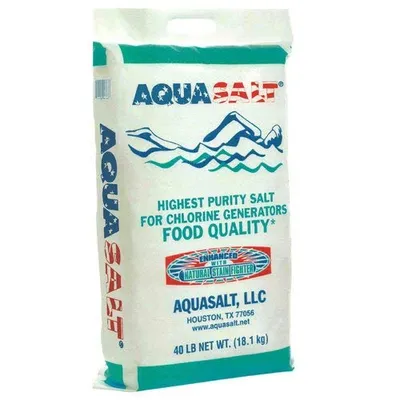
The evaporated process is a manufacturing detail; this is still pool salt, not table salt. More importantly, "greater than 99%" is not specific enough for a generator manual that requires at least 99.8% sodium chloride.
There is also an additive conflict to resolve. An older safety data sheet still linked on AQUASALT's website mentions trace yellow prussiate of soda, an anti-caking agent, while Hayward's AquaRite manual specifically prohibits salt containing it.
Use AQUASALT only when the current bag and product-specific safety data confirm both the purity your cell requires and the absence of prohibited additives. If you cannot confirm those points, skip it. That makes AQUASALT a conditional pick rather than a default recommendation.
Check AQUASALT Pool Salt on Amazon →
4. Aromasong Dead Sea Pool & Hot Tub Salt — Best for Compatible Saltwater Hot Tubs
The linked Aromasong product is a 5-pound package marketed as 99.9% pure sodium chloride for saltwater chlorine generators. It earns the hot-tub category because the smaller bag is easier to measure and store; the "Dead Sea" name does not give the salt special sanitizing power.
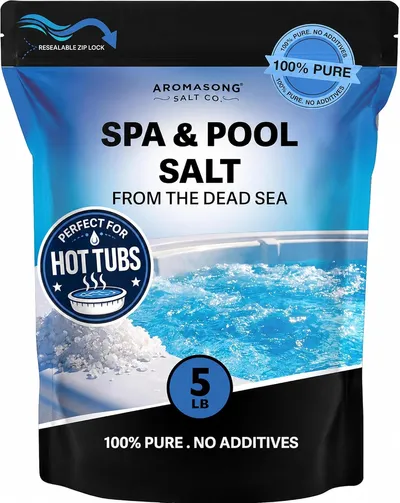
Five pounds is manageable for small spa adjustments and avoids storing an open 40-pound pool bag. Buy this specific pool-and-hot-tub sodium chloride product, not ordinary mineral bath salts from the same brand.
Your spa still needs an approved saltwater system, and its target salinity may be far lower than a pool's. Match the current product label to the spa manufacturer's salt requirements before adding any of it.
Check Aromasong Pool & Hot Tub Salt on Amazon →
How to Choose the Best Salt for Your Pool
Let the equipment manual set the standard
Read the salt section in your generator manual before comparing bags. Pentair's IntelliChlor Plus/LT instructions, for example, specify at least 99.8% pure sodium chloride and recommend evaporated, granulated, non-iodized salt without additives. Treat that purity number as a pass-or-fail requirement.
The ingredient should be sodium chloride. Rock salt, ice melt, and mineral blends can introduce contaminants or entirely different salts. Calcium chloride, potassium chloride, and sodium bromide are not substitutes for the sodium chloride a salt cell is designed to use.
Confirm the whole pool is salt-compatible
The buying rules are the same for above-ground and inground pools. The pool manufacturer must permit saltwater operation, the heater and other equipment must be compatible, and the salt must meet the cell's written requirements. A recommendation on a bag cannot override a warranty or material restriction.
Compare delivered cost and usable bag size
Divide the delivered price by the bag weight. Shipping can turn the cheaper-looking option into the expensive one.
Then buy a size you can measure and store properly. A 40-pound bag suits pool startups and larger corrections; a smaller package gives spa owners better control over one- or two-pound adjustments.
Saltwater vs. Chlorine Pools: Why Choose Salt?
The practical comparison is generated chlorine versus manually added chlorine. A saltwater system uses electricity and dissolved salt to make the same sanitizer a conventional pool receives from products such as liquid chlorine.
Convenience is the reason to install a salt system. A correctly sized cell produces chlorine during scheduled pump operation, which reduces routine pouring and handling. You still test free chlorine, adjust cell output as swimmer load and weather change, and keep pH and the rest of the water balance in range.
The equipment adds ownership costs. Cells collect scale when water balance permits it, need periodic inspection, and eventually wear out. My best salt cells guide covers replacement options and costs.
Check the heater, pool structure, fasteners, and surrounding materials before converting. Hayward specifically recommends consulting a qualified specialist about natural stone around a saline pool. Follow material restrictions and rinse splash-prone surfaces as directed instead of assuming every backyard finish tolerates salt exposure the same way.
For the full head-to-head, read my saltwater vs. chlorine pools comparison. Thinking about switching? Start with converting a chlorine pool to saltwater.
How Much Salt Should You Add to a Pool?
Every salt dose starts with three numbers: the pool's actual water volume, a measured salinity reading, and the target in the equipment manual.
Use the volume at the normal fill line, not exterior wall dimensions or a rounded marketing capacity. If the pool has benches, steps, a shallow end, or thick inflatable walls, those features reduce the amount of water in the vessel. Test current salinity even after a fresh fill because source water and previous chemicals can already contribute salt.
Targets belong to the equipment. Hayward AquaRite specifies 2,700–3,400 ppm, with 3,200 ppm optimal. Pentair IntelliChlor Plus/LT uses a 3,600 ppm ideal. Hot Spring's FreshWater startup guidance targets 1,750 ppm. Do not borrow a target from a different pool or spa system.
For high-purity sodium chloride, use this estimate:
| Pool volume | Raise salt by 500 ppm | Raise salt by 1,000 ppm |
|---|---|---|
| 10,000 gallons | 41.7 lb | 83.4 lb |
| 15,000 gallons | 62.6 lb | 125.1 lb |
| 20,000 gallons | 83.4 lb | 166.8 lb |
Use the table to plan the dose, then hold back roughly 10% until the first addition has fully mixed. Pool-volume estimates and salinity readings both have tolerances, while excess salt usually has to be corrected by draining and replacing water.
A 15,000-gallon pool moving from 2,800 to 3,200 ppm needs approximately 50 pounds. Add most of that amount, circulate, retest, and use the remaining salt only if the reading is still short of 3,200 ppm.
A 400-gallon spa starting at zero needs approximately 5.8 pounds to reach 1,750 ppm. One 5-pound Aromasong bag would fall short of that complete startup dose, although the spa's instructions may direct you to begin with an even smaller portion and retest.
How to Add Salt to Your Pool
Gather the equipment manual, approved salt, a dependable salinity test, a pool brush, and a scale for partial bags. Keep your chlorine and pH test kit nearby as well. A digital salt meter or the Taylor K-2006 salt test kit gives you a separate reading instead of making the controller display your only reference. My pool-water testing guide explains how that manual check fits with strips and continuous monitors.
- Measure salinity and water volume. Test before opening a bag, calculate the ppm increase, and weigh any partial-bag dose. A warning light alone does not tell you how many pounds to add.
- Start circulation and follow the cell's salt-addition procedure. Keep chlorine generation off during addition and mixing wherever the manual directs. Never bypass a flow switch or another safety control.
- Distribute the salt over the pool surface. Walk the perimeter and pour gradually. Keep salt out of the skimmer and do not leave an entire bag in one concentrated pile.
- Brush the floor, steps, and benches. Move every visible crystal until no piles remain against the finish.
- Circulate for the full mixing period. Hayward's AquaRite instructions call for 24 hours of circulation after addition. Dissolved crystals do not mean the full water volume is uniformly mixed or the controller has caught up.
- Retest before normal operation. Confirm salinity with a separate test, then check free chlorine and pH. Set cell output only after the water is inside the system's operating range.
New plaster and resurfaced finishes often require a salt-free startup period. Follow the finish manufacturer's schedule before adding any salt.
Hot tubs use their own startup sequence. Hot Spring, for example, directs owners to run the jets, begin with half the recommended amount, and test before adding more. Follow the spa procedure rather than shrinking a pool dose and assuming the steps are otherwise identical.
Saltwater Pool Maintenance Still Matters
A normal salt reading only tells you the cell has raw material. It does not confirm that the cell is producing enough chlorine. Test free chlorine and pH routinely, along with alkalinity, calcium hardness, stabilizer where appropriate, and salinity.
CDC recommends checking chlorine and pH at least twice daily and more often during heavy use. Clear water can still be under-sanitized, especially after a hot, sunny day or a large swimmer load.
Inspect the cell on the schedule in its manual. Scale on the plates needs attention, but a reminder light is not proof that acid cleaning is required. Hayward says a cell with no visible deposits can be reinstalled; unnecessary cleaning only exposes the plates to more wear.
Salt quality cannot compensate for poor water balance, inadequate circulation, or a cell set too low for current demand. My saltwater pool maintenance guide covers the full routine. A pool water monitor can make trends easier to follow, but it does not replace the tests required by your system.
Pool Salt FAQs
How often should I add pool salt?
Add salt only when a reliable test puts the water below your system's target. Salt does not evaporate, so routine weekly dosing is unnecessary. Levels fall when salty water leaves through splash-out, backwashing, draining, or overflow and is replaced with fresh water.
Can I use water-softener salt in my pool?
Only when the exact product meets the generator manual. Hayward permits certain high-purity sodium chloride products, including some pellets, while prohibiting iodine and anti-caking additives. Read the ingredients and purity on the current bag; water-softener salt is a category, not a single formula.
Can I swim immediately after adding salt?
Follow the equipment instructions and wait until the dose has dissolved and circulated. Swim only after testing confirms appropriate sanitizer and pH. "Fast dissolving" is not a universal clearance time.
What happens if I add too much salt?
Excess salinity can trigger warnings, stop chlorine production, or put the cell outside its operating range. Correction usually means draining a calculated portion and replacing it with fresh water. Do not completely drain a pool to fix salt; have a pool professional plan safe dilution when structural or groundwater conditions are uncertain.
The Pool Nerd's Bottom Line
Morton is the best overall pool salt here because its additive-free formulation is clear and its 40-pound bag is practical. Choose Aqua Joe for routine pool corrections after confirming the current purity label, and use Aromasong when a compatible saltwater hot tub calls for a smaller package.
AQUASALT stays conditional. Its current label and safety data need to satisfy your cell's purity and additive restrictions before it belongs in the water.
The right purchase is plain sodium chloride that meets the manual. The right dose comes from actual water volume, measured salinity, and a retest after circulation.
GET THE BEST POOL GEAR DEALS
I post the freshest discounts on salt systems, ICO monitors, robotic pool cleaners, and all my favorite pool gear at ThePoolNerd.com/deals. Want to keep nerding out over your pool? Subscribe to The Pool Nerd on YouTube for weekly reviews and head-to-heads. Until next time — enjoy that pool.
Related Reading
- Pool Salt Calculator — Get your exact dose before you open a bag
- Best Salt Chlorine Generators — The equipment that turns this salt into chlorine
- Best Salt Cells — Replace the cell, not the system
- Saltwater Pool Maintenance — The routine that keeps a salt pool clear
- Saltwater vs Chlorine Pools — The honest comparison, corrosion and all
- Converting Chlorine to Saltwater — Thinking about switching? Start here
- Best Pool Water Monitors — Automate the testing a salt pool still needs
- Best Way to Test Pool Water — Build a dependable manual and continuous testing routine




Comments
Loading comments…