
 Justin D.
You can have balanced water and an excellent filter, but neither can do its job well without enough circulation. Your pump has to move water through the filter and other treatment equipment, then distribute that treated water around the pool.
A lot of pool owners are told to run the pump for eight hours a day. But that is like running your air conditioner for exactly four hours no matter how large your house is or how hot it gets. Eight hours may work for some pools, but it is not a universal rule.
What matters is how much water your system actually moves. That is where pool turnover comes in.
Hey there, and welcome back to The Pool Nerd. I'm Justin, your resident pool aficionado. In this guide, I'll explain what pool turnover means, how to calculate it, and how to build a pump schedule that keeps your water moving without wasting electricity.
The Quick Answer
For most residential pools, use one calculated turnover per day as a practical starting point. Move closer to two when the pool gets heavy use, collects lots of debris, has weak circulation, or needs more pump time for a salt cell, heater, UV system, or other equipment.
Turnover time in hours = pool gallons ÷ actual GPM ÷ 60
Turnover is a planning tool—not proof that every gallon was filtered or that the water is properly sanitized.
If you are shopping for a replacement, start with my complete guide to the best pool pumps. I also have dedicated rankings for the best variable-speed pool pumps and best two-speed pool pumps, including picks for inground and above-ground pools.
What Is Pool Turnover?
One turnover means moving an amount of water equal to the total volume of your pool through the circulation system.
If you have a 20,000-gallon pool:
- Moving 20,000 gallons equals one calculated turnover.
- Moving 30,000 gallons equals 1.5 turnovers.
- Moving 40,000 gallons equals two turnovers.
But that does not mean every gallon passed through the filter exactly once. Pool water is constantly mixing. Some water may travel through the system several times, while water in a poorly circulated corner may move much more slowly.
Turnover is best used as a planning metric. It tells you how much water your pump theoretically moves, but it does not tell you whether the pool is clean or properly sanitized.
Your pump moves the water. Your filter catches debris. Your sanitizer controls algae and harmful microorganisms. You need all three working together.
Running the pump longer will not make up for low sanitizer, incorrect pH, a clogged filter, or badly positioned return jets. If you want the broader runtime strategy after doing the turnover math, read my guide on how long to run a pool pump.
How Many Turnovers Does a Pool Need?
For most residential pools, one to two calculated turnovers per day is a useful operating range—not a health guarantee or a rule that every pool must follow.
Start around one turnover and watch how the pool responds. Move closer to two if you have:
- Heavy swimmer use
- Lots of leaves, pollen, or other debris
- Weak skimming or obvious dead spots
- A salt cell that needs more production time
- A heater, UV system, cleaner, or water feature that needs additional runtime
- Water-clarity problems after chemistry and filter condition have been checked
You do not automatically need three or four turnovers just because you live somewhere hot. Extra circulation also will not fix algae caused by inadequate sanitizer.
Residential Pools Only
These are planning targets for private backyard pools. Commercial, public, shared, and some semi-public pools usually have turnover requirements set by local health codes. Follow the applicable code rather than this residential rule of thumb.
How to Calculate Pool Turnover
You only need two numbers for a single-speed calculation:
- Your pool volume in gallons
- Your pump's actual flow rate in gallons per minute, or GPM
If you do not know your pool volume, use the pool volume calculator before estimating runtime.
Turnover-Time Formula
Turnover time in hours = pool gallons ÷ GPM ÷ 60
Suppose you have a 20,000-gallon pool and your system is moving 50 GPM:
20,000 ÷ 50 ÷ 60 = 6.67 hours
That is about six hours and 40 minutes for one calculated turnover.
Now see what happens if that same pump runs for eight hours:
50 GPM × 60 minutes × 8 hours = 24,000 gallons
In a 20,000-gallon pool, that equals:
24,000 ÷ 20,000 = 1.2 turnovers
The old eight-hour rule works reasonably well in this example. Change the pool size or flow rate, though, and the answer changes completely.
Daily-Turnover Formula
If you already know the runtime and want to calculate daily turnovers, use:
Daily turnovers = GPM × 60 × runtime hours ÷ pool gallons
You can run both calculations—and compare electricity use—with the free pool pump runtime and energy calculator.
The Biggest Mistake: Guessing Your Flow Rate
A turnover calculation is only useful when the flow rate is reasonably accurate.
Pump horsepower does not tell you the actual GPM in your pool. Your pump's RPM setting alone does not tell you either.
Real flow depends on:
- The pump model and its performance curve
- Pump speed
- Pipe diameter and length
- Fittings and valve positions
- Filter type and condition
- Heater, chlorinator, UV system, and other restrictions
- Water level and suction conditions
- Total dynamic head, or the complete resistance in the system
That means two pools can use the same pump at the same RPM and still move very different amounts of water.
Some modern pumps estimate flow. For a more direct reading, use a properly selected and installed flow meter. You can also estimate flow from the manufacturer's pump curve if you know your total dynamic head.
If you have a variable-speed pump, record the approximate GPM and power use at every speed you actually run. Do not measure high-speed flow and use that number for the entire day. Flow and wattage change whenever pump speed changes.
Use the pool pump size calculator if you need help estimating required flow and head before selecting a pump. Then confirm the result against the exact model's published pump curve.
Variable-Speed vs. Two-Speed Pumps
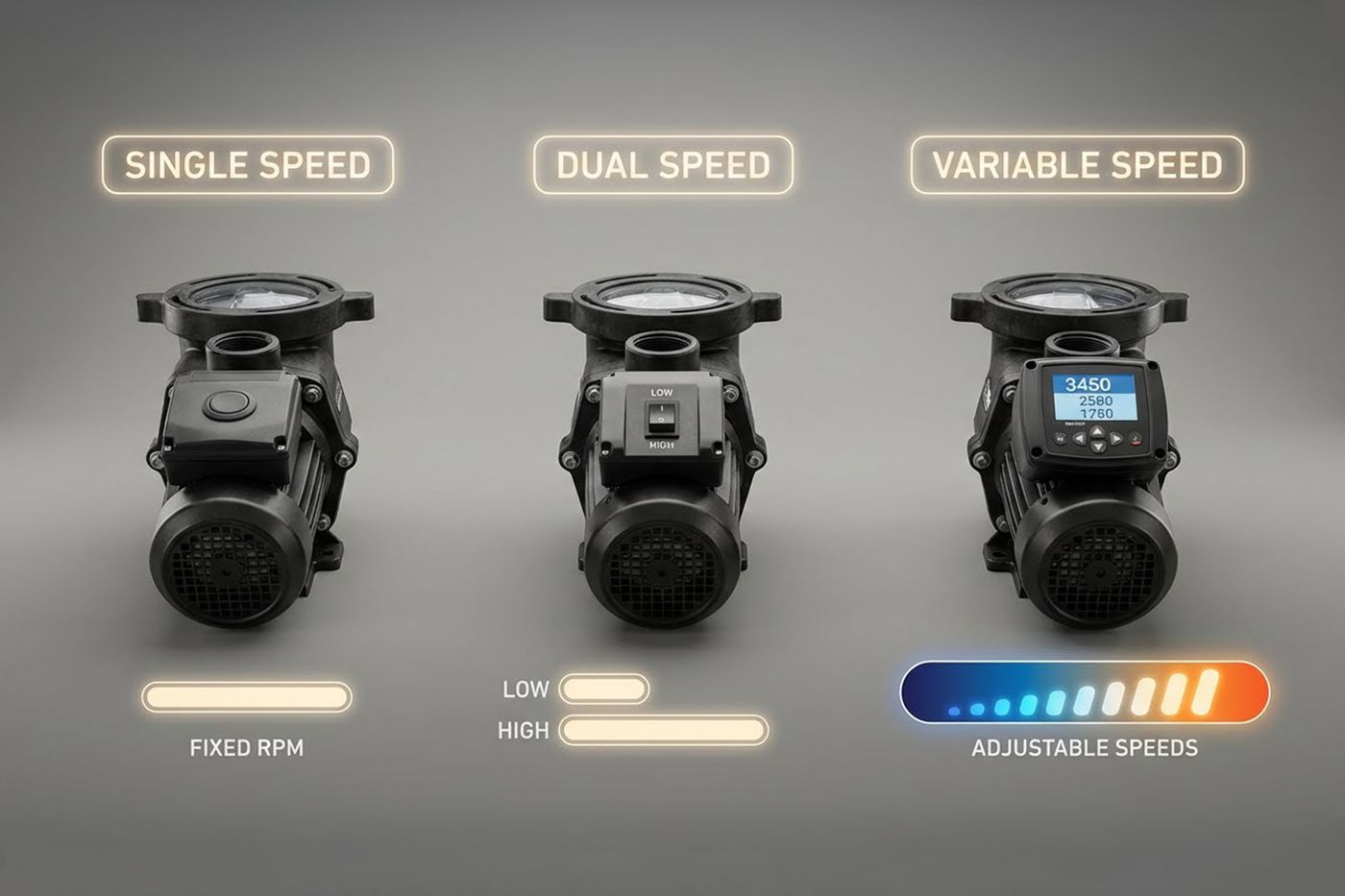
A two-speed pump gives you a high setting and a low setting. That is already a meaningful improvement over running a single-speed pump at full power every time it turns on.
A variable-speed pump gives you finer control. You can use:
- A lower speed for everyday circulation
- A medium speed for stronger skimming or chlorine production
- A higher speed for a heater, spa, cleaner, backwash cycle, or water feature
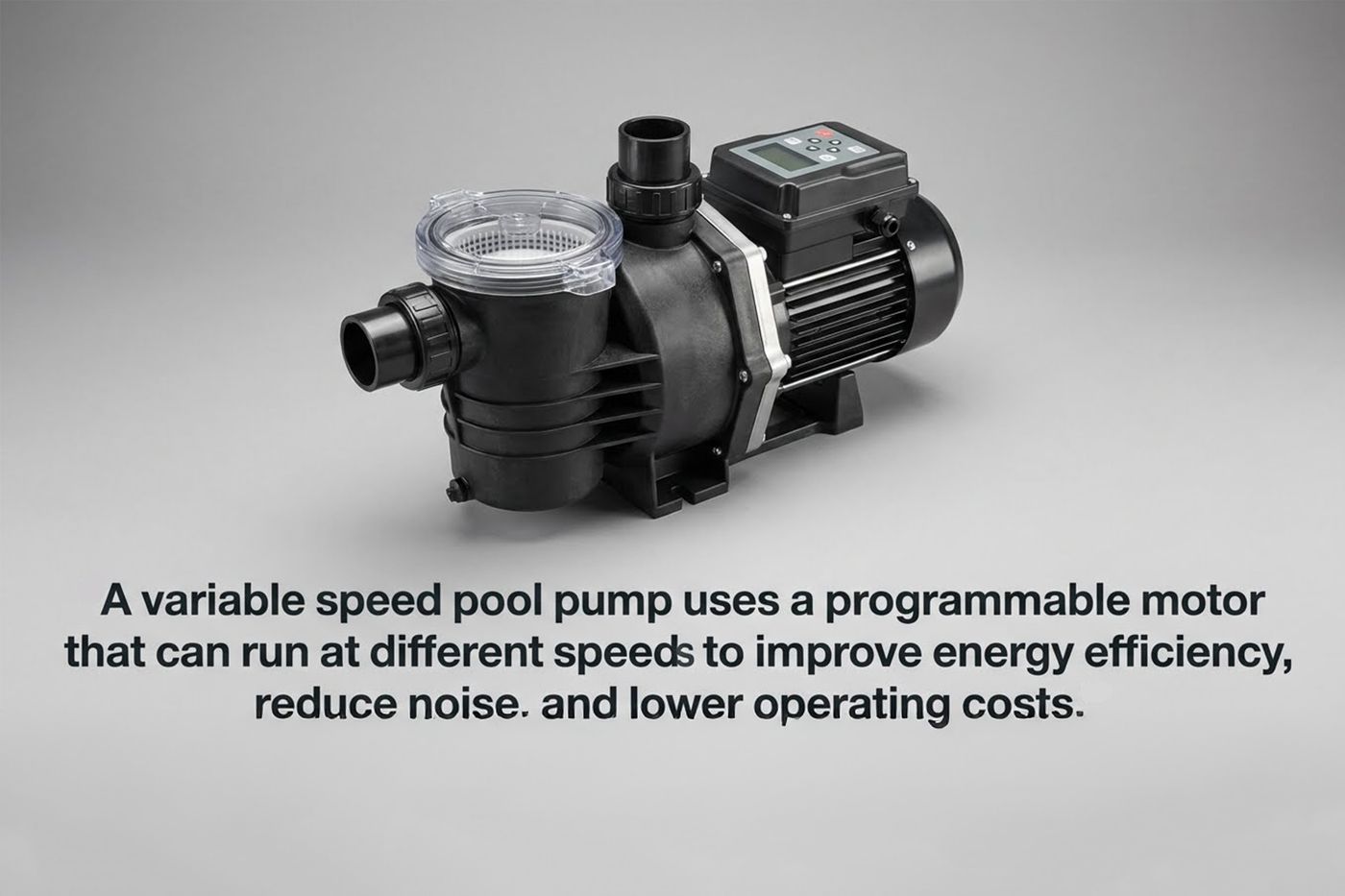
That flexibility is why I usually recommend a correctly sized variable-speed model when replacing an old single-speed pump or building a new pool.
But that does not mean you should immediately replace a working two-speed pump. Compare installed cost, current electricity use, expected savings, and how well the two available speeds serve your equipment.
For current models and buying advice, compare my top variable-speed pool pumps with the best two-speed pool pumps. For a broader look at every pump type, use the main pool pump buying guide.
Why Lower Speeds Can Save So Much Electricity
Variable-speed pumps save energy because power demand drops quickly as motor speed comes down.
Under ideal affinity-law conditions, cutting pump speed in half can reduce power demand by up to about 87.5%, dropping it from full power to roughly one-eighth. Real pools will not match the ideal law perfectly because static lift, equipment restrictions, and motor efficiency affect the result.
The trade-off is lower flow. If flow is cut roughly in half, the pump may need to run about twice as long to move the same amount of water. Even then, total energy use can still fall sharply.
Here is an illustrative comparison:
- One setting moves 60 GPM for eight hours while using 1,500 watts. It circulates 28,800 gallons and uses 12 kilowatt-hours.
- Another setting moves 30 GPM for 16 hours while using 250 watts. It circulates the same 28,800 gallons and uses four kilowatt-hours.
The second schedule runs twice as long but uses one-third as much electricity in this example.
Those numbers are not a savings guarantee. Use the flow and watt readings from your own installed pump, then compare equal amounts of circulated water with the pump runtime and energy calculator.
How to Build a Variable-Speed Schedule
The easiest way to build your schedule is with my completely free variable-speed pool pump schedule calculator. Enter your pool size, flow at each speed, turnover target, and minimum equipment runtimes, and it will do the math for you.
When your pump changes speeds during the day, calculate each block separately:
Gallons circulated = GPM × 60 × hours
Add the gallons from every speed, then divide the total by your pool volume:
Daily turnovers = total gallons circulated ÷ pool gallons
For example, a 20,000-gallon pool might use this 24-hour schedule:
- High speed moves 7,200 gallons
- Medium speed moves 14,400 gallons
- Low speed moves 19,200 gallons
- Total daily circulation is 40,800 gallons
- 40,800 ÷ 20,000 = 2.04 calculated turnovers
That is an example—not a universal schedule to copy.
When it comes to pump speed, lower is not always better. At only 25 GPM, moving 40,000 gallons would take more than 26 hours. Your goal is the lowest useful speed, not the lowest possible RPM.
Let Your Equipment Set the Minimum Speed
A schedule can look perfect on paper while your equipment is not getting enough flow to operate correctly.
A saltwater chlorine generator needs enough flow to activate its flow switch. It also needs enough runtime at that flow to produce the chlorine your pool uses. A heater has a minimum flow requirement, too.
The same principle applies to:
- UV systems
- Solar heaters
- Pressure-side cleaners
- Spa spillovers
- Fountains and water features
- In-floor cleaning systems
- Automated chemical feeders
If you use SpectraLight UV, remember that it treats only the water passing through its chamber. Follow its specified flow range and make sure the schedule provides enough useful runtime.
If you use automated liquid-chlorine injection, the dosing system should feed only when adequate circulation is confirmed. A proper flow interlock—a safety control that stops chemical feed when water is not moving—is safer than simply placing the pump and feeder on matching timers.
An ICO water monitor can help you track pH, temperature, and ORP trends. It does not measure GPM, however, so use it to support turnover planning and regular water testing—not replace them.
Never Defeat a Flow Switch
If a heater, salt cell, UV system, or feeder will not operate at low speed, raise the flow or schedule that equipment during a higher-speed block. Never bypass a safety or flow switch just to make a low-RPM schedule work.
Before You Add More Pump Hours
If circulation looks weak, do not immediately add several hours to the schedule.
First, check:
- Pool water level
- Skimmer and pump baskets
- Filter pressure and condition
- Valve positions
- Return-jet direction
- Whether the pump is fully primed
- Whether air is entering the suction side
Also confirm that the problem is actually circulation. Cloudy water and algae are often caused by weak sanitation or poor filtration—not simply a lack of pump runtime.
If you hear unusual noises, notice leaks, lose prime, or see the pump repeatedly shut down or overheat, diagnose the equipment problem. Do not try to cover it up by running the pump longer.
Never run a pump dry, and always follow the manufacturer's shutdown and pressure-relief instructions before opening the pump, filter, or other pressurized equipment.
What About Winter?
Do not confuse a shorter winter schedule with freeze protection or winterization.
A pool that stays open may need less circulation in cooler water, but there is no universal rule that every pool should run four hours in winter. Reduce runtime gradually and keep watching water clarity, sanitizer levels, skimming, and equipment operation.
Freeze protection needs its own plan. An automatic freeze setting cannot protect the pool during a power outage, and it may not move water through every exposed pipe or piece of equipment.
If you close the pool for winter, follow a complete winterization process instead of relying on a normal turnover schedule.
Frequently Asked Questions
Does a robotic pool cleaner count toward turnover?
Not for this calculation.
A robotic cleaner moves and filters water inside the pool while collecting debris from the floor, walls, or waterline. That is useful, but you should not add the robot's advertised flow rate to the main pump calculation.
Water moving through a robot is not passing through your main filter, heater, chlorinator, or UV system. Treat the robot as a bonus for cleaning and local circulation—not a replacement for your pool pump.
Should you run the pool pump 24/7?
You can, but you do not always need to.
Continuous low-speed operation can use less electricity than a shorter high-speed schedule. It may also improve skimming and keep sanitizer distributed more consistently.
But the speed still has to be useful. If the skimmers are not working or other equipment cannot activate, that low setting may not accomplish the jobs you need.
Running only at night is not automatically cheaper, either. It saves money only if your electric company offers lower off-peak rates. Use higher speeds for tasks that require them, then fill the rest of the schedule with efficient lower-speed circulation where it makes sense.
Is one pool turnover per day enough?
One calculated turnover is a reasonable starting point for many residential pools. It may be enough when sanitizer, clarity, skimming, and equipment operation remain stable. Heavy use, high debris, dead spots, or equipment runtime requirements can justify moving closer to two.
Can a pool have too many turnovers?
Extra turnovers are not automatically harmful, but they can waste electricity and may push unnecessary flow through the filter and plumbing. Excessive flow can also exceed equipment limits. Once the pool is clear, sanitized, skimmed, and all equipment requirements are met, more circulation may provide little additional benefit.
How do I know my pool pump's GPM?
Use a properly installed flow meter for a direct reading. You can also estimate GPM from the pump's performance curve when you know total dynamic head. Do not infer GPM from horsepower or RPM alone.
Is eight hours enough for a pool pump?
It depends on pool volume and actual flow. A 20,000-gallon pool moving 50 GPM completes about 1.2 calculated turnovers in eight hours. A larger pool or lower-flow setting may move much less than one turnover in the same time.
My Final Verdict
The old eight-hour pool-pump rule is not completely useless. It is simply incomplete.
Your ideal schedule depends on pool volume, actual flow rate, equipment requirements, debris load, water chemistry, and electricity costs.
For most residential pools, start with roughly one calculated turnover per day and move closer to two when actual pool conditions or equipment needs justify it. Use lower speeds for efficient everyday circulation, then add shorter higher-speed periods for skimming, heating, chlorination, UV treatment, spa use, backwashing, or anything else that requires more flow.
Do not buy the biggest pump just because it moves more water. Do not judge efficiency by runtime alone. And do not assume more turnovers will solve a chemistry problem.
The best schedule gives your pool enough useful circulation and treatment while using as little electricity as practical.
To build your schedule, use the free variable-speed pool pump schedule calculator. Enter your pool size, flow rate at each speed, and turnover target to create a schedule based on your pool—not somebody else's random eight-hour rule.
If your current pump cannot meet that schedule efficiently, compare my best pool pumps, best variable-speed pool pumps, and best two-speed pool pumps before choosing a replacement.
Related Pool Pump Guides
- How Long to Run a Pool Pump
- Pool Pump Runtime and Energy Calculator
- Variable-Speed Pool Pump Schedule Calculator
- Pool Pump Size Calculator
- Best Pool Pumps
- Best Variable-Speed Pool Pumps
- Best Two-Speed Pool Pumps
- Pool Pump Reviews
This guide is for private residential pools. Follow the pump and equipment manufacturers' instructions, applicable electrical and health codes, and any local turnover requirements. Have electrical work and unfamiliar equipment service completed by a qualified professional.




Comments
Loading comments…