
 Justin D.
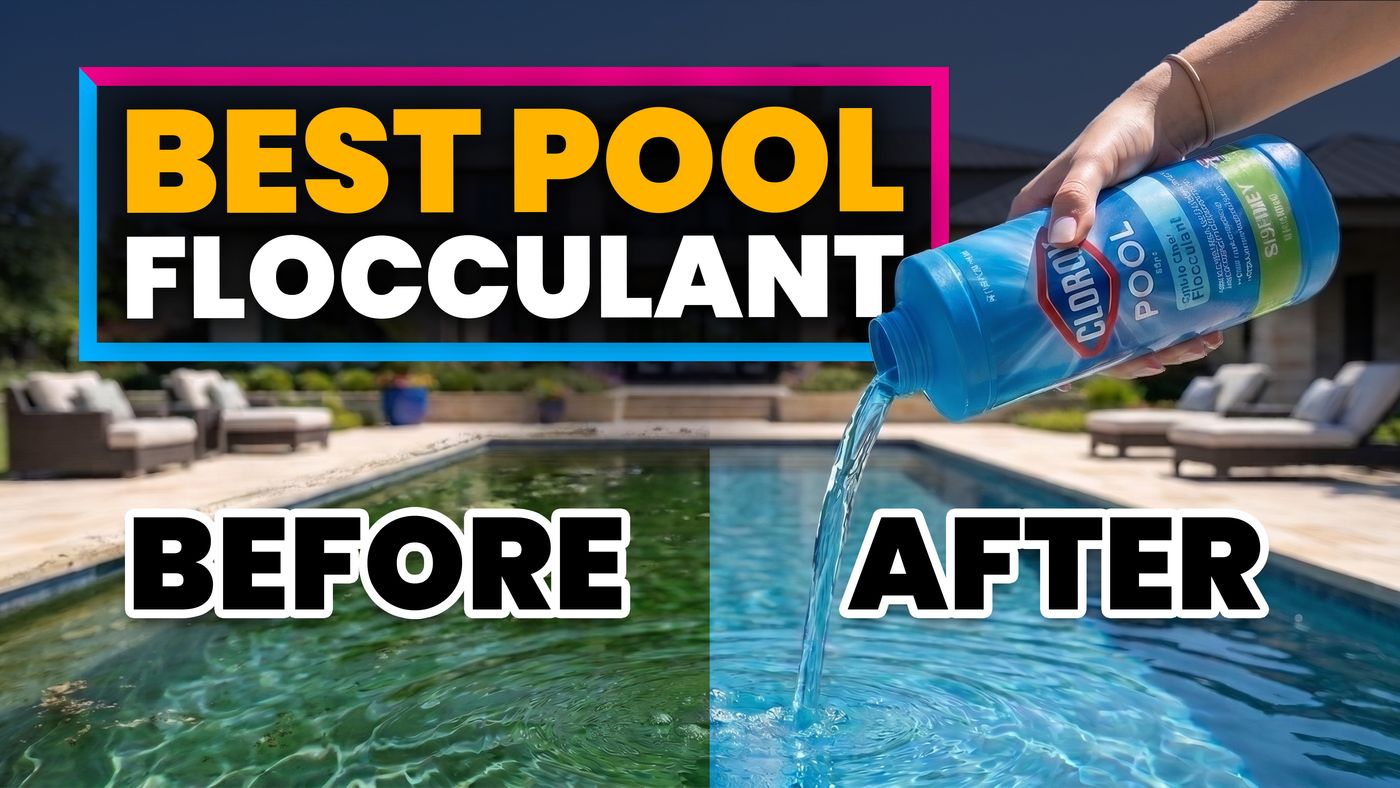
You shock the pool, run the pump, and come back the next morning expecting clear water. Instead, the pool is still a cloudy blue mess. The green may be gone, but you can barely make out the bottom.
That's where pool flocculant can help. Usually called pool floc, it gathers suspended particles into larger clumps that settle onto the pool floor. You then vacuum that layer out. It can be useful after an algae cleanup or when suspended debris leaves the water stubbornly cloudy.
But before you buy a bottle, check one thing: can you vacuum your pool to waste?
My straightforward pick is Clorox Pool&Spa Sink to Clear Flocculant for a pool with the right equipment. If you have a cartridge filter and no way to bypass it and discharge the dirty water, I'd choose Clorox Super Water Clarifier instead.
The other picks below are worth considering, too. The goal is to choose a treatment you can finish properly, including getting the debris out of the pool. If you haven't yet worked out why the water went cloudy, start with my how to clear cloudy pool water guide.
Best Pool Flocculants at a Glance
Best Pool Flocculants at a Glance


| Product | My recommendation | Type | How the debris leaves |
|---|---|---|---|
| Clorox Sink to Clear | Best overall | Settling flocculant | Vacuum to waste |
| BioGuard PowerFloc | Specialty option for heavy cloudiness | Settling flocculant | Vacuum to waste |
| HTH 67229 Drop Out | My HTH pick for saltwater pools | Settling flocculant | Vacuum to waste |
| HTH 67080 Drop Out | Another HTH listing to compare on value | Settling flocculant | Vacuum to waste |
| In The Swim Super Floc Out | Another option for overnight settling | Settling flocculant | Plan on vacuuming to waste |
| Clorox Super Water Clarifier | Best alternative without vacuum-to-waste | Filter-aid clarifier | Your filter captures particles |
I wouldn't pay more just because a bottle says "power" or "super." Look at the directions, your equipment, and the cost per treatment. And HTH isn't the only saltwater-compatible choice; Clorox also confirms saltwater compatibility for Sink to Clear.
MY QUICK VERDICT
If your filter valve has a Waste setting and you own a manual vacuum, buy Clorox Sink to Clear, follow the overnight settling window, and vacuum slowly to waste. If you run a cartridge filter with no bypass, skip the floc entirely and use Clorox Super Water Clarifier so the filter does the removal. Fix the sanitizer, pH, and filter problem that caused the cloud first, or you'll be buying another bottle next week.
What Pool Flocculant Actually Does
Cloudy water can contain particles small enough to stay suspended instead of settling. Floc helps gather those particles into heavier clusters. Once the water is left still, those clusters drop.
That means the mess is still in your pool. It has moved from the water onto the floor.

Vacuuming is part of the treatment. If you skip it, stir everything up, or send the settled material back through the wrong filtration setup, you haven't finished the job.
I'd consider floc when there's a substantial suspended-debris problem and a practical way to remove the resulting sediment. I wouldn't reach for it automatically every time the water looks a little dull.
First, check water balance, sanitizer, circulation, and the condition of the filter. High pH, inadequate sanitation, and filtration problems can all contribute to cloudy water. Buying another bottle won't repair the underlying problem. My pH calculator tells you how much acid or soda ash the correction takes.
Floc does not kill algae
Floc can help remove dead algae after treatment, but it doesn't replace the treatment that kills living algae. If the pool is still actively growing algae, address that first and follow the chemical labels for sequencing. HTH explicitly makes this distinction in its product guidance.
And clear water alone doesn't establish that a pool is safe to swim in. You still need appropriate sanitizer and pH readings.
Pool Flocculant vs Pool Clarifier
The difference matters more than the brand name.
| Question | Settling flocculant | Filter-aid clarifier |
|---|---|---|
| What does it do? | Forms larger clumps that settle | Helps particles become easier to filter |
| Where does the debris go? | Onto the pool floor | Into the filter |
| Does the pump keep running? | Only for the directed distribution period, then off for settling | Filtration continues as directed |
| What cleanup is required? | Slow vacuuming to waste | Filter cleaning as needed |
| Which would I choose? | A substantial debris cleanup with suitable plumbing | Light haze or a pool without waste vacuuming |
Floc can produce a noticeable settling result overnight, but you still have to vacuum and replace lost water. Clarifier often takes longer to clear the water through filtration, with less manual cleanup.
For a slightly hazy pool with a working filter, I'd usually start with correcting the cause and letting the filter work. A clarifier can help when needed. Creating a whole layer of sediment to vacuum may be more work than the problem calls for.
Check Your Filter Before Buying Floc
Vacuum-to-waste means the water you vacuum leaves the pool without passing through the filter media. It does not return through the pool's jets.
A suitable multiport valve may have both Recirculate and Waste settings. Recirculate bypasses the filter and returns water to the pool. Waste bypasses the filter and sends water out. Backwash is a different flow path and isn't a substitute for vacuuming to waste.
Here's how I'd approach the common setups:
- Sand filter: Check the valve. Having a sand filter doesn't automatically mean every required setting is available.
- DE filter: Confirm the plumbing and equipment instructions. Some systems have fewer valve options.
- Cartridge filter: Choose a compatible clarifier unless you have a properly configured way to bypass the filter during the required treatment stages and vacuum directly to waste.
- Above-ground pool: Make the decision from the equipment, just as you would with an inground pool. A small cartridge setup needs different handling from a sand system with a suitable multiport valve.
HTH specifically limits Drop Out to pools that can vacuum the settled material directly to waste. Clorox confirms its Super Water Clarifier can be used with cartridge, sand, and DE filters. If you're not sure which filter type you have, my complete guide to pool filters explains the differences.
Also check your sanitizer system. If you use a biguanide product such as SoftSwim, confirm chemical compatibility before choosing a flocculant; BioGuard's guidance specifically advises against PowerFloc in SoftSwim pools.
If you're unsure where the dirty water will go, sort that out before adding floc. A drain outlet somewhere on the system doesn't necessarily establish a usable vacuum-to-waste setup.
Clorox Sink to Clear Flocculant: Best Overall Pool Floc
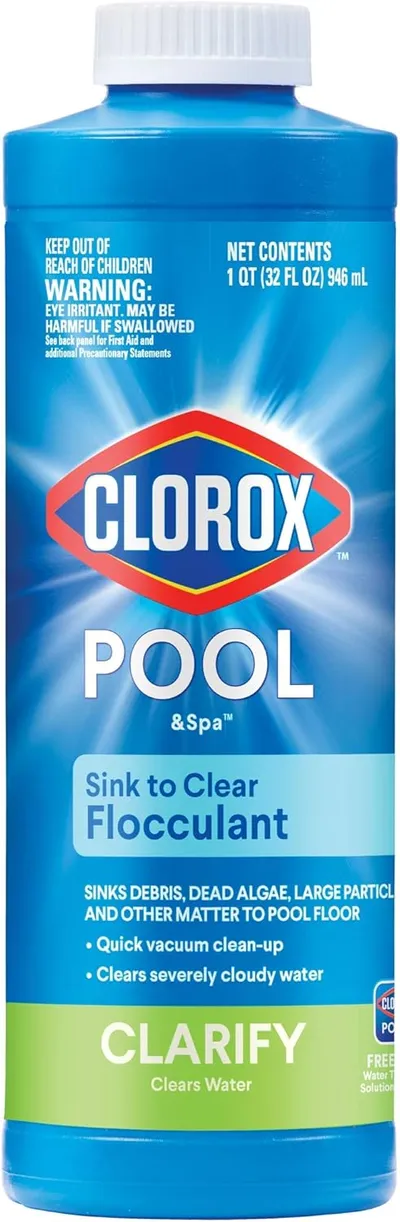
Clorox Sink to Clear is where I'd start when the pool needs a settling treatment and the equipment can handle the cleanup. Clorox positions it for severely cloudy water, including debris left after killing heavy algae and particles encountered during pool opening.
The appeal is a defined process: prepare the water, distribute the treatment, leave it still, and vacuum out what drops. That's a useful fit for someone who can set aside an overnight treatment period and time to clean the floor afterward.
The photographed bottle directions specify 8 fluid ounces per 10,000 gallons, two hours of circulation, then 12–24 hours undisturbed with the pump off. Treatment conditions include pH 7.5–8.0 and free chlorine 1–4 ppm, with pH returned to 7.2–7.6 after cleanup. Use your bottle's directions if they differ.
The catch is the work afterward. You need a manual vacuum arrangement that sends the sediment to waste, and you'll lose water during that process.
What I like: A clear role for substantial suspended-debris cleanup, with an explicit settling and removal process.
What to know: This is a different product from Clorox Super Water Clarifier. Check the name before checking out.
Check Clorox Sink to Clear on Amazon.
BioGuard PowerFloc: Best Specialty Option for Heavily Clouded Water
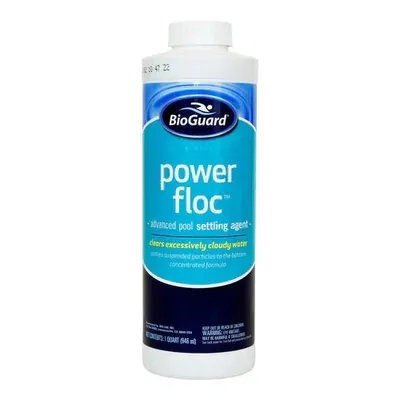
BioGuard PowerFloc is another option I'd consider when the water is heavily clouded with suspended material. BioGuard describes it as a concentrated settling treatment for excessive cloudiness, including the debris associated with algae blooms.
Its standard published dose is 8 fluid ounces per 10,000 gallons. The reproduced product directions call for pH 7.5–8.0, two hours of circulation, then 12–24 hours of undisturbed settling and vacuuming to waste.
That makes it a practical alternative for the same kind of cleanup as Sink to Clear. If you already get advice from a BioGuard dealer, being able to discuss the treatment with someone familiar with the product may also be useful.
I wouldn't interpret "concentrated" or "PowerFloc" as proof that it will clear your pool faster than every other bottle here. The published directions don't establish that kind of ranking.
What I like: A product specifically positioned for a substantial cloudiness problem.
What to know: Paying more doesn't eliminate settling time, vacuuming, or the need to correct the original cause of the cloudiness. Choose it for its fit with your cleanup, rather than assuming the name guarantees extra strength.
Check BioGuard PowerFloc on Amazon.
HTH 67229 Drop Out Flocculant: Best for Saltwater Pools With Waste Vacuuming
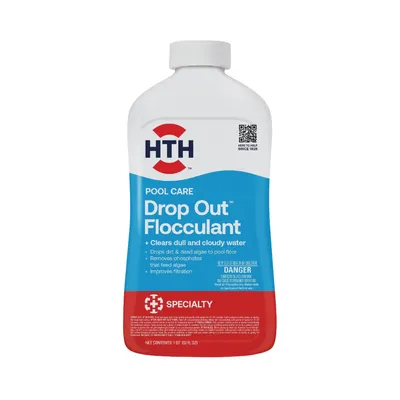
HTH Drop Out is a sensible option if you want a settling treatment with explicit saltwater compatibility. It performs the same basic job as the other flocculants: gather suspended material, let it settle, then remove it.
HTH's current Drop Out instructions specify 8 fluid ounces per 10,000 gallons, two hours of circulation, and overnight settling, followed by vacuuming directly to waste.
The important buying decision is still your plumbing. A saltwater pool with a cartridge filter and no bypass isn't ready for a floc treatment simply because the chemical is compatible with saltwater.
HTH also advertises phosphate removal. I'd treat that as a secondary feature. My reason for buying this product would be to remove suspended debris, while continuing to manage sanitizer and water balance.
What I like: Saltwater compatibility is clearly addressed in the product family's labeling.
What to know: The HTH name and a saltwater label don't change the vacuum-to-waste requirement.
Check HTH 67229 Drop Out on Amazon.
HTH 67080 Drop Out Flocculant: Another HTH Listing Worth Comparing on Value
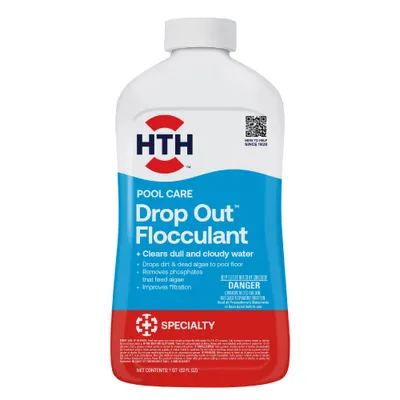
You'll also find HTH Drop Out under item number 67080. Both 67080 and 67229 are listed as 32-ounce Drop Out products. A different item number alone doesn't establish a different strength or a faster result.
The 67080 label specifies the familiar 8-fluid-ounce dose per 10,000 gallons, two hours of circulation, overnight settling, and waste vacuuming. It also explicitly states that it works with saltwater pools.
I wouldn't buy both bottles as separate stages of a cleanup, and I wouldn't pay a premium just because one listing has a higher number. Compare the price, seller, and directions on the bottle you'll receive.
What I like: Another listing to check when shopping for HTH Drop Out.
What to know: There's no verified performance advantage here that gives me a reason to rank 67080 above 67229, or vice versa.
Check HTH 67080 Drop Out on Amazon.
In The Swim Super Floc Out: Another Option for an Overnight Settling Treatment
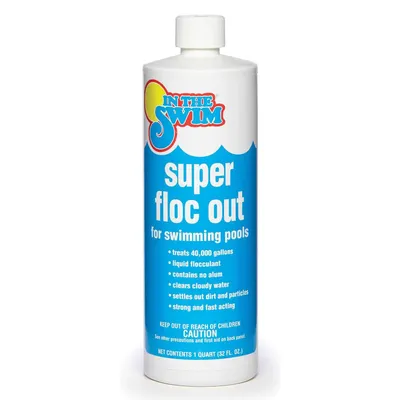
In The Swim Super Floc Out targets suspended debris, including dead algae and nonliving organic material. Its published liquid dose is 8 fluid ounces per 10,000 gallons, and the manufacturer advertises 8–12 hours for settling.
I'd read that as a settling window, rather than a promise that the pool will be ready for swimming in eight hours. Removing the sediment, refilling, and checking the water still take time.
There's one detail I'd be careful with: its online product copy and educational guidance conflict about sending debris through the filter. In The Swim's floc guidance says to vacuum to waste because the resulting clumps can clog filters. I would only select this product with suitable waste-vacuum equipment and clear directions on the actual bottle.
What I like: Another liquid-floc option to compare when planning an overnight cleanup.
What to know: "Works within hours" describes part of the process. It doesn't remove the manual cleanup, and conflicting web copy is a reason to confirm the label before use.
Check In The Swim Super Floc Out on Amazon.
Clorox Super Water Clarifier: Best Choice When You Cannot Vacuum to Waste
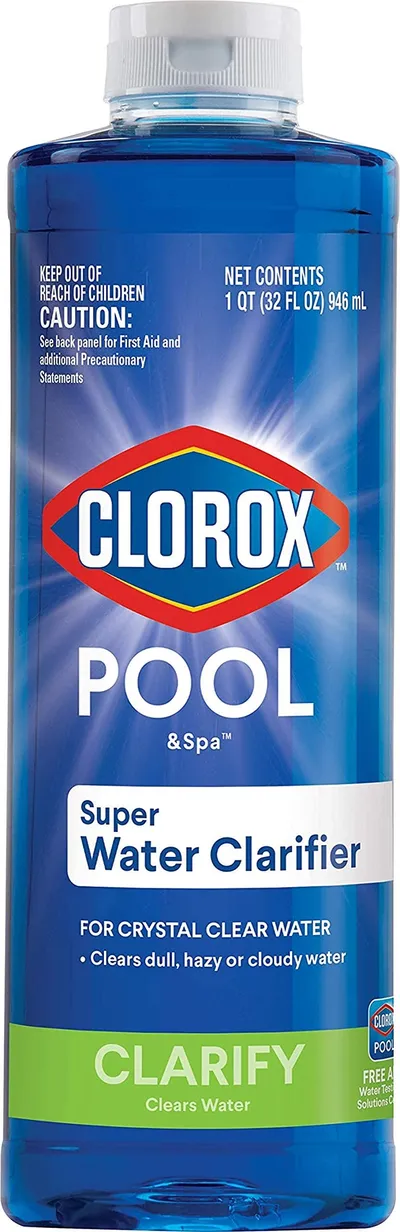
This is the bottle I'd choose from this list for a cartridge-filter pool without a waste-vacuum setup. Clorox Super Water Clarifier helps the filter capture particles, and Clorox confirms compatibility with cartridge, sand, and DE filters.
That means you keep filtering according to the directions instead of turning the pump off to create a sediment layer.
The photographed label specifies 1 fluid ounce per 5,000 gallons and at least eight hours of pump operation. It allows another application after 36 hours if the water is still cloudy and warns that overtreatment can prolong cloudiness. Check the directions on your bottle before dosing.
The much smaller dose doesn't make this a stronger flocculant. It's a different treatment with a different removal process.
What I like: A useful alternative for a pool whose filter needs help collecting fine particles, without creating a waste-vacuum job.
What to know: It depends on a working, maintained filter. It won't repair damaged equipment or solve an active algae problem by itself.
Check Clorox Super Water Clarifier on Amazon.
Are These Flocculants Really Different?
The biggest difference in this group is settling floc versus filter-aid clarifier. After that, I'd focus on the actual directions and the total cost of treatment.
Several of these flocculants publish the same normal dose: 8 fluid ounces per 10,000 gallons. At that rate, a 32-ounce bottle treats 40,000 gallons once. That's four normal doses for a 10,000-gallon pool or two for a 20,000-gallon pool. Equal dosing does not prove identical formulations or equal performance. Not sure of your volume? Use my pool volume calculator.
The treatment pH can differ, too. For example, the pictured Clorox floc label calls for 7.5–8.0, while the HTH 67080 label lists 7.2–7.8. You shouldn't copy one product's preparation instructions onto another.
My shopping priorities would be a suitable product, readable directions, a reliable seller, and a reasonable cost per treatment. Review counts and words like "super" don't tell me whether a bottle will work better in your particular water.
How to Use Pool Flocculant
Here's the overall workflow. The bottle controls the dose, application method, water balance, and timing. These steps apply to a settling floc, not the Clorox clarifier.
1. Confirm the cleanup route
Before adding anything, have your vacuum head, pole, hose, and waste discharge ready. Confirm that the system can distribute the product as directed and later send vacuumed water out without passing it through the filter media.
Turn the pump off before changing a multiport valve's position, following the equipment instructions.
Don't count on a robotic cleaner to finish this job. For these waste-vacuum treatments, you need a way to remove the water and sediment from the pool together.
2. Address the cause and prepare the water
Remove large debris, clean the filter as directed, and test the water. Deal with active algae before using floc to remove the residue. Adjust the water to the treatment range on your bottle.
Use the protective equipment specified on the label. Never mix concentrated pool chemicals together. Allow separately added treatments to disperse according to their directions.
3. Measure and add the correct dose
Use your actual pool volume. For a label specifying 8 fluid ounces per 10,000 gallons, a 20,000-gallon pool takes 16 fluid ounces, or half a quart.
Application methods differ. HTH directs even distribution over the pool surface; the pictured Clorox floc label uses the skimmer with the system in Recirculate. Only use a skimmer application when your label specifically directs it, with the prescribed valve setting and no other chemical in the skimmer.
4. Circulate for the directed time
Run the pump for the product's distribution period. Don't confuse this stage with normal filtration or assume more pump time is better.
5. Stop circulation and let the debris settle
After the prescribed circulation period, shut the pump off and leave the pool undisturbed for the label's settling window. Keep swimmers, cleaners, and water features from disturbing the water. Make sure a timer won't restart circulation halfway through.
Plan around the full window. With a product calling for 12–24 hours, an overnight start may still leave you waiting into the next day.
6. Vacuum slowly to waste
For a multiport setup, stop the pump, select Waste/Drain, and restart only once the vacuum is connected and primed according to the equipment instructions.
Vacuum with slow, deliberate passes. Rushing can stir the layer back into the water. If that happens, pause and let it settle again instead of chasing the cloud around.
Monitor the falling water level. Stop before the skimmer draws air, refill as needed, and don't let the pump run dry. The discharge must go to a location permitted for pool wastewater in your area.
7. Refill and rebalance
After removing the sediment, restore the water level, clean or backwash as directed for your equipment, and resume normal filtration. Retest and rebalance before swimming. If you backwash a DE filter, follow its instructions for replacing the DE.
The job is complete when the debris has been removed, the water is clear, and the chemistry meets the appropriate swimming conditions. Clear water by itself isn't the final check.
Common Questions About Pool Floc
What is the best pool flocculant?
For a pool that can vacuum to waste, Clorox Sink to Clear is my straightforward pick. For a cartridge-filter pool with no way to bypass the filter, Clorox Super Water Clarifier is the better choice because the filter does the removal.
Why is my pool still cloudy after flocculant?
Check the treatment before adding more. Was the dose right for the pool volume? Was the water in the required range? Did the pump stay off long enough? Was sediment stirred up during vacuuming? Is algae still growing, or is the filter struggling? Those questions give you something to correct. Pouring in more product without knowing why the first treatment failed may add expense without solving the problem.
Can I use floc in an above-ground pool?
Yes, when the product and equipment support the full process. Pool shape and whether it sits above or below ground aren't the deciding factors. The ability to distribute the treatment correctly and vacuum to waste is what matters. For a cartridge-only setup, I'd choose the compatible clarifier.
Can I use floc and clarifier together?
I wouldn't stack them as an improvised attempt to speed things up. Their operating instructions differ, including whether filtration continues or the water sits still. Choose the appropriate treatment and follow its directions; combine treatments only when the manufacturers specifically authorize the sequence.
How soon can I swim after flocculant?
Wait until settling and waste vacuuming are finished, the water is clear enough to see the bottom, and water tests and product directions permit swimming. A stated settling time is not a guaranteed swim-ready time.
Should I floc my pool every week?
I wouldn't make a settling treatment part of a routine for an otherwise clear pool. Repeated floc treatments mean repeated vacuuming, water loss, and refilling. If cloudiness keeps coming back, investigate sanitation, water balance, circulation, and filtration. My weekly pool maintenance guide covers the routine that keeps the water clear in the first place.
My Final Verdict
Clorox Sink to Clear is my straightforward starting pick for a pool that can vacuum to waste. BioGuard PowerFloc is another option for substantial cloudiness, and HTH Drop Out deserves consideration when you want clearly stated saltwater compatibility. Between HTH 67080 and 67229, I'd compare the actual bottles and value instead of treating the numbers as a performance ranking.
In The Swim Super Floc Out is another settling option, provided the bottle directions and your equipment support the complete cleanup.
If you can't vacuum to waste, Clorox Super Water Clarifier is the better choice from this list.
Floc can move a frustrating cloud of debris into a layer you can remove. Buy it with that entire job in mind: prepare the water, let the debris settle, and get it out of the pool.
This article contains Amazon affiliate links. The Pool Nerd may earn a commission on qualifying purchases at no extra cost to you. Product directions, prices, and availability can change; follow the label on the bottle you receive.
Related Reading
- How to Clear Cloudy Pool Water
- How to Get Rid of Pool Algae
- Best Pool Shock
- Pool Filters: The Complete Guide
- Best Handheld Pool Vacuums
- Pool Volume Calculator
- Weekly Pool Maintenance Guide


Comments
Loading comments…