
 Justin D.
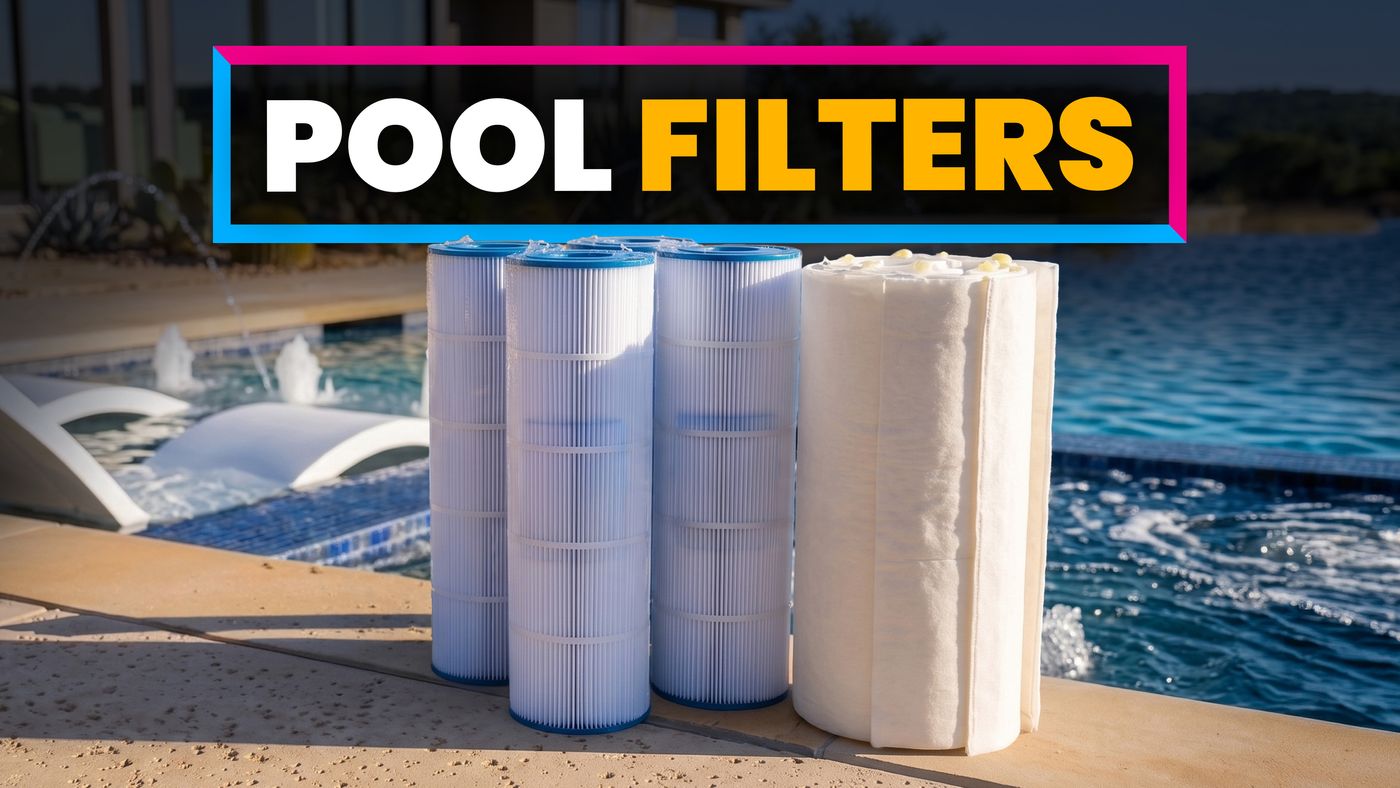
A pool filter is one of the least exciting things you can buy for your pool—until you realize how much the right one can simplify ownership.
Most people shop for a filter by asking one question: "Will this work with my pool?"
I would ask a better one: "How well will it clean the water, and how much work will it create for me?"
That is where sand, cartridge, and diatomaceous earth filters start to look very different.
My starting recommendation for most residential pools is a generously sized cartridge filter. It offers an excellent balance of fine-particle filtration, straightforward ownership, and water conservation. Large cartridge systems can also hold considerably more debris between cleanings than smaller ones. But that does not make sand obsolete or erase DE's advantage in capturing exceptionally fine particles.
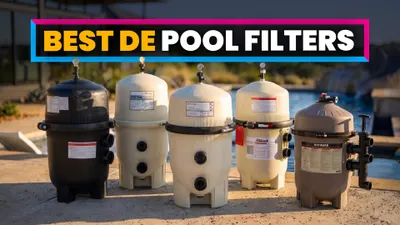
If you already know which type you want, my ranked picks are in the best pool filters, best sand pool filters, and best DE pool filters guides. If you are still deciding, keep reading.
Let's break down what actually matters, beginning with the number that appears in almost every filter comparison.
Micron Ratings: How Small Can Your Filter Go?
A micron, also called a micrometer, is one-millionth of a meter. A strand of human hair is roughly 50–70 microns thick, giving you a useful reference for just how small these measurements are.
The smaller the particles a filter captures effectively, the better it can remove the fine material that makes water look dusty or hazy.
You will commonly see the three filter types summarized this way: sand around 20–40 microns, cartridge around 10–15 microns, and DE around 1–3 microns. Treat those as comparison shorthand, not universal specifications. For example, Jandy describes conventional sand filtration at approximately 20 microns and larger, cartridge filtration down to about 10 microns, and DE at about 2–3 microns.
A micron rating is not a brick wall
A "10-micron filter" does not necessarily catch every 10-micron particle while allowing everything smaller to pass through. Performance depends on the media, flow rate, particle characteristics, and the way the rating was tested.
A more useful specification tells you what percentage of particles it removes at a particular size and flow rate. That is how some alternative-media manufacturers present their test results—and why two products displaying the same micron number may not perform identically.
Also, filtration and sanitation are different jobs. The filter removes particles; your sanitizer controls microorganisms. Even exceptionally clear water still needs properly maintained sanitizer levels. A finer filter does not replace chlorine.
The Three Main Types of Pool Filters
Cartridge filters: Pleated fabric captures the dirt
Inside a cartridge filter are one or more pleated elements. The folds pack a large amount of filtering material into the tank.
Water passes through that material, debris stays behind, and filtered water returns to the pool. Larger systems commonly use four cartridges to provide more filtering area and dirt-holding capacity.
When cleaning is necessary, you remove the elements and wash them. There is no routine backwashing or fresh powder to add afterward. Cartridge models lead my best pool filters list for exactly that reason.
Sand filters: A bed of media does the work
A conventional sand filter contains specially graded pool-filter sand.
Water moves through the sand bed, which traps suspended dirt. Small collection fittings near the bottom, called laterals, collect the filtered water and send it back toward the pool.
Cleaning happens through backwashing: reversing the flow through the bed so trapped debris leaves through a waste line. A rinse cycle follows before returning to normal filtration. My ranked sand picks, including complete pump-and-filter packages for above-ground pools, are in the best sand pool filters guide.
DE filters: A fine powder forms the filtering layer
DE stands for diatomaceous earth, a material derived from the fossilized remains of microscopic aquatic organisms called diatoms.
A DE filter uses internal grids or other supporting elements coated with filter powder. That coating—not simply the bare grid fabric—provides the fine filtration.
When the coating becomes loaded with dirt, the filter needs cleaning and the appropriate amount of fresh media. The elements must be properly coated for normal operation; leaving out the powder is not a shortcut. See the best DE pool filters guide for the three models I would shortlist.
Alternative Filter Media Worth Knowing About
Most alternatives do not create an entirely new category of backyard filter. They change the material inside an existing design.
Glass: An upgrade for compatible sand-filter systems
Pool-filter glass replaces conventional sand in compatible systems. Some products are simply graded glass; others undergo additional processing to improve their filtration properties.
That distinction matters. "Glass media" is not one standardized performance level.
For example, Dryden Aqua publishes substantially finer particle-removal results for certain activated-glass grades than for conventional sand under specified test conditions. Those results should not be applied to every bag of glass on the shelf.
Before changing media, check the filter manufacturer's approval, required grading, loading quantity, and backwashing requirements. Some manufacturers still specify only pool-filter sand for particular models. An alternative-media seller's compatibility claim is not automatically the tank manufacturer's approval.
Zeolite: Filtration plus ion exchange
Zeolite is a porous mineral used as another sand alternative. Pool-grade products can provide mechanical filtration, while natural zeolite also has the ability to exchange and retain certain dissolved ions, including ammonium.
This is where the "traps chloramines" claim needs some explanation.
The potential benefit is partly about removing ammonium, a chloramine precursor, rather than acting as an unlimited filter for every form of combined chlorine. Its capacity is finite, and performance depends on the product and water conditions.
I would consider that an additional feature—not a reason to stop testing sanitizer or managing swimmer waste. Follow the product's installation and any regeneration instructions carefully.
Perlite and cellulose: Alternatives to DE powder
Pool-grade perlite and cellulose products are available as alternatives to conventional DE filter powder. Perlite products such as CelaPerl and cellulose products such as Fiber Clear are specifically marketed for pool filtration.
They can be attractive to owners who would rather avoid handling conventional DE, but alternative does not mean safe to breathe. Check the product's safety information and use the recommended dust precautions.
Compatibility and dosing matter, too. Do not substitute pound-for-pound: the required weight can be very different. Use filtration-grade material, not gardening perlite, and confirm the exact application with your filter manufacturer.
Regenerative media filters: Interesting technology, usually a specialist purchase
Regenerative media filters use a fine coating, commonly perlite, and periodically redistribute it through a process often called "bumping."
Instead of backwashing every time the coating needs refreshing, the system rearranges the media to expose additional filtering capacity. Eventually, the dirty media still needs replacement.
These systems are especially relevant to commercial aquatic facilities, where water use and operating costs can justify specialized equipment. They are worth understanding, but I would treat one as a specialist residential project—not the obvious replacement for an ordinary backyard cartridge filter.
Pool Filter Comparison Chart
These are broad comparisons for conventional residential systems. Actual ratings and cleaning requirements depend on the specific product.
| Filter type | Approximate filtration | Maintenance frequency and method | Backwash water waste? | Ease of ownership |
|---|---|---|---|---|
| Sand | Commonly described as roughly 20–40 microns | Backwash when pressure or flow indicates cleaning is needed | Yes | Simple routine cleaning; eventual media replacement |
| Cartridge | Often around 10–15 microns; product ratings vary | Remove and wash elements as needed; large systems may go months between cleanings | No backwashing, but tank draining and hose cleaning still use water | More hands-on cleaning, but no powder recharge |
| DE | Commonly advertised around 1–3 microns; roughly 2–3 is a useful manufacturer reference | Backwash or clean as required, replace media, and periodically clean internal elements | Usually yes, depending on system design | More involved, with excellent fine-particle capture |
The key distinction is not simply which filter needs attention most often. It is what that attention involves: operating a backwash valve, washing cartridges, or cleaning and recoating DE elements.
The Real Pros and Cons
Sand: Convenient cleaning, coarser filtration
Sand's biggest selling point is convenience during routine cleaning. You generally do not have to open the tank and wash individual elements to remove accumulated dirt.
The sand also lasts for years. Five to seven years is a commonly published replacement guideline, although condition, contamination, and the manufacturer's guidance matter more than a birthday on the calendar.
The tradeoff is fine-particle performance. In one published comparison, high-quality silica sand removed 95% of particles larger than 20 microns, while certain activated-glass grades captured substantially smaller material. Conventional sand can produce attractive water, but finer alternatives have an advantage when very small suspended particles are the problem.
Then there is the hidden ownership cost: backwashing sends pool water out with the dirt.
For illustration, a discharge rate of 50 gallons per minute for five total minutes would remove 250 gallons. Your actual flow and cleaning duration will differ, but the calculation shows how a routine cleaning can involve hundreds of gallons.
That is water you must replace—and water that already contained the chemicals you paid to maintain.
DE: Excellent clarity, more involved maintenance
DE's strength is straightforward: fine-particle capture. Pool-grade DE can remove particles down to around 2 microns, making it a strong choice when maximum water clarity is the priority.
However, you are committing to handling filter media, correctly recharging the system, and periodically opening the tank to clean the elements. A backwash does not eliminate the need for deeper servicing.
The powder deserves respect. Certain pool-grade DE products contain crystalline silica, and their safety data sheets warn about serious inhalation hazards. Minimize dust, keep your face away from the material, and follow the product's eye and respiratory-protection instructions. "Natural" does not mean harmless to inhale.
Disposal is another consideration. Pool-water and backwash-discharge rules vary by location, water chemistry, and discharge destination. Check with your local wastewater or stormwater authority, plus any applicable HOA rules. Do not assume a street drain, yard, or sanitary sewer is an approved destination.
Cartridge: My favorite balance, with a hands-on cleaning job
Cartridge's appeal is the combination: effective filtration, no routine backwashing, and—in a sufficiently large system—substantial debris capacity.
Manufacturers such as Pentair specifically design multi-element cartridge filters to increase dirt-holding capacity and extend the interval between cleanings.
But the tradeoff is real. Someone must open the tank, remove the elements, clean them thoroughly, and reassemble everything correctly. That is more involved than moving a backwash valve.
And no, cartridge filtration does not mean zero water waste. You still drain water from the housing and use water to rinse the cartridges.
What you avoid is using the pool's circulation pump to discharge treated water during routine backwashing. That reduces refill-related water and chemical losses. It does not make the filter a pH controller or guarantee stable chlorine or ORP readings.
My preference is to retain treated water when practical—not to pretend filtration replaces water chemistry.
Which Pool Filter Is Best? The Pool Nerd Verdict
For most homeowners, I would begin with a large cartridge filter and compare the alternatives against it.
Not the smallest cartridge unit that technically meets the specification. A genuinely roomy filter with enough capacity to make ownership easier.
I would lean toward sand when convenient backwashing is especially important and there is an appropriate discharge route. I would lean toward DE when the owner values its fine-particle performance enough to accept the additional servicing.
My Top Pick in Each Filter Type


Each of those links to the full guide for that filter type, where I compare the alternatives by pool size and installation.
Let your backyard influence the decision
A pool surrounded by mature trees presents a different maintenance problem from one beside a dusty construction site.
With leaves and larger debris, I would first focus on keeping material out of the circulation system: effective skimming, regularly emptied baskets, and a suitable robotic pool cleaner. With persistent fine dust, I would place greater emphasis on fine-particle filtration.
Season length, debris load, and filter design all influence how often cleaning is necessary. A calendar estimate without that context is not much of an estimate.
The best sizing advice: Buy more filtering area, not more pump horsepower
A filter advertised as "425 square feet" contains approximately that much effective filtering area—not a footprint large enough to cover your backyard. In a multi-cartridge design, that area is folded into the elements.
Here is why additional area matters.
Imagine distributing the same 40 gallons per minute across two different filters. A 200-square-foot filter receives 0.20 gallons per minute per square foot. A 400-square-foot filter receives 0.10.
You have spread the same workload over twice the area.
That does not automatically halve the micron rating, but larger cartridge systems offer greater dirt-holding capacity and can extend cleaning intervals.
For a mid-sized inground pool, I would ask the installer to quote a large four-cartridge option alongside the minimum-sized option. Systems in the 400–500-square-foot range are worth evaluating, provided they fit the equipment pad and the system's flow requirements.
Could that move you from monthly cleaning toward once a season? Possibly. Hayward describes some large SwimClear systems as capable of operating up to an entire season without cleaning. That is a potential benefit, not a promise for every pool.
Before choosing, confirm the filter's maximum flow rating, the pump's actual flow at its programmed speeds, plumbing compatibility, and clearance for removing the lid and elements. A gallon-capacity label alone does not answer those questions. My pool filter size calculator turns your pump's flow into a minimum filter area for each media type, and the pool pump size calculator gives you the flow number to start from.
Maintenance: How to Keep Your Filter Working Properly
Start with a clean-pressure baseline
After the filter is properly cleaned and operating normally, record its pressure. For DE, record that baseline after the correct media charge has been added.
A common cleaning trigger is a rise of 8–10 PSI above the clean baseline, but the exact instruction varies. Pentair, for example, specifies approximately 10 PSI for Clean & Clear Plus and 8–10 PSI for Clean & Clear RP.
If your applicable threshold is a 10-PSI rise and clean pressure is 12 PSI, the cleaning point is around 22 PSI—not 10 PSI total.
Compare readings at the same pump speed and valve settings. A variable-speed pump's low-speed reading cannot be compared directly with its high-speed reading. Also investigate reduced flow rather than waiting indefinitely for a particular number.
Use pressure and performance to guide cleaning, while still following the manual's inspection and maximum-service intervals. "Do not clean unnecessarily" is good advice. "Never clean on a schedule" is too absolute.
Before opening any filter
Never loosen a filter clamp while the tank is pressurized.
Turn off the pump, prevent automatic restarting, isolate electrical power as instructed, open the manual air relief, and verify that pressure is fully relieved before opening the housing. Follow the model's instructions for valve positioning and draining.
A gauge reading is not a substitute for actually relieving pressure. Incorrectly serviced pressure vessels can separate violently. When you are unfamiliar with the clamp or startup procedure, have a pool professional demonstrate it.
Cleaning a cartridge filter
Once the filter has been safely shut down, depressurized, and drained, remove the elements and wash between the pleats with a garden hose. Work systematically rather than spraying only the outside.
Do not use a pressure washer. It can damage the filtering material.
Inspect the elements, clean the tank and sealing surfaces, and reinstall everything exactly as the manual specifies. Follow the proper air-bleeding and restart procedure; do not guess at clamp tightening.
For stubborn oils, use an approved cartridge-cleaning product. Do not make an acid bath your default cleaning method: mineral-scale treatment is a separate issue, and oils should be removed before any manufacturer-approved acid cleaning.
Cleaning a sand filter
The normal sequence is backwash, rinse, then filter, following the model's instructions.
Stop the pump before every valve-position change. Watch the waste discharge and pool water level, and do not let the pump run dry.
The required flow matters as much as the duration. For example, Hayward specifies a 62-GPM backwash rate for one 24-inch ProSeries model. A low-speed filtration setting is not automatically sufficient for backwashing.
Cleaning a DE filter
Follow the filter's specified cleaning procedure, then recharge with the prescribed media amount.
Do not automatically assume that the quantity after a backwash is identical to the quantity after a complete teardown. Use the instructions for the exact model and cleaning method.
Periodic element cleaning is still necessary, and normal operation requires the correct filter coating. Repeatedly adding powder without understanding what remains inside is not a maintenance strategy.
Variable-speed pumps: Let the filter work without excessive flow
A variable-speed pump lets you run routine filtration at a lower speed than equipment-intensive activities may require.
Lower filtration rates can improve filtering performance while reducing energy use and strain on the circulation system. ENERGY STAR specifically identifies more effective filtration as a benefit of slower circulation.
But the goal is appropriate flow, not the lowest RPM the motor can manage. Your installer should account for circulation, skimming, and the operating requirements of connected equipment. Backwashing is a separate setting with its own flow requirement. If you are programming one now, start with my guide to what RPM to run a pool pump.
Robotic cleaners: A useful second filtration system
A robotic cleaner collects debris in its own onboard filter rather than relying on the main pool filter to receive everything it picks up.
That is why I favor a capable robot with strong pickup and fine pleated filters—such as NanoFilters on compatible Dolphin models—rather than considering suction alone. Fine-filter options are designed to capture dust and dirt that coarser collection media may miss.
The practical benefit is simple: dirt you remove in the robot's basket does not need to be collected later by the main filter. That can reduce its workload.
However, the improvement in cleaning intervals depends on your pool and the robot's coverage. Keep its filters clean, and treat it as a supplement—not a replacement for the main circulation system or sanitizer. My ranked picks are in the best robotic pool cleaners guide.
What Pool Filters Really Cost
Upfront cost: Compare complete systems
Filter prices overlap more than a simple "sand is cheap, DE is expensive" ranking suggests.
Here are representative advertised U.S. equipment prices checked for this guide. These are examples, not equivalent-flow designs or installed quotes.
| Type | Representative equipment example | Advertised equipment price |
|---|---|---|
| Sand | Hayward ProSeries 24-inch W3S244T | $689 |
| Cartridge | Hayward SwimClear 425-square-foot W3C4030 | $1,819 |
| DE | Hayward ProGrid 60-square-foot W3DE6020 | $1,709 |
The important lesson is that a large cartridge system can cost more upfront than a particular DE system. Compare the actual equipment, not just the category. Prices can change.
Ask whether the quote includes the valve, initial media, fittings, installation, and old-equipment removal. For example, the listed DE filter requires a separately purchased backwash valve, while the sand example includes its multiport valve.
Long-term cost: Replacement parts and your time
A cartridge filter has recurring element-replacement costs. Large multi-element systems deserve particular attention: replacing four cartridges is a different purchase from replacing one small element.
As an example, one current parts listing prices a compatible 105-square-foot cartridge at about $109 each—roughly $436 for four before other charges.
Sand ownership includes eventual media replacement and servicing the valve and internal components. DE adds replacement powder and eventual grid or other component repairs. The owner manuals' parts lists make it clear that none of these systems is maintenance-free.
I would also put a value on your time. A lower purchase price is not automatically the better deal when it creates a cleaning routine you dislike.
Backwashing costs more than the water alone—but keep the math honest
Suppose each cleaning discharges 250 gallons and you do it 20 times in a year. That is 5,000 gallons.
At an illustrative water cost of $10 per 1,000 gallons, the replacement water alone costs $50. Your actual utility charges, cleaning frequency, and discharge volume determine the real number.
The discharged water also carries dissolved pool chemicals. But a modest backwash does not erase your entire chemistry balance. Removing 250 gallons from a well-mixed 20,000-gallon pool removes about 1.25% of its water and dissolved contents.
After refilling, test and adjust as needed. Do not automatically add muriatic acid simply because you backwashed; the appropriate adjustment depends on the resulting water chemistry.
Cartridge's advantage is avoiding unnecessary routine discharge—not guaranteeing enormous chemical savings in every pool.
Pool Filter FAQ
Can I switch from sand to cartridge?
Yes, but this normally means replacing the filter assembly and modifying the plumbing—not putting cartridge elements inside a sand tank.
Have the installer check flow compatibility, available space, and how the pool will handle any future draining or vacuum-to-waste needs. Existing sand-filter plumbing may not line up with the replacement cartridge unit.
How long do cartridges actually last?
There is no universal expiration date. Jandy publishes a general replacement expectation of approximately two to three years, but condition and performance matter.
Replace damaged elements or ones that no longer recover adequately after proper cleaning. Hayward's manual specifically uses elevated pressure after cleaning as an indicator that replacement is approaching. Looking white is not the same as filtering properly.
Is glass media worth upgrading to?
It can be worth evaluating when you already have a serviceable, compatible sand filter and want improved fine-particle performance.
Look for documented performance at stated flow rates, not simply "filters smaller particles" on the bag. Confirm approval for your tank before buying; some filter manufacturers specify sand only.
Does a larger filter mean I need a larger pump?
No. Increasing filtering area is not a reason by itself to increase pump size.
The goal is to give your existing required flow more filtering capacity—not to push more water simply because the tank is larger. Match the whole system's flow requirements and equipment ratings. If you are replacing the pump as well, start with the best pool pumps guide.
Can I add DE powder to a cartridge filter?
Do not assume so. Hayward specifically warns that adding DE to its SwimClear cartridge filter can damage the elements.
Only use additives or alternative media explicitly approved for the exact filter.
Why is my filter pressure low instead of high?
Low pressure can indicate that insufficient water is reaching the filter rather than that the filter is beautifully clean.
Check the pool water level, skimmer baskets, and pump basket. A different pump-speed setting can also explain a different reading. Persistent abnormal pressure or weak circulation deserves further diagnosis.
Will a better filter cure an algae problem?
Not by itself.
Filtration removes material from the water; it does not replace the treatment needed to control an active algae problem. A new filter is not permission to neglect sanitation. If you are fighting an outbreak now, start with how to get rid of pool algae, and if the water is hazy rather than green, see how to clear cloudy pool water.
The Bottom Line
My recommendation is to shop for the ownership experience, not just the smallest micron number.
Sand makes sense when convenient backwashing is the priority. DE makes sense when exceptionally fine filtration is worth the extra servicing. A generously sized cartridge filter remains my preferred starting point for most residential pools.
Before buying, compare flow requirements, cleaning access, replacement-element costs, and discharge arrangements. Then ask what it costs to move up one size rather than settling automatically for the minimum.
The goal is not the fanciest tank on the equipment pad.
It is clear water—and a maintenance routine you will actually keep up with.
When you are ready to compare specific models, go to the best pool filters guide for my overall picks, the best sand pool filters guide for backwash-style systems, or the best DE pool filters guide for the finest filtration.
This article contains Amazon affiliate links. The Pool Nerd may earn a commission on qualifying purchases at no extra cost to you. Product specifications, prices, and availability can change; verify the exact model before ordering.
Related Reading
- Best Pool Filters
- Best Sand Pool Filters
- Best DE Pool Filters
- Pool Filter Size Calculator
- Pool Pump Size Calculator
- Best Pool Pumps
- Best Variable Speed Pool Pumps
- Weekly Pool Maintenance Guide

Comments
Loading comments…