


Pool Chlorine Calculator
Get the exact chlorine dose for your pool, product, and target level
Use the calculatorHow to use
Chlorine Dosage Calculator
Use a fresh water test and the strength printed on your chlorine label. The calculator updates as you type.
Pool and test results
Not sure? Use the pool volume calculator.
Test immediately before dosing.
At 0.5 ppm or higher, you may need to shock.
Needed only for the CYA-based target.
Target chlorine level
A practical maintenance target for a clear residential pool.
For shock-level targets, use the dedicated shock calculator.
Chlorine product
Use the percentage listed under “available chlorine” or “sodium hypochlorite.”
Enter your pool volume to calculate the dose.
Add This Much
--
How to add it
Safety: Never mix chlorine with acid or any other pool chemical. Wear eye protection and gloves, keep swimmers out while dosing, and follow the product label.
What you need next
Chlorine matched to your dose
The first card swaps to the chlorine type you picked above. Keep pH at 7.2–7.6 so the chlorine you add actually works.


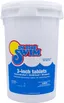

Matched to your result FAS-DPD test · reads free chlorine to 0.2 ppm Taylor K-2006 Chlorine Test Kit

Products are picked independently. The Pool Nerd may earn a commission on orders placed through these links, at no extra cost to you. Learn more
How Much Chlorine to Add to a Pool
The exact chlorine dose depends on four numbers: pool volume, current free chlorine, target free chlorine, and product strength. A fixed instruction such as “add one gallon” cannot be correct for every pool because a 5,000-gallon above-ground pool and a 30,000-gallon inground pool need very different amounts.
For a quick reference, the following amounts raise free chlorine by approximately 1 ppm in 10,000 gallons:
- 12.5% liquid chlorine: 10.2 fluid ounces
- 10% liquid chlorine: 12.8 fluid ounces
- 7.5% concentrated bleach: 17.1 fluid ounces
- 6% household bleach: 21.3 fluid ounces
- 68% cal-hypo: 2.0 ounces by weight
- 56% dichlor: 2.4 ounces by weight
- 90% trichlor: 1.5 ounces by weight, released slowly
Multiply the amount by the chlorine increase you need and by your pool size divided by 10,000. For example, a 15,000-gallon pool going from 1 ppm to 3 ppm needs a 2 ppm increase. With 12.5% liquid chlorine, that works out to about 30.7 fluid ounces:
10.2 fl oz × 2 ppm × 1.5 = 30.7 fl oz
The calculator above does this automatically and also converts the answer into cups, quarts, gallons, milliliters, pounds, or grams as appropriate. If you do not know your water volume, measure it first with the pool volume calculator. Pool gallons are the foundation of every chemical dose.
Liquid Chlorine Dosage Chart
This chart shows how much product raises free chlorine by 1 ppm. Multiply any entry by the number of ppm you need to add. The amounts assume fresh product at the strength printed on the label.
| Pool Volume | 12.5% Liquid Chlorine | 10% Liquid Chlorine | 6% Bleach | 68% Cal-Hypo | 56% Dichlor |
|---|---|---|---|---|---|
| 5,000 gallons | 5.1 fl oz | 6.4 fl oz | 10.7 fl oz | 1.0 oz | 1.2 oz |
| 10,000 gallons | 10.2 fl oz | 12.8 fl oz | 21.3 fl oz | 2.0 oz | 2.4 oz |
| 15,000 gallons | 15.4 fl oz | 19.2 fl oz | 32.0 fl oz | 2.9 oz | 3.6 oz |
| 20,000 gallons | 20.5 fl oz | 25.6 fl oz | 42.7 fl oz | 3.9 oz | 4.8 oz |
| 25,000 gallons | 25.6 fl oz | 32.0 fl oz | 53.3 fl oz | 4.9 oz | 6.0 oz |
| 30,000 gallons | 30.7 fl oz | 38.4 fl oz | 64.0 fl oz | 5.9 oz | 7.2 oz |
Liquid chlorine loses strength in storage, especially in heat and direct sun. An old jug labeled 12.5% may no longer deliver a true 12.5% dose. Buy the freshest product available, store it in a cool and ventilated place away from acid, and retest the pool after circulation rather than assuming the calculated dose produced the exact result.
How Much Liquid Chlorine for a 10,000-Gallon Pool?
For a 10,000-gallon pool, each 1 ppm increase takes about 10.2 fluid ounces of 12.5% liquid chlorine. That means:
- From 0 to 3 ppm: 30.7 fluid ounces
- From 1 to 3 ppm: 20.5 fluid ounces
- From 2 to 3 ppm: 10.2 fluid ounces
- From 0 to 5 ppm: 51.2 fluid ounces
Always calculate the difference between the current and target readings. Dosing for the full target when chlorine is already present is one of the most common causes of over-chlorination.
How the Pool Chlorine Calculator Works
The calculator first subtracts your current free chlorine from your target:
Required chlorine increase = target FC − current FC
It then scales that increase by water volume and product concentration. Liquid and dry products require different math because liquid chlorine is measured by volume while cal-hypo, dichlor, and trichlor are measured by weight.
Liquid Chlorine and Bleach Formula
For sodium hypochlorite products:
Fluid ounces = required ppm × pool gallons × 128 ÷ (strength % × 10,000)
This works for pool-grade liquid chlorine and plain household bleach. Select the percentage shown on the bottle. Do not guess based on the brand or container size.
Granular Chlorine Formula
For dry chlorine, the calculator determines the amount of available chlorine needed in the water, then divides by the product's available-chlorine percentage. It converts the result to ounces, pounds, grams, or kilograms.
The calculation is a reliable starting dose, but pool water is not a laboratory. Sunlight, water temperature, pH, cyanuric acid, swimmers, algae, leaves, and the age of the product all affect the final test result. Run the pump, allow the dose to mix according to the label, and retest before adding more.
Maintenance Dose vs. Shock Dose
This page is designed for routine free-chlorine adjustments. The 3 ppm preset is a common residential maintenance target, while the 5 ppm preset provides a modest temporary boost after rain or heavy swimming.
Visible algae, combined chlorine at or above 0.5 ppm, or a large sanitation problem requires a different target and process. Use the pool shock calculator for those situations. It calculates higher treatment levels and includes product-specific shock instructions.
Choosing the Right Type of Chlorine
Every chlorine product can raise free chlorine, but the extra chemistry it leaves behind is different. The calculator reports those side effects so you can choose a product that fits the rest of your water balance.
Liquid Chlorine or Plain Bleach
Liquid chlorine is sodium hypochlorite. Pool products are usually 10% or 12.5%, while household bleach is commonly 5.25%, 6%, or 7.5%.
Best for: Routine chlorination and precise same-day adjustments
Advantages:
- Works immediately
- Adds no cyanuric acid
- Adds no calcium hardness
- Easy to measure by volume
Only use plain, unscented bleach with sodium hypochlorite as the active ingredient. Avoid scented, splashless, color-safe, gel, and thickened products because their additives do not belong in pool water.
Calcium Hypochlorite
Cal-hypo is a strong granular chlorine, typically 48% to 73% available chlorine. It adds roughly 0.7 ppm of calcium hardness for every 1 ppm of free chlorine it supplies.
Best for: Pools with low or moderate calcium hardness, or when a dry product is easier to store
Cal-hypo can cloud water temporarily and can bleach a vinyl liner if undissolved granules sit on the surface. Follow the product label for whether to broadcast or pre-dissolve it. Never put cal-hypo in a feeder, scoop, or container that has held trichlor; contamination between the two products can start a fire or explosion.
Dichlor
Dichlor is stabilized granular chlorine. It dissolves quickly, but it adds approximately 0.9 ppm of CYA for every 1 ppm of free chlorine.
Best for: Occasional dosing when CYA is low
Dichlor is convenient for new water or small pools, but regular use can push stabilizer too high. Once CYA is elevated, it does not evaporate with the water; lowering it normally requires partial draining and refilling.
Trichlor Tablets
Trichlor is the active ingredient in most 3-inch chlorine pucks. It is about 90% available chlorine, adds approximately 0.6 ppm of CYA per 1 ppm of free chlorine, and is strongly acidic.
Best for: Slow, controlled release through a compatible floating or inline feeder
The tablet result in the calculator is a chlorine-equivalent amount, not an immediate dose. A puck dissolves over several days, and its actual feed rate changes with water temperature, circulation, and feeder setting. Use liquid chlorine when you need to correct a measured free-chlorine level now. Never place a tablet directly on a liner or pool finish.
How CYA Changes Your Chlorine Target
Cyanuric acid protects outdoor-pool chlorine from ultraviolet light, but it also binds to part of that chlorine. A pool with 40 ppm CYA therefore needs a different maintenance strategy than a pool with no stabilizer.
The calculator offers a CYA-based option using 7.5% of the measured CYA level, with a 2 ppm minimum. At 40 ppm CYA, that produces a 3 ppm target. At 60 ppm CYA, it produces a 4.5 ppm target.
That option is a practical relationship for residential water management, not a replacement for local regulations or the instructions supplied with your sanitizer. Public pools and some local jurisdictions use fixed minimum and maximum levels. Always follow the stricter requirement.
For most outdoor residential pools:
- Below 30 ppm CYA: Chlorine may disappear quickly in sunlight
- 30–50 ppm CYA: A practical range for many manually chlorinated pools
- Above 80 ppm CYA: Chlorine becomes harder to manage and dilution may be necessary
Do not keep adding stabilized chlorine when CYA is already high. Switch to liquid chlorine, test accurately, and read the full guide to lowering CYA if dilution is needed.
pH matters too. When pH drifts high, a smaller share of free chlorine remains in its most active sanitizing form. Balance pH before chasing chlorine with larger and larger doses. The pool pH calculator and pool acid calculator can calculate that correction.
How to Add Chlorine Safely
- Test first. Measure free chlorine and pH with a reliable kit. If possible, also check combined chlorine and CYA.
- Confirm the pool volume. A 20% error in gallons creates a 20% error in every chemical dose.
- Read the product label. Confirm the active ingredient, strength, application method, protective equipment, and required wait time.
- Run the circulation system. Moving water distributes chlorine and prevents a concentrated pocket from sitting against the pool surface.
- Measure with dedicated equipment. Never use the same measuring cup or scoop for different pool chemicals.
- Add one chemical at a time. Never combine chlorine with acid, ammonia, another chlorine type, or any other pool chemical.
- Dose at dusk when possible. Evening application gives unstabilized chlorine more time to work before sunlight begins breaking it down.
- Circulate and retest. Follow the label's mixing and swimming interval, then verify the actual free-chlorine level before anyone enters.
Store chlorine upright in its original container in a cool, dry, well-ventilated location. Keep it away from muriatic acid, fuels, oils, metal tools, and organic material. Chlorine and acid can release toxic chlorine gas when mixed.
Common Chlorine Dosing Mistakes
Using the Wrong Strength
Ten ounces of 12.5% liquid chlorine is not equivalent to ten ounces of 6% bleach. The weaker product requires more than twice as much volume. Check the percentage every time you change products.
Treating Total Chlorine as Free Chlorine
The dosing input is free chlorine, not total chlorine. Total chlorine includes combined chlorine that has already reacted with contaminants. If total chlorine is 3 ppm and free chlorine is 2 ppm, combined chlorine is 1 ppm—high enough to investigate a shock treatment.
Ignoring Old Liquid Chlorine
Sodium hypochlorite degrades with time and heat. Product stored for weeks in a hot shed may be much weaker than its label. Freshness matters more with liquid chlorine than with most dry pool chemicals.
Using Tablets for an Immediate Correction
Trichlor pucks are slow-release products. The calculated tablet fraction may represent the correct total amount of chlorine, but it will not enter the water all at once. Use a fast-acting product for a measured correction.
Forgetting What the Product Adds
Repeated cal-hypo use raises calcium hardness. Repeated dichlor or trichlor use raises CYA. Those side effects accumulate even when the pool looks clear, so include calcium and CYA in your regular testing schedule.
Adding More Before Retesting
The calculator provides a starting dose, not permission to stack treatments. Give the product enough time to circulate, retest, and only then make a second adjustment. It is easier to add a little more than to remove excess chlorine.
Pool Chlorine Calculator FAQs
How much liquid chlorine do I add to a pool?
To raise free chlorine by 1 ppm in 10,000 gallons, add about 10.2 fluid ounces of 12.5% liquid chlorine, 12.8 fluid ounces of 10% liquid chlorine, or 21.3 fluid ounces of 6% bleach. Multiply by the ppm increase you need and by your pool volume divided by 10,000.
Can I use household bleach in a swimming pool?
Yes, if it is plain, unscented sodium hypochlorite without fragrance, thickeners, “splashless” additives, or fabric protectants. Select the exact label strength in the calculator. Household bleach is weaker than pool-grade liquid chlorine, so the dose is larger.
What if my current chlorine is already above the target?
Do not add more. Keep swimmers out if the level exceeds the safe range on your product label or local guidance, allow chlorine to fall, and retest. Sunlight and normal chlorine demand usually lower it over time.
Is liquid chlorine the same as liquid pool shock?
They are commonly the same active chemical—sodium hypochlorite. “Liquid shock” usually refers to a strong 10% or 12.5% solution used at a larger treatment dose. The difference is how much you add and the target level, not a separate chemical reaction.
When should I shock instead of adding a maintenance dose?
Use a shock treatment when combined chlorine is 0.5 ppm or higher, algae is visible, sanitation has been lost after contamination, or a large chlorine increase is required. Calculate that treatment with the pool shock calculator.
How soon can I swim after adding chlorine?
Follow the manufacturer's label and test the water before entering. The answer depends on the product, dose, circulation, and resulting free-chlorine level. A routine liquid dose and a high shock dose do not have the same waiting period.
Accurate chlorination starts with accurate testing. Use this calculator for the dose, then confirm the result instead of treating the math as a substitute for a water test. For the rest of your water balance, use the complete pool chemical calculator.
More from The Pool Nerd
Keep Reading

Disclaimer: Estimates only. Always read product safety labels and directions before handling pool chemicals or equipment. The Pool Nerd isn't liable for any damage, injury, or loss — when unsure, consult a pool professional.