Are you struggling with low cyanuric acid? Hey, I'm Justin, your resident pool aficionado — and today we're talking about how to raise your pool's cyanuric acid the right way.
Here's the thing: most people don't have a chlorine problem. They have a stabilizer problem.
Your pool looked great all morning. You tested at sunrise — chlorine at a beautiful 3 ppm. By 4 PM the water's flat. By the next morning there's a faint green tint creeping along the steps. So you do what every pool store on earth tells you to do: dump in more chlorine. Maybe shock it. Maybe grab another bucket of tabs. And it keeps happening. Over and over. Every single week.
You're not losing chlorine because you don't have enough chlorine. You're losing it because the sun is eating it for breakfast.
Cyanuric acid is the most misunderstood thing in pool chemistry, and it's the one chemical that decides whether your chlorine actually works or just evaporates into thin air. So let's dive in.
Raising CYA: What You Need Checklist
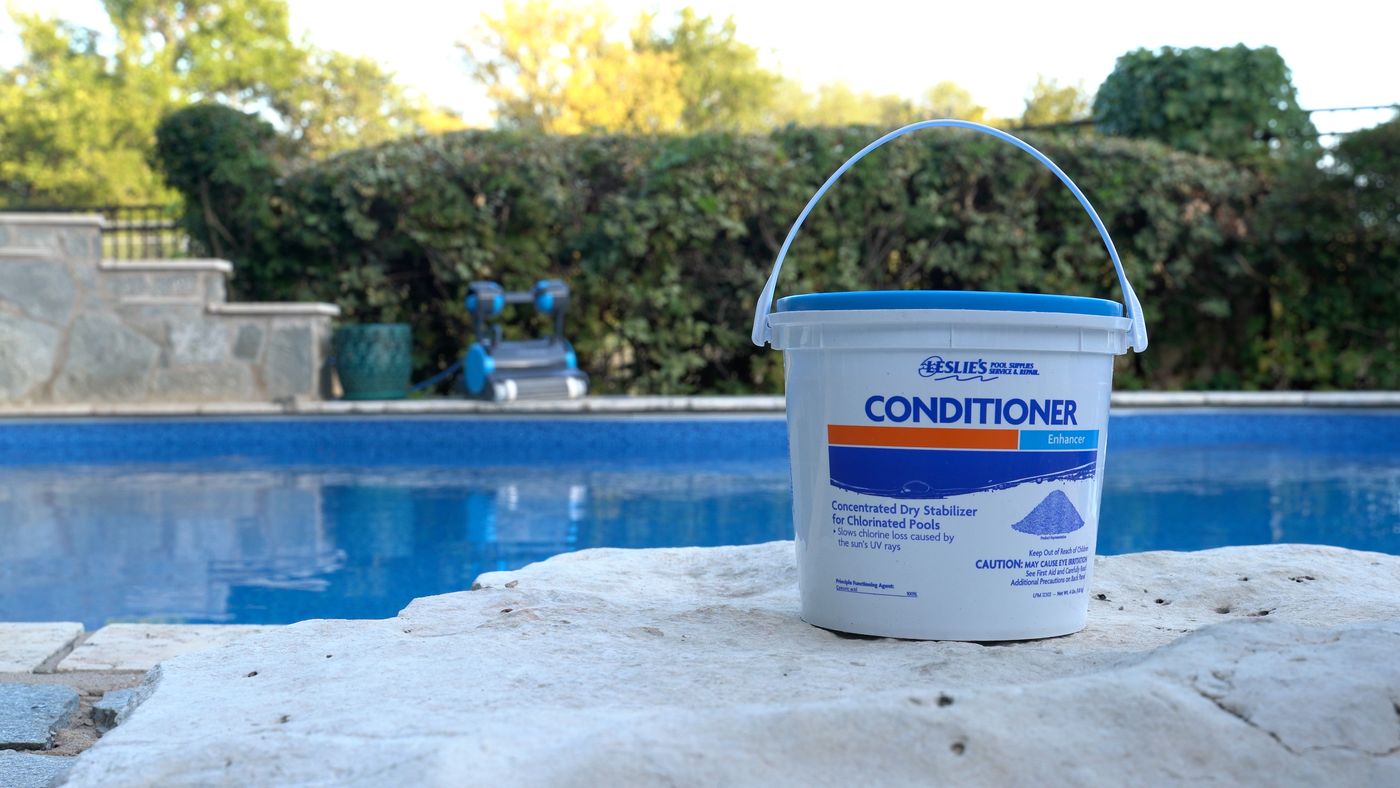
Use pure granular cyanuric acid (sold as “stabilizer” or “conditioner”) and a drop kit to test before and after. Dose 10 ppm at a time and wait—CYA is easy to add and very hard to remove.
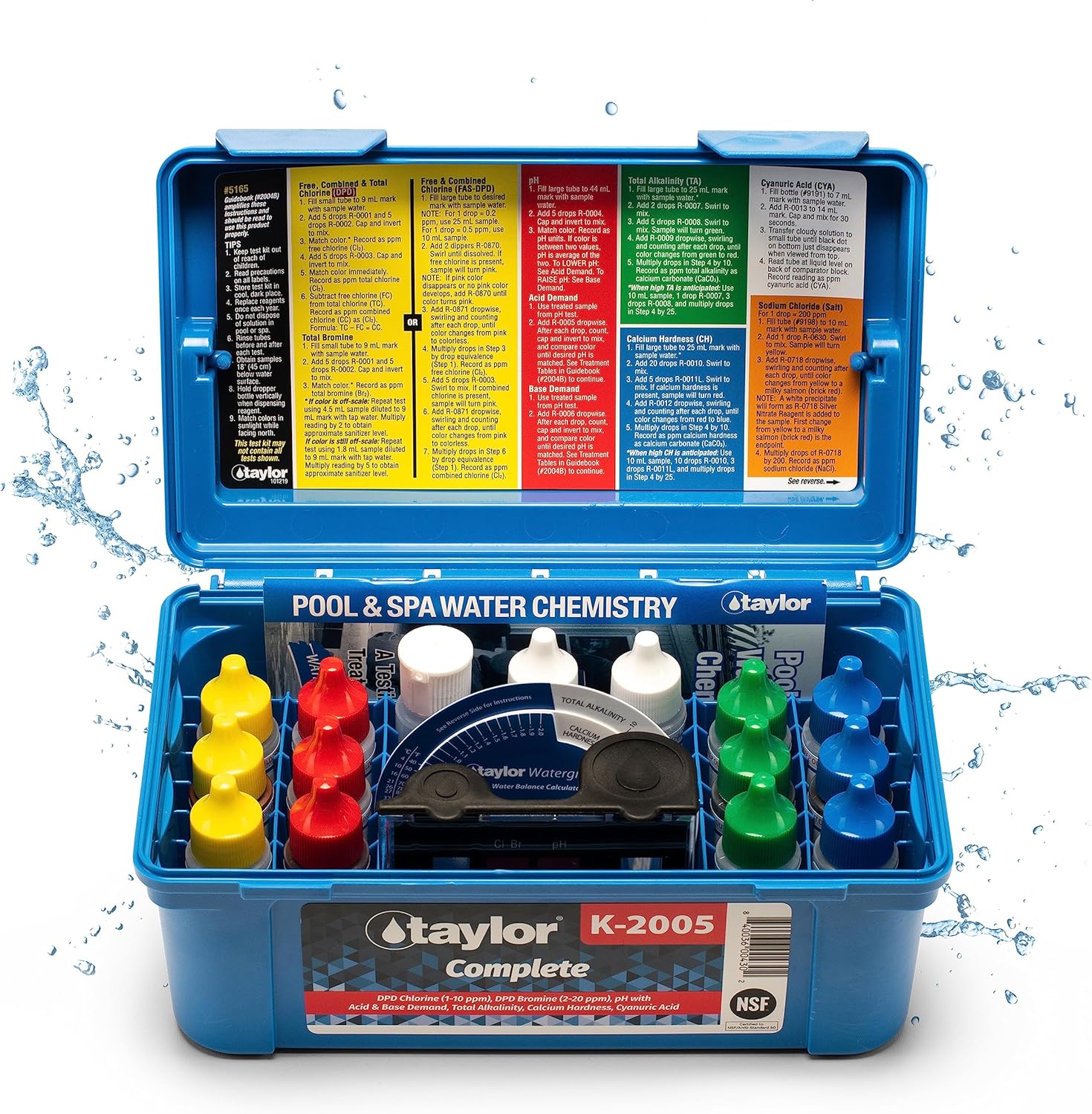
Taylor K-2005 Test Kit
What it is: A professional drop (titration) kit for chlorine, pH, alkalinity, calcium hardness, and cyanuric acid.
Why you need it: You can’t SLAM or balance blind—especially CYA, which handcuffs chlorine. This kit gives numbers you can trust, not strip guesswork.
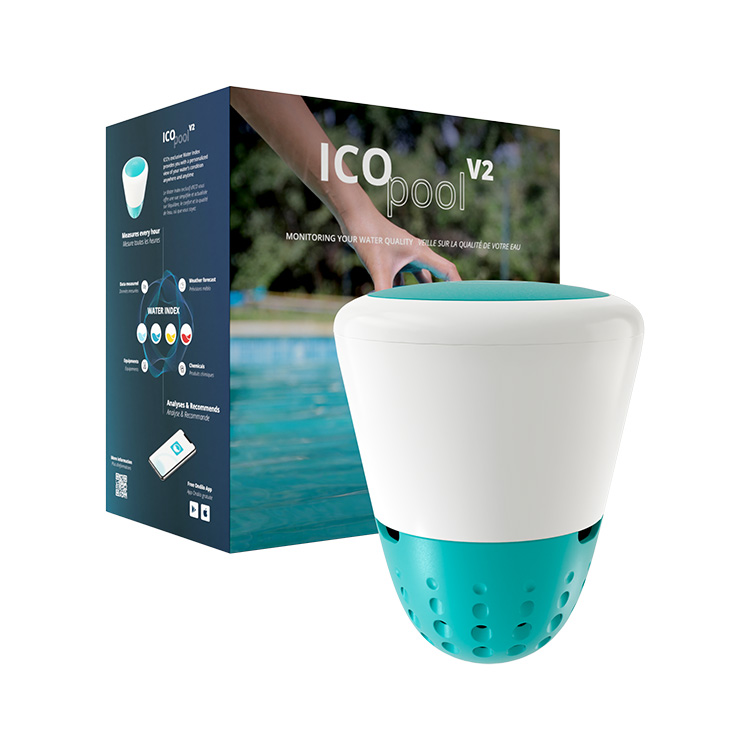
Ondilo ICO Pool Water Monitor
What it is: A floating smart monitor that samples pH, ORP (sanitizer effectiveness), and temperature on a schedule and sends trends to your phone.
Why you need it: You still need a real drop kit for parameters the ICO doesn’t replace (like TA and CYA), but hourly ORP/pH catches drift and dosing mistakes long before weekly strip checks do.
Read the full ICO review — Shop ICO direct (no Amazon listing for the hardware we run).
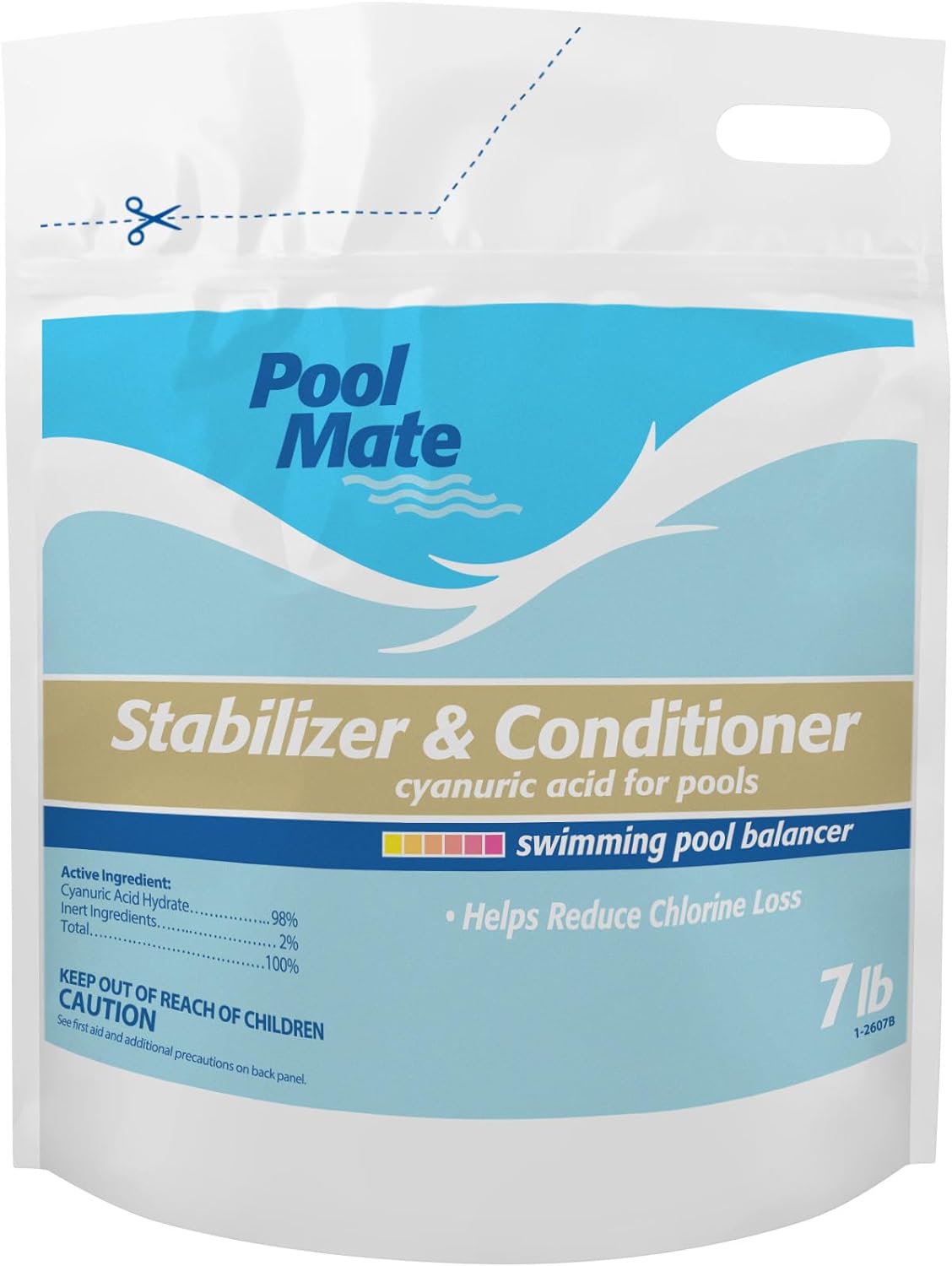
Pool Mate 7 lb Cyanuric Acid Stabilizer
What it is: Granular CYA (chlorine stabilizer)—protects free chlorine from sunlight.
Why you need it: New fills, heavy rain dilution, or unstabilized liquid programs often land below ~30–50 ppm CYA; without it, the sun burns chlorine fast. Add slowly per label (skimmer or predissolve) and retest after circulation.
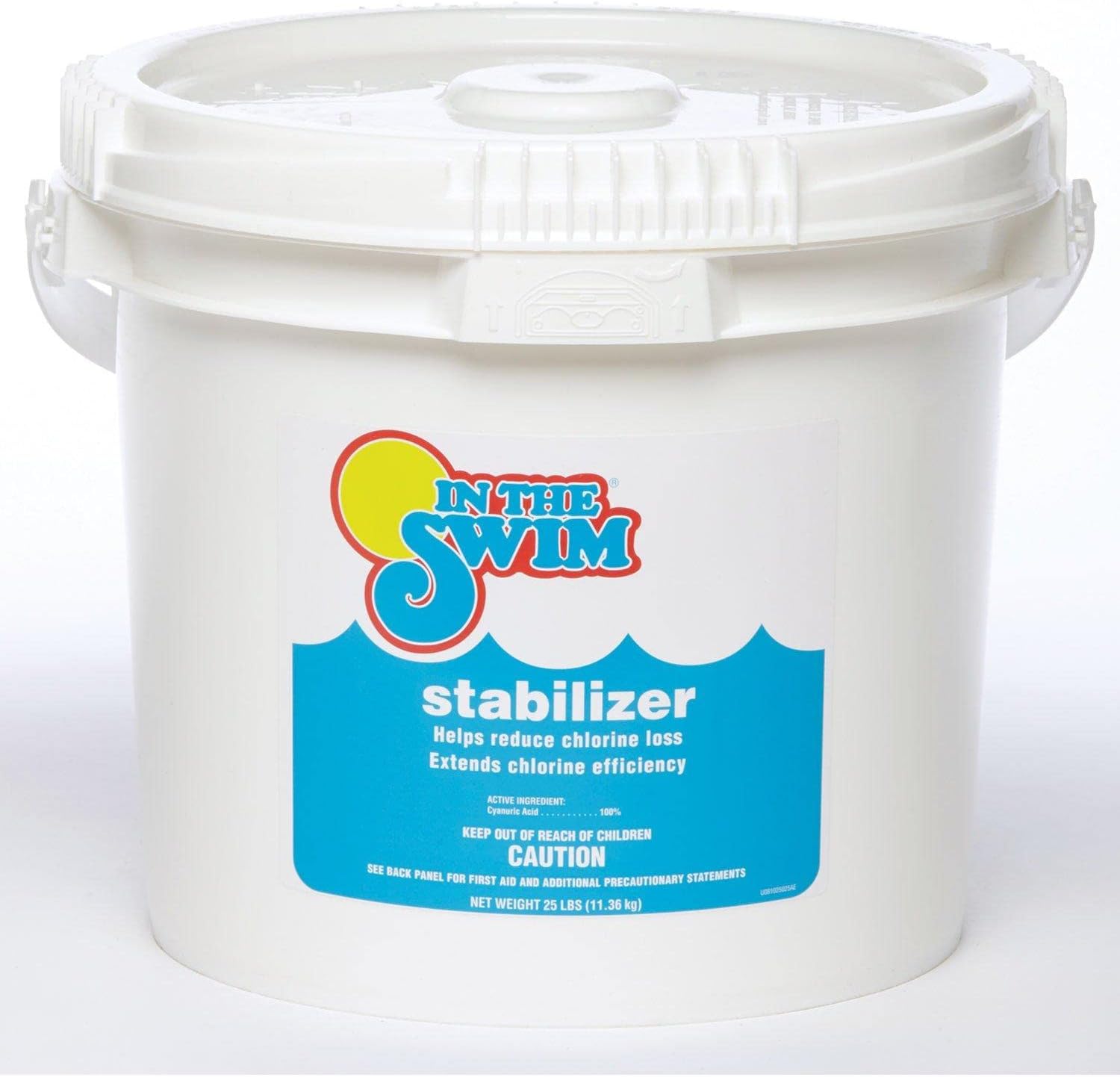
In The Swim Cyanuric Acid Stabilizer (25 lb)
What it is: Bulk granular stabilizer for larger pools or owners who prefer fewer restocks.
Why you need it: Same job as smaller bags—raise CYA into range so daily chlorine survives UV. Weigh or measure carefully; CYA is hard to remove without dilution.
What Cyanuric Acid Does
Cyanuric acid — also called CYA, pool stabilizer, conditioner, or "the stuff hiding in your tablets that you didn't know was there" — is basically sunscreen for your chlorine.
Outside in direct sunlight, free chlorine without stabilizer can vanish in hours. Not days. Hours. UV rays tear chlorine molecules apart faster than you can replace them. CYA binds loosely to chlorine and shields it from UV destruction, releasing it slowly so it can do its job — sanitizing your water.
No CYA in an outdoor pool is like pouring chlorine into a furnace. That's not an exaggeration. In peak summer sun, an unstabilized outdoor pool can lose nearly all of its free chlorine in a single afternoon.
Indoor pools are a different story. No UV, no need for stabilizer. Most indoor pools sit at 0–20 ppm and run just fine. Before we get into how to raise your CYA, let's look at what the ideal range actually is.
The Ideal CYA Range
So what CYA level should your pool be at? It depends on your pool type, but here's what to target.
| Pool Type | Target CYA |
|---|---|
| Standard chlorine pool | 30–50 ppm |
| Saltwater pool | 60–80 ppm |
| Indoor pool | 0–20 ppm |
That's it. Keep your pool in these ranges and you shouldn't have any problems.
Salt pools need more stabilizer because salt cells produce unstabilized chlorine all day long. Without protection, that chlorine burns off as fast as the cell makes it — which is exactly why your salt cell runs constantly and dies in three years instead of seven.
In my experience, low stabilizer in a salt pool is like running an air conditioner with the windows wide open. The system works, but it's burning itself out for almost nothing.
How To Test CYA
CYA testing is a pain. The standard method is a turbidity test — mix pool water with a reagent and look for a dot to disappear at the bottom of a vial. Half art, half science.
Here are your best options, in order:
-
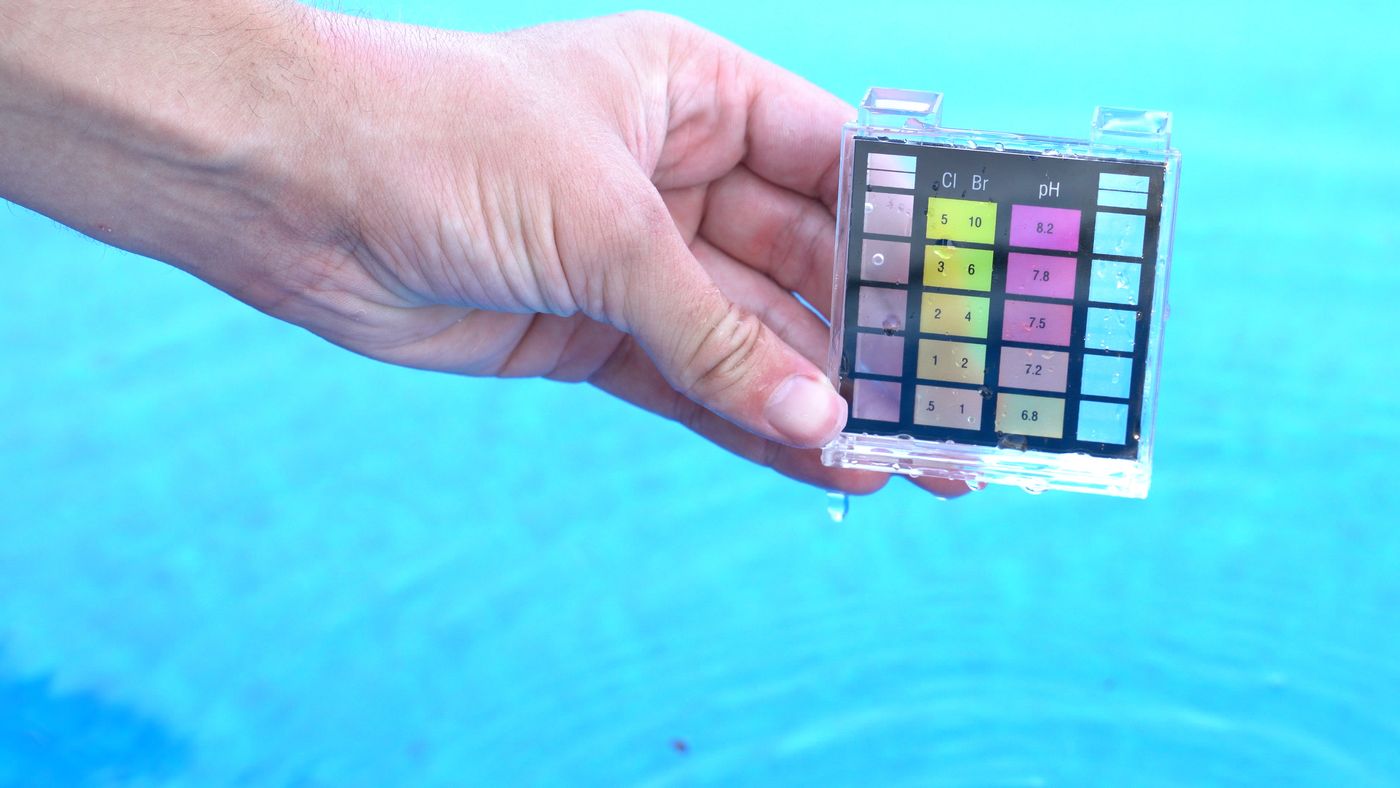
Taylor K-2005 / K-2006 liquid kit — the gold standard. Get one. Use it. The drop-titration method gives you a number you can actually trust for dosing. Grab the K-2006 for chlorine pools or the K-2006 Salt for salt pools.
-
Pool Water Monitor — a monitor like the ICO by Ondilo tracks pH, ORP, temperature, salinity, and chemistry trends continuously, then warns you when something drifts. In my testing, this is the single biggest upgrade you can make to a pool.
-
Test strips — fine for a quick gut check, but never trust them for dosing decisions.
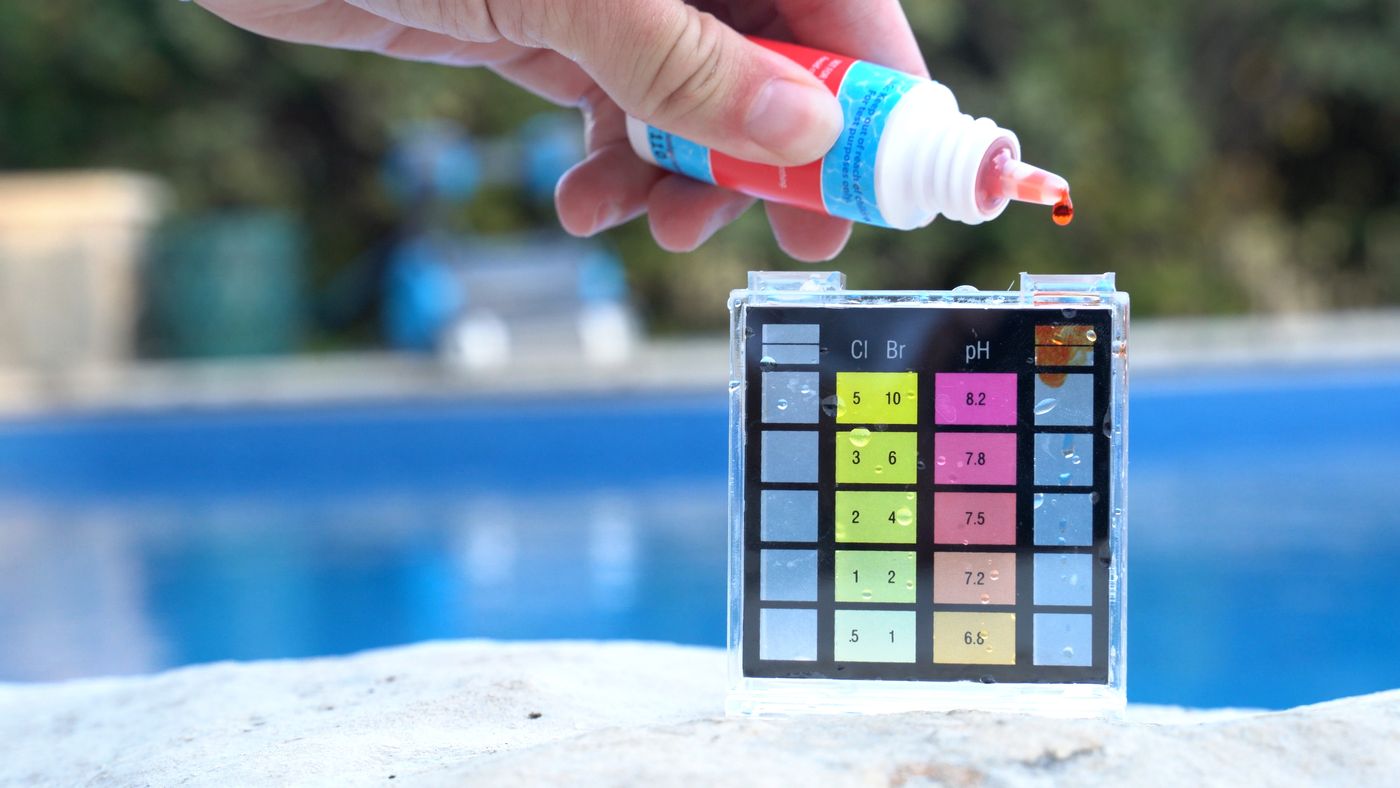
Using a Taylor liquid drop kit to measure cyanuric acid // The Pool Nerd
Here's the kicker on testing: CYA is easy to add and incredibly annoying to remove. Test twice before you dose. Once is not enough.
When To Raise CYA (And When To Leave It Alone)
Not every low-ish reading means you need to dose. CYA is one of those chemicals where doing nothing is sometimes the smartest play.
Raise CYA when:
- You're opening your pool in spring. Rain, snow, and partial winter drains dilute stabilizer. Spring tests almost always come back lower than where you closed. (See my full pool opening guide for the whole sequence.)
- After heavy rainfall or a major storm. Heavy rain dilutes everything. Test before you assume.
- After a partial drain and refill. Replace 25% of your water and you've replaced about 25% of your CYA.
- After major splash-out or weeks of pool parties. Water you lose takes stabilizer with it.
- When you switch from tabs to liquid chlorine. Tabs were quietly adding CYA for you. Liquid chlorine isn't.
- On a brand-new salt pool. Salt cells need protection from day one.
- When your ORP keeps crashing during peak sun despite a healthy free chlorine reading. That's CYA telling you it can't do its job.
Leave it alone when you're sitting around 30 ppm and your ORP looks great, when you just dosed within the last week and haven't given it time to register, or when your pool's closing in 30 days anyway. Don't chase a number for the sake of a number.
Why You Have To Be Careful
CYA is the only chemical in pool care I treat with this level of caution. The reason is simple:
You can't easily lower CYA.
There is no easy chemical fix for high CYA. None. The "CYA Reducer" bottles at the pool store don't really work in my experience — save your money.
The only reliable way to lower CYA is to physically drain pool water and replace it with fresh. That means a water bill spike, hours of work, re-balancing every other chemical from scratch, possible calcium spikes from hard fill water, and in some pools, drainage risk to the shell itself. Reverse osmosis (RO) services exist in some markets, but they aren't cheap and they aren't everywhere.
I've seen homeowners take a perfectly fine 30 ppm pool to 130 ppm in a single weekend because they panicked, dumped a full bag of stabilizer into the skimmer, and didn't wait for the dose to register before adding more. That mistake causes major headaches, so be careful.
Pool Nerd Rule: Dose like you mean it, and dose small. 10 ppm at a time. Wait 48 hours minimum. Retest. Repeat only if needed.
Pick Your Method
There are really only two ways to get CYA into your pool. One is precise. The other is convenient — but sneaky.
Method 1: Pure Cyanuric Acid
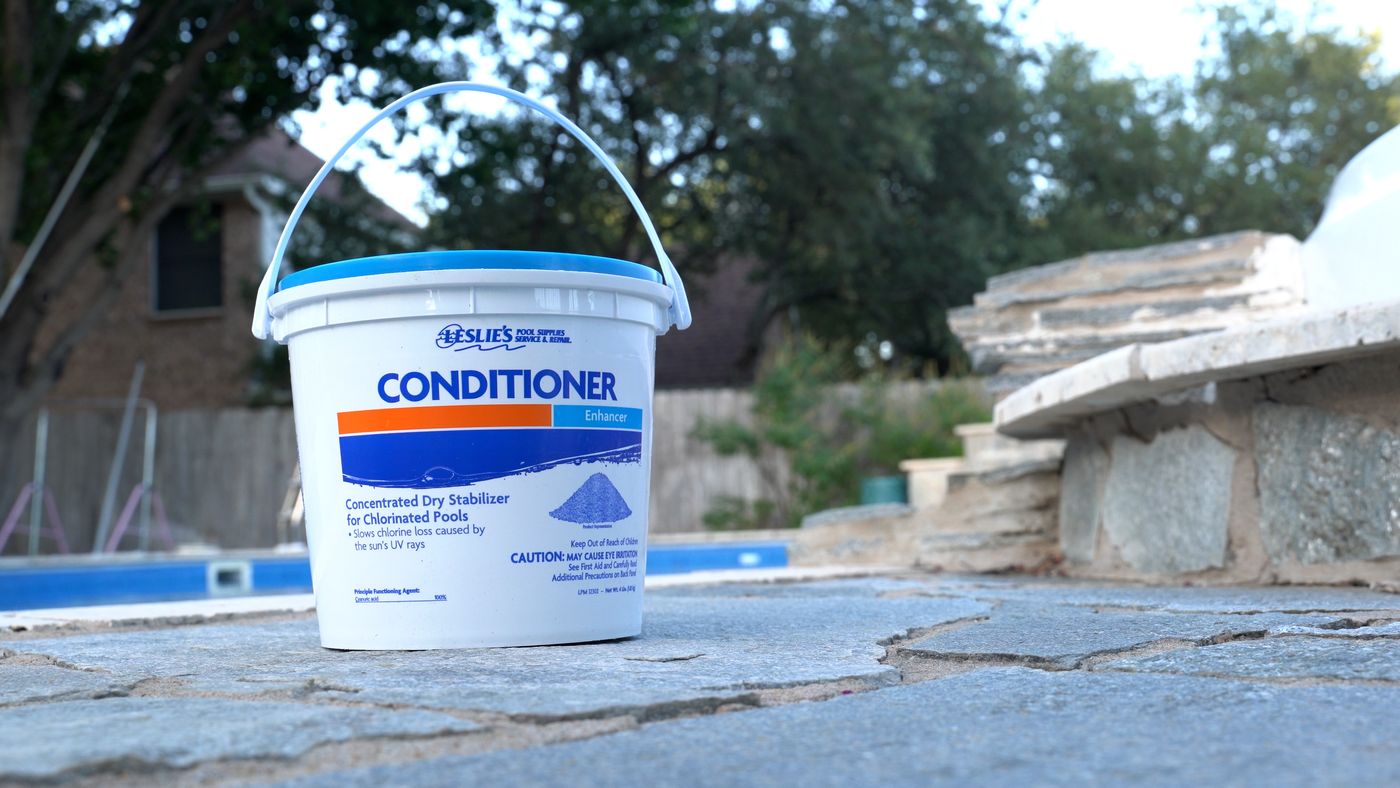
This is what I use. It's sold as "pool stabilizer" or "conditioner" in granular form. You add exactly as much as you need, when you need it, and that's the end of it.
Dosing: roughly 13 oz of pure CYA raises 10,000 gallons by about 10 ppm.
Best for: liquid chlorine users, salt pools, and anyone who wants complete control over their water chemistry.
Method 2: Stabilized Chlorine (Trichlor or Dichlor)
Trichlor tablets and dichlor granules already contain CYA. Every time you add chlorine this way, you're sneaking in stabilizer at the same time. Sounds great — until you realize it never stops. We'll dig into why that's a problem in a minute.
The Sock Method: Step-By-Step
This is the method I use. Forget the skimmer dump — it dissolves slowly, concentrates undissolved acid in your plumbing, and can bleach vinyl liners.
Step 1: Test first. Know your current CYA. Know your gallons. Use my pool volume calculator if you're not sure how many gallons you have.
Step 2: Measure your dose. Aim for raising 10 ppm at a time. Always. Never chase a big number in one shot.
Step 3: Fill an old sock or pantyhose with the granular stabilizer. Tie it off tight.
Step 4: Hang the sock in front of a return jet or in the skimmer where water flow can work on it.
Step 5: Squeeze the sock every few hours to break up clumps and speed dissolving. Wear gloves.
Step 6: Wait. Then wait some more. CYA is one of the slowest-dissolving chemicals in pool care.
The Cold Water Trap
This is where the majority of CYA accidents happen.
CYA dissolves slowly in warm water. In cold water — like opening your pool in spring — it can take nearly a week to fully register on a test. So you add stabilizer Monday, test Wednesday, see almost no change, panic, and add more. By the time the first dose finally dissolves, you're sitting at 110 ppm and looking at a partial drain.
Pool Nerd Pro Tip: Add CYA, then leave it alone for at least 48 hours in summer — up to a full week in cool spring water. Patience prevents an accidental overdose. Slow chemistry changes are almost always safer than fast ones.
The Cloudy Water Paradox
Here's something that trips people up constantly. Low CYA doesn't always make your pool look dirty. A lot of the time, the water looks crystal clear — sun-bleached, almost sparkling. The chlorine got vaporized by UV, but the water itself is just sitting there, shiny.
That's a trap. Clear water is not the same as sanitary water. A pool can look picture-perfect at 2 PM and have zero sanitizing power. The bacteria and early algae spores are still in there — they just haven't multiplied enough yet for you to see them. Give it 48 hours and you'll see haze. Give it 72 and you'll see green.
This is exactly why I push a pool water monitor like the ICO so hard. It tracks ORP — Oxidation-Reduction Potential, which measures the actual killing power of your water, not just how much chlorine is sitting in it. You can literally watch your ORP nosedive throughout the day as the sun chews through unprotected chlorine. Eye-opening the first time you see it on a graph.
Why Tabs Quietly Destroy Pool Chemistry
Trichlor tablets are the easiest way to add chlorine. Pop them in a floater, walk away, come back next week. The pool store loves you.
Except your CYA goes up. And up. And up. Every pound of trichlor you dissolve adds roughly 6 ppm of CYA per 10,000 gallons. Use tabs all summer and you've quietly added 80, 100, even 150 ppm of stabilizer to a pool that should be sitting at 40.
Now chlorine becomes less effective. The pool store sells you more shock. Algae shows up anyway. Nothing works the way it should.
Pool Nerd Disapproved — Trichlor Tabs As Primary Chlorine: Tabs aren't a chlorine product. They're a slow-motion chemistry problem. I use liquid chlorine, monitor ORP, and keep CYA in the 30–50 range. That's the whole game.
Saltwater Pools And CYA
Salt pools are the ones I see running low on stabilizer most often — and they're the ones that punish you the hardest for it.
In my experience, a properly stabilized salt pool will see the cell last roughly twice as long as one running at 20 ppm CYA. You're not just saving chlorine. You're protecting the most expensive part of your salt system. Target 60–80 ppm and don't wait until the cell is straining to find out.
Signs Your CYA Is Too High
Just as important as knowing when it's low. Watch for:
- Chlorine "stops working" even at 3+ ppm free chlorine
- Algae keeps coming back despite shocking
- Cloudy water with no obvious cause
- Salt cell runs constantly to maintain target FC
- ORP stays stubbornly low even with high chlorine readings
- Pool store keeps telling you to "add more chlorine"
If that sounds like your pool, get a CYA test. Over 80–100 ppm on a chlorine pool, or over 100 ppm on a salt pool, it's time for a partial drain and refill. That's the only reliable way to lower it.
The Smart Pool Setup
Here's how I run my test pool, and what I recommend for anyone who wants stable, predictable chemistry instead of a chemical roller coaster.
-
Pure CYA, not tabs. Add stabilizer once or twice a season in controlled doses. Liquid chlorine for daily sanitization.
-
ICO Pool Water Monitor. Continuous pH, ORP, and chemistry tracking straight to your phone. Catches problems before they show up in the water. You can learn more at mysmartpool.com or in my full ICO review.
-
SpectraLight UV. Kills 99.9% of pathogens before they hit your pool water. Lower chlorine demand means lower CYA requirements and more stable chemistry.
-
A robotic cleaner. A good robot like the Dolphin Premier pulls organic debris out before it decomposes into acids that wreck your pH — and it creates extra circulation while it cleans.
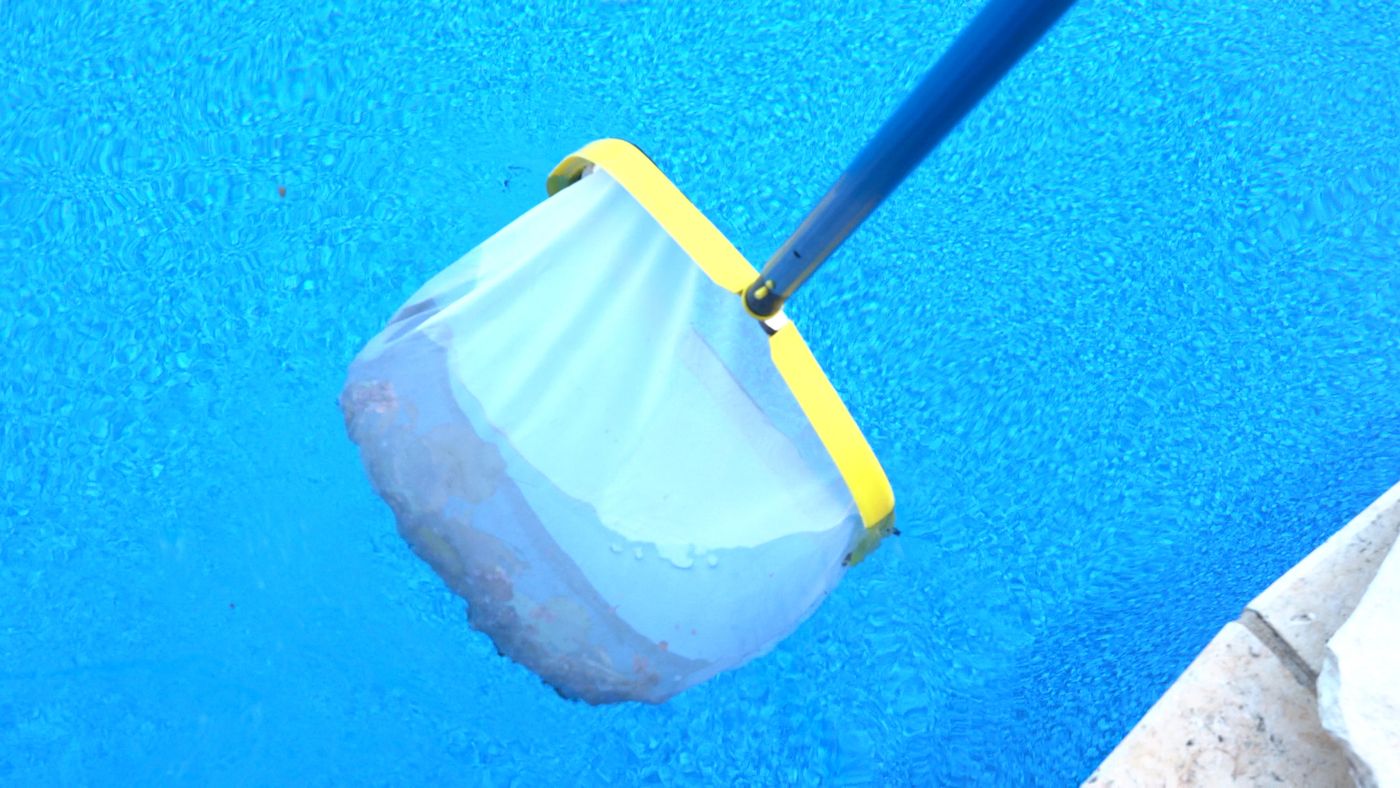
Pulling debris out before it breaks down keeps chemistry stable // The Pool Nerd
Final Verdict
So what's my final verdict? Be careful when raising your CYA, and do it the right way. Here's a quick recap:
- Outdoor pools need CYA. 30–50 ppm for chlorine, 60–80 for salt, 0–20 for indoor.
- Test before you dose. Then dose only 10 ppm at a time.
- Use the sock method. Skip the skimmer dump.
- Wait at least 48 hours to retest — up to a full week in cold spring water.
- Avoid trichlor tabs if you want long-term control over your chemistry.
- Watch ORP, not just chlorine. Clear water lies.
Cyanuric acid is one of the most misunderstood parts of pool chemistry. Too little and your chlorine disappears. Too much and it sits there doing nothing. The goal isn't dumping in more chemicals — it's stable, predictable water that takes care of itself.
The information is for educational purposes only. Always read manufacturer labels before handling pool chemicals. Use this information at your own risk.
If you want a pool water monitor like the ICO, a UV system like SpectraLight, or a robotic cleaner like the Dolphin Premier, head over to my deals page — I post the best deals on top pool equipment all season long.
Until next time — enjoy that pool.
Frequently Asked Questions
What is cyanuric acid (CYA) in a pool?
Cyanuric acid is a chlorine stabilizer — also called conditioner. It acts like sunscreen for your chlorine, shielding it from UV so it doesn't burn off in a few hours of sunlight.
What should my CYA level be?
- Standard chlorine pool: 30–50 ppm
- Saltwater pool: 60–80 ppm
- Indoor pool: 0–20 ppm
How much cyanuric acid do I need to raise CYA?
Roughly 13 oz of pure CYA raises 10,000 gallons by about 10 ppm. Scale it to your pool volume, and only raise 10 ppm at a time. Use my pool volume calculator if you don't know your gallons.
What's the best way to add cyanuric acid?
The sock method. Fill an old sock or pantyhose with granular stabilizer, tie it off, and hang it in front of a return jet or in the skimmer. Squeeze it every few hours to speed dissolving. Avoid dumping it straight into the skimmer — it's slow to dissolve and can damage plumbing and vinyl liners.
How long does CYA take to register on a test?
In warm summer water, give it at least 48 hours. In cold spring water it can take up to a week to fully dissolve and register. Don't add more before it shows up — that's how people overshoot.
Can you have too much cyanuric acid?
Yes. Too much CYA locks up your chlorine so it barely sanitizes, even at high free chlorine readings. Over 80–100 ppm on a chlorine pool (or over 100 ppm on a salt pool), it's time to lower it.
How do you lower cyanuric acid?
The only reliable way is to drain part of your pool and refill with fresh water. "CYA reducer" products don't work well in my experience. Reverse osmosis services exist in some areas but they're expensive.
Do chlorine tablets raise CYA?
Yes. Trichlor tablets and dichlor granules contain cyanuric acid. Every pound of trichlor adds roughly 6 ppm of CYA per 10,000 gallons — which is why tab users often end up with sky-high stabilizer by late summer.
Why do salt pools need more CYA?
Salt cells produce unstabilized chlorine continuously, so it burns off fast in sunlight without protection. Higher CYA (60–80 ppm) means the cell runs less, chlorine lasts longer, and the cell lasts years longer.
My water is clear but I have no chlorine — what's wrong?
Clear water isn't the same as sanitary water. If your CYA is low, UV vaporizes your chlorine and the water can look sparkling while having zero sanitizing power. Within a day or two you'll start seeing haze, then green. Test ORP or free chlorine, not just clarity.